How to Use an Interlinear Bible for Deeper Scripture Study
Key Takeaway
An interlinear Bible shows you the original Hebrew or Greek next to the English translation, word by word. Learning to use one transforms how you study Old Testament passages and unlocks meaning that translations cannot convey.
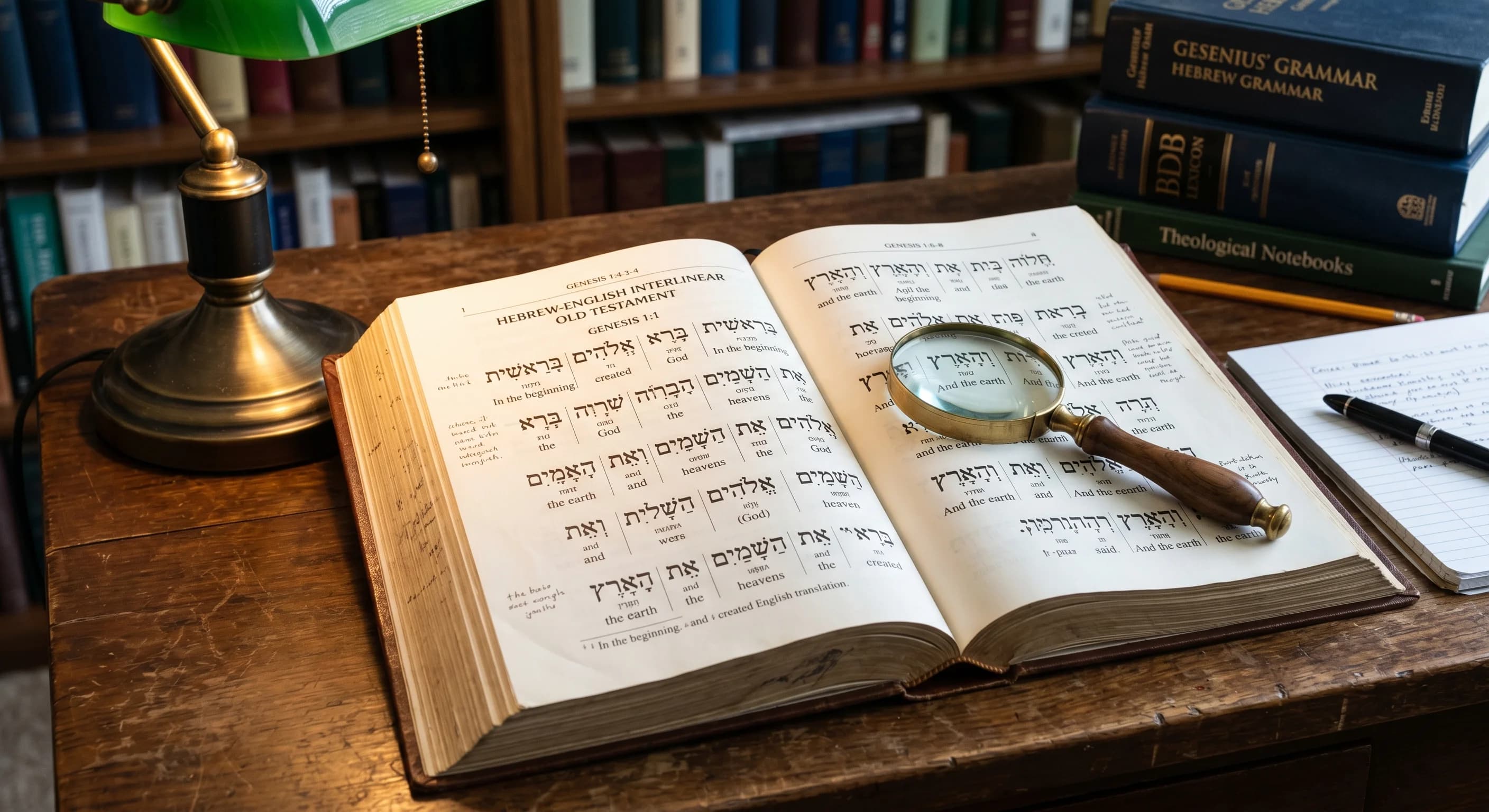
An interlinear Bible is a study tool that displays the original language text -- Hebrew for the Old Testament, Greek for the New Testament -- directly alongside the English translation, word by word. Unlike a standard Bible with a commentary, an interlinear reader keeps the original text in constant view and lets you see the exact Hebrew or Greek behind every English word. For serious scripture study, it is one of the most valuable tools available.
What an Interlinear Reader Shows You
A well-designed interlinear reader typically shows you:
Free Scripture Study Tools
Explore the scriptures with Latter-Day Daily
Interlinear readers, word studies, timeline, maps, Come Follow Me guides, and 40+ more tools — all free.
Start for free- The original Hebrew or Greek word in its script (e.g., the Hebrew letters or Greek characters)
- A transliteration in Roman characters (so you can pronounce the word even if you don't read the script)
- A word-by-word English gloss (a brief definition of each word in context)
- The word's grammatical form (verb, noun, adjective; tense, person, number)
- A Strong's Concordance number (linking to the root and all other occurrences)
- The translator's rendering in the chosen English version
This display reveals immediately which English words correspond to which original words, where the translator made an interpretive choice, and where the original language is more specific (or more ambiguous) than the English suggests.
Reading Genesis 1:1 in the Interlinear
The very first verse of the Bible offers a productive first exercise. "In the beginning God created the heaven and the earth" (Genesis 1:1) contains only seven Hebrew words, but the interlinear reveals several things the English obscures:
"Bereshit" (in the beginning): the preposition "be" (in) combined with "reshit" (beginning, first, head). "Reshit" shares its root with "rosh" (head), as in Rosh Hashanah (Head of the Year). The beginning is the head -- the first and governing principle of what follows.
"Bara" (created): this verb appears only with God as its subject in the Hebrew Bible. When human beings make things, the Bible uses "asah" (to make/fashion) or "yatsar" (to form/shape). "Bara" is reserved for divine creative activity. Noticing this reservation tells you something the English "create" does not -- that this is categorically different from anything humans do.
"Elohim" (God): grammatically plural, syntactically singular. One God who encompasses divine completeness.
"Et" (an untranslatable particle): "et" marks the direct object in Hebrew but carries no meaning in English, so translators omit it. Its appearance here has generated centuries of rabbinic interpretation -- some traditions say it marks the inclusion of everything between "alef" (the first Hebrew letter) and "tav" (the last), meaning "everything." In a Restoration context, "alef to tav" is "Alpha and Omega" -- Christ.
Practical Methods for Interlinear Study
The most productive use of an interlinear is not to read entire chapters but to slow down to a single verse -- or even a single phrase -- and work through it carefully.
Method 1 (Word by Word): Take one verse and read each Hebrew word individually. For each word, notice: how is this translated in English? What does the original mean? Does the original carry nuances or precision the English misses? What Strong's root does it share with other words you know?
Method 2 (Keyword Focus): Choose one keyword in the passage (e.g., "covenant" in Genesis 9, or "fear" in Exodus 20:20) and trace its Hebrew original through the interlinear. Notice every time the word appears in the chapter and how the translator rendered it. Inconsistent rendering often signals a word the translator struggled with.
Method 3 (Comparison): Read the same passage in two different Bible versions, then open the interlinear and ask: where do the versions differ, and what in the Hebrew is producing the disagreement? Translators often disagree on hapax legomena, poetic ambiguity, or theologically loaded terms.
Method 4 (Verb Tense and Form): Hebrew verbs carry information about aspect (completed action vs. ongoing action) that English simple past tense cannot always convey. In Genesis 1, "God said" repeatedly -- the Hebrew form indicates that God's speaking was a series of completed divine acts, each definitive and final. The tense itself carries authority.
Common Interlinear Discoveries for Come Follow Me 2026
A few discoveries available to any interlinear user studying the Old Testament curriculum:
Isaiah 53:5: "He was wounded for our transgressions" -- the Hebrew "mecholal" (wounded) carries the meaning of being pierced through, not merely bruised. The word for "stripes" ("chavurah") indicates welts from flogging, specific to the physical reality of the scourging. The interlinear makes the concrete, physical nature of this suffering unmistakable.
Psalm 23:1: "The LORD is my shepherd; I shall not want" -- "I shall not want" translates "lo echsar," literally "I will not lack." The verb "chaser" means not merely "want" in the sense of desire, but "lack" in the sense of deficiency. The psalmist is not merely saying his desires will be satisfied -- he is saying he will have no deficiency in what God provides.
Exodus 20:2: "I am the LORD thy God" opens the Ten Commandments. In Hebrew, the "I" is emphatic -- "Anokhi" rather than the shorter "Ani." The emphatic first-person pronoun was used for formal declarations and covenantal speech. The Decalogue begins with God asserting His own covenantal identity in the most emphatic form the language allowed.
Using Latter-Day Daily's Interlinear Reader
Latter-Day Daily's Interlinear Reader provides all of these features in a digital format designed for the Come Follow Me curriculum. Each word in the Hebrew Old Testament is linked to its Strong's number, root, and lexicon entry. You can click any word to see all its occurrences across the Old Testament, compare how different English translations rendered it, and explore its etymology. The tool is built for the student who wants to work with the original language without formal language training.
Frequently Asked Questions
Go deeper with Latter-Day Daily
Interlinear Hebrew & Greek, word origins, Come Follow Me, maps, timelines, and 40+ more tools. Free to start — Scholar plan unlocks everything.
Related Study Tools
Interlinear Reader
Read Old and New Testament passages with the original language displayed word by word alongside English.
Etymology Explorer
Trace any Hebrew word to its root and see every occurrence across scripture.
Word Explorer
Search for any Hebrew or Greek word and find every verse where it appears.
Translation Forensics
Compare how different Bible translations rendered any given Hebrew or Greek word.
Hapax Legomena
Identify rare words in any passage -- words that appear only once in the entire Bible.
Related Posts
Genesis 24-33 Study Guide -- "Let God Prevail" (Jacob and Esau)
Jacob's story is the story of transformation. From the scheming supplanter who stole a birthright to the man who wrestled with God and became Israel, Genesis 24-33 shows that God works with imperfect people.
Genesis 42-50 Study Guide -- "God Meant It unto Good"
Joseph's reunion with his brothers and his declaration -- "ye thought evil against me; but God meant it unto good" -- is one of the Old Testament's most powerful statements of divine providence.
Isaiah 13-35 Study Guide -- Come Follow Me 2026 Week 35
Isaiah 13-35 moves from oracles against specific nations to an apocalyptic vision of worldwide judgment and restoration. Week 35 of Come Follow Me 2026 contains some of Isaiah's most stunning poetry.
Weekly scripture insights
Get study guides delivered to your inbox each week.