Isaiah 13-35 Study Guide -- Come Follow Me 2026 Week 35
Key Takeaway
Isaiah 13-35 moves from oracles against specific nations to an apocalyptic vision of worldwide judgment and restoration. Week 35 of Come Follow Me 2026 contains some of Isaiah's most stunning poetry.
Isaiah 13-35 is the most geopolitically dense section of the book. It opens with a series of oracles ("massa" in Hebrew, meaning burden or pronouncement) against specific nations: Babylon, Assyria, Philistia, Moab, Damascus, Egypt, and others. But these are not merely historical predictions -- they establish the principle that God holds all nations accountable to covenant standards of justice, not just Israel. The section culminates in chapters 24-27, sometimes called "Isaiah's Apocalypse," and the breathtaking vision of restoration in Isaiah 35.
Isaiah 13-23: Oracles Against the Nations
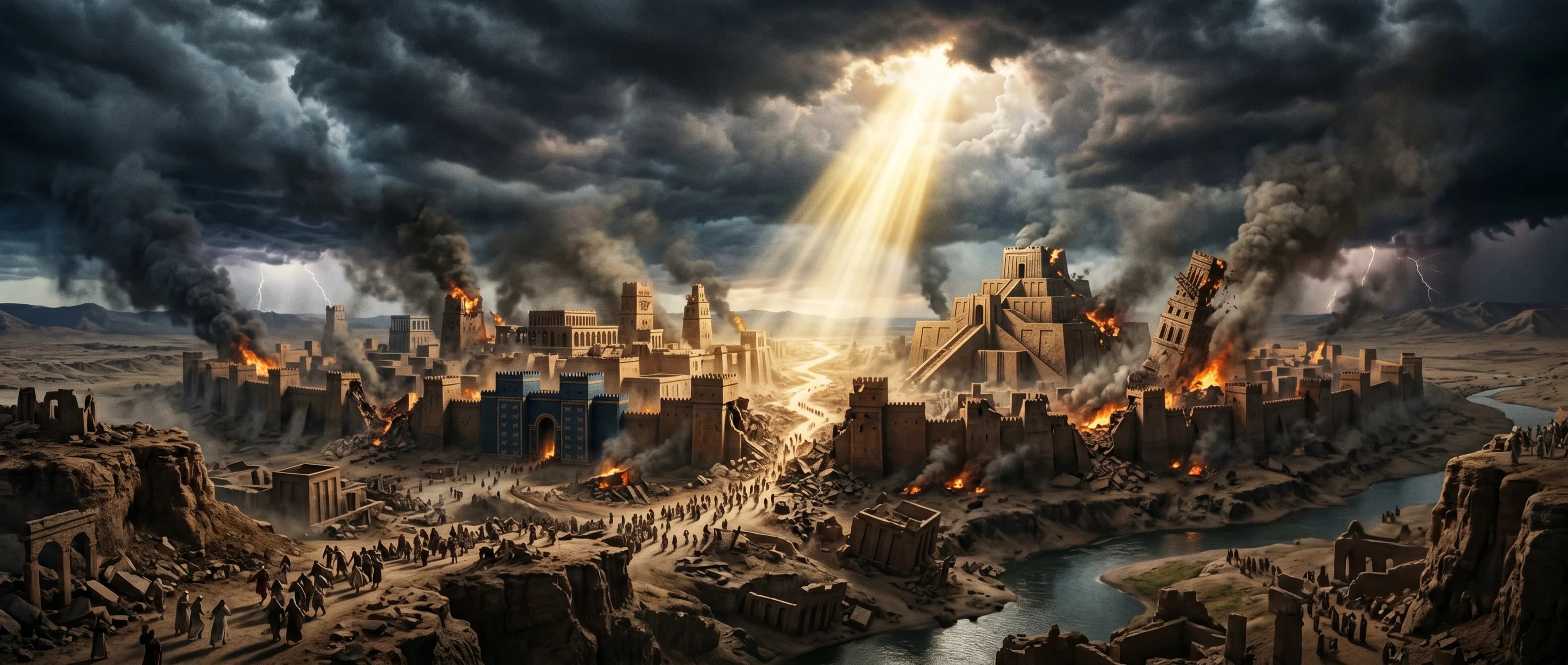
The oracle against Babylon (Isaiah 13-14) is the longest and theologically richest of the series. Babylon had not yet risen to its world-dominant power in Isaiah's day -- the prophet is seeing forward to the empire that would eventually conquer Judah and carry it into exile. The fall of Babylon's king in Isaiah 14:12-15 contains the famous "Lucifer" passage: "How art thou fallen from heaven, O Lucifer, son of the morning!" The Hebrew "Helel ben Shachar" (shining one, son of the dawn) was almost certainly applied originally to the king of Babylon but became linked in tradition to Satan's original fall. The spiritual principle -- pride that reaches for God's throne leads to catastrophic descent -- applies equally to both.
Free Scripture Study Tools
Explore the scriptures with Latter-Day Daily
Interlinear readers, word studies, timeline, maps, Come Follow Me guides, and 40+ more tools — all free.
Start for freeThe oracle against Egypt (Isaiah 19) contains a remarkable closing vision: Egypt, Assyria, and Israel worshiping together, with God calling Egypt "my people" and Assyria "the work of my hands" alongside Israel "mine inheritance" (Isaiah 19:25). The very nations that oppressed Israel become covenant members. This universalistic vision directly anticipates Paul's doctrine that Gentiles are fellow heirs (Ephesians 3:6).
Isaiah 24-27: The Apocalypse
Chapters 24-27 shift from specific nations to cosmic scope. Isaiah 24 envisions worldwide judgment: "The earth also is defiled under the inhabitants thereof; because they have transgressed the laws, changed the ordinance, broken the everlasting covenant" (Isaiah 24:5). The cause of judgment is not merely wickedness but specifically covenant violation -- the same framework God used in his indictment of Israel in chapter 1.
Isaiah 25:8 contains the earliest Old Testament promise of resurrection: "He will swallow up death in victory; and the Lord God will wipe away tears from off all faces." Paul quotes this verse in 1 Corinthians 15:54 as the triumphant conclusion of his resurrection chapter -- the ultimate defeat of mankind's final enemy. Isaiah saw it seven centuries before it happened.
Isaiah 26:3-4 contains one of the most beloved promises in the Hebrew Bible: "Thou wilt keep him in perfect peace, whose mind is stayed on thee: because he trusteth in thee. Trust ye in the Lord for ever: for in the Lord Jehovah is everlasting strength." The Hebrew "shalom shalom" (perfect peace) is doubled for emphasis -- complete, wholistic peace that encompasses body, mind, and spirit. "Yah Yahweh" (Lord Jehovah) combines the short and full forms of the divine name, emphasizing eternal, unchanging stability.
Isaiah 28-33: Woes Against Israel and Judah
The woe oracles of chapters 28-33 return to the domestic scene. Isaiah condemns the drunken priests of Ephraim (28:1-8), the leaders of Jerusalem who made a "covenant with death" by trusting Egypt (28:15), and the people who offer lip service while their hearts are far from God (29:13 -- quoted by Christ in Matthew 15:8). The theological center of these chapters is Isaiah 28:16: "Behold, I lay in Zion for a foundation a stone, a tried stone, a precious corner stone, a sure foundation: he that believeth shall not make haste." The cornerstone of Zion -- quoted in 1 Peter 2:6 and applied to Christ -- is laid precisely when human political strategies have failed.
Isaiah 35: The Highway of Holiness
The section closes with one of Isaiah's most beautiful visions. Chapter 35 describes the return of the exiles through a transformed wilderness: "The wilderness and the solitary place shall be glad for them; and the desert shall rejoice, and blossom as the rose" (Isaiah 35:1). A "highway of holiness" ("derek ha-qodesh") runs through the desert, and on it the ransomed of the Lord return to Zion with "songs and everlasting joy upon their heads" (Isaiah 35:10).
The healings described in Isaiah 35:5-6 -- the blind seeing, the deaf hearing, the lame leaping, the mute singing -- are the signs Jesus uses to confirm his identity to John the Baptist (Matthew 11:4-5, Luke 7:22). The prophet who described the Messianic age also described the Messiah's ministry in detail.
Study Questions for Week 35
What does the oracle against Babylon teach about the relationship between national pride and spiritual destruction? How does Isaiah 25:8 change how you think about death and resurrection? What does the "highway of holiness" in Isaiah 35 look like for your own life's journey back to God?
Frequently Asked Questions
Go deeper with Latter-Day Daily
Interlinear Hebrew & Greek, word origins, Come Follow Me, maps, timelines, and 40+ more tools. Free to start — Scholar plan unlocks everything.
Related Study Tools
Chiastic Structures
Find the chiastic architecture in Isaiah's apocalyptic chapters 24-27.
Parallel Passages
Compare Isaiah 25:8, 28:16, and 35:5-6 with their New Testament and Book of Mormon parallels.
Etymology Explorer
Study 'massa' (oracle/burden), 'shalom shalom' (perfect peace), and 'derek ha-qodesh' (highway of holiness).
Names of Christ
Trace the cornerstone prophecy of Isaiah 28:16 to its fulfillment in Christ.
Scripture Connections
See how Isaiah 35:5-6 connects to Christ's miracles and 3 Nephi 26:15.
Related Posts
Isaiah 36-55 Study Guide -- Come Follow Me 2026 Week 36
Isaiah 36-55 contains the most beloved poetry in the Old Testament: 'Comfort ye, comfort ye my people.' It also contains Isaiah 53 -- the most explicit Old Testament prophecy of Christ's atoning suffering.
Isaiah 1-12 Study Guide -- Come Follow Me 2026 Week 34
Isaiah 1-12 opens with one of the most dramatic prophetic calls in scripture and climaxes with the Immanuel prophecy and the shoot from Jesse. Week 34 of Come Follow Me 2026 covers Isaiah's most foundational chapters.
Isaiah 56-66 Study Guide -- Come Follow Me 2026 Week 37
Isaiah 56-66 closes the book with a vision of gathered Israel, the true fast of Isaiah 58, the glory of Zion in Isaiah 60, and the new heaven and new earth. Week 37 of Come Follow Me 2026 culminates Isaiah's prophetic vision.
Weekly scripture insights
Get study guides delivered to your inbox each week.