Loading...
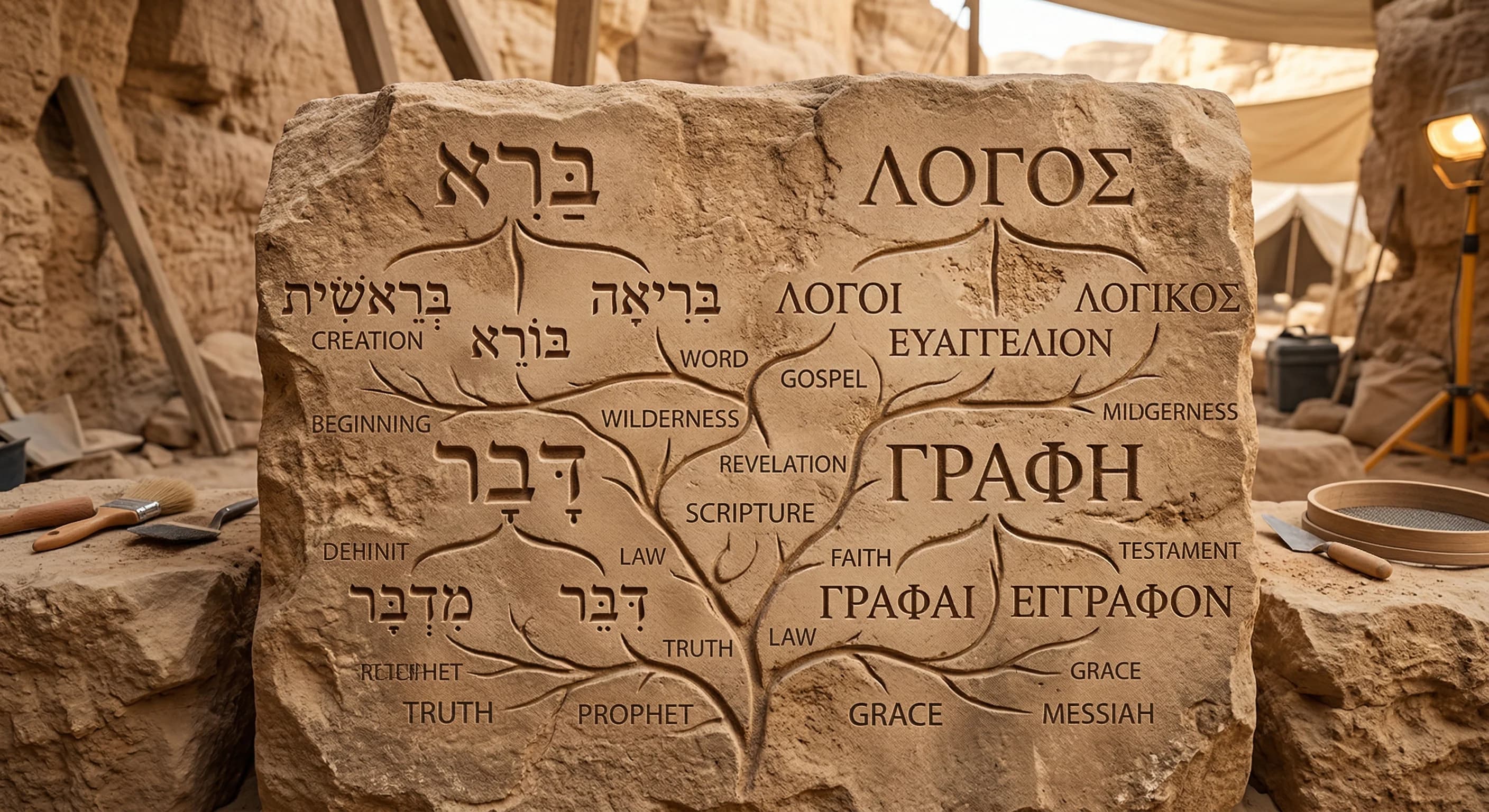
Hebrew and Greek Etymology of Scripture Words
Trace every key scripture word back to its original Hebrew or Greek root. See how meaning evolved across ancient eras and discover the layers of significance hidden beneath English translation.
What is the Etymology Explorer?
Etymology is the study of word origins -- where a word came from, what it originally meant, and how its meaning changed over time. The Etymology Explorer lets you search any significant scripture term and see its full linguistic history, from the earliest attested root form through its Classical, Hellenistic, or Rabbinic usage and into the English form you read in the King James Version today.
The Old Testament was written primarily in Biblical Hebrew, a language where a single three-letter root can generate dozens of related words spanning vastly different semantic fields. The New Testament was composed in Koine Greek, the common tongue of the first-century Mediterranean world. In both cases, English translations compress rich, layered meaning into a single word. The Etymology Explorer unpacks that compression so you can see what the original authors intended.
For Latter-day Saints, etymological study illuminates connections that span the entire standard works. When you discover that the Hebrew word 'shalom' means not merely 'peace' but wholeness, completeness, and covenant well-being, passages in Isaiah, the Psalms, and the Book of Mormon take on a richer dimension. When you trace the Greek 'agape' through its development, the Savior's teachings on love in the New Testament gain theological precision that English alone cannot convey.
Each word in the Etymology Explorer includes a visual timeline showing its root form, the language of origin, the era in which each meaning was active, and explanatory notes connecting the linguistic data to scriptural context. You do not need any background in Hebrew or Greek -- the tool presents everything in accessible English with transliterations and clear definitions.
How It Works
1
Search for a word
Type any English scripture term, Hebrew root, or Greek word. The explorer searches across all indexed entries and shows matching results with their language of origin.
2
View the etymology timeline
Select a word to see its full etymological history displayed as a visual timeline, showing how the meaning developed from its earliest root through each historical era.
3
Connect to scripture
Each entry links the linguistic data back to specific scripture passages, helping you see how the original meaning enriches your reading of the text.
Key Features
Hebrew Root Analysis
Explore Biblical Hebrew three-letter roots and the families of words they generate, from verbs and nouns to adjectives and place names.
Greek Word Origins
Trace New Testament Greek vocabulary back through Classical and Hellenistic usage to understand the precise shade of meaning each word carried.
Searchable Word Database
Search across hundreds of indexed scripture terms by English word, Hebrew root, or Greek form with paginated results and instant filtering.
Visual Era Timelines
See how each word's meaning shifted across historical periods -- from Proto-Semitic roots through Biblical, Rabbinic, and modern usage.
Frequently Asked Questions
What does etymology mean in Bible study?
Etymology is the study of word origins and how their meanings have changed over time. In Bible study, etymology means tracing an English scripture word back to its original Hebrew or Greek root to uncover layers of meaning that translation obscures. For example, the English word 'atonement' connects to the Hebrew 'kaphar' meaning to cover or ransom, revealing the sacrificial theology embedded in the term.
Do I need to know Hebrew or Greek to use the Etymology Explorer?
No. The Etymology Explorer presents all information in English with transliterations showing how Hebrew and Greek words are pronounced. Each entry includes clear definitions, historical context, and explanatory notes. The tool is designed for anyone interested in deeper scripture study, regardless of language background.
How does studying word origins help with Book of Mormon study?
The Book of Mormon draws heavily on biblical language and theological vocabulary. Understanding the Hebrew roots behind terms like covenant, priesthood, atonement, and repentance illuminates Book of Mormon passages that use these same concepts. Many Book of Mormon names also have Hebrew etymologies that reveal character traits or prophetic significance.
What is the difference between etymology and a concordance?
A concordance indexes where words appear in scripture, showing you every verse that contains a given term. Etymology goes deeper by tracing the origin and historical development of the word itself -- where it came from, what it meant in its original language, and how that meaning evolved. The Etymology Explorer focuses on this deeper linguistic history rather than simple word location.
How many scripture words are included in the Etymology Explorer?
The Etymology Explorer contains hundreds of significant Hebrew and Greek terms that appear throughout the Old and New Testaments. The database is continually expanding to include more entries. Each word includes its root form, language of origin, era-by-era meaning development, and connections to specific scripture passages.
Start Using Etymology Explorer
Full access to Etymology Explorer and 40+ other study tools.
Starting at $7/mo or $69.99/yr
Already have an account? Sign in