Loading...
Chiasmus Finder for the Book of Mormon and Bible
Explore chiastic structures -- the ancient Hebrew literary pattern where ideas mirror around a central pivot point. Discover hundreds of chiasmi across all five volumes of scripture with interactive, color-coded visualization.
What is Chiasmus in Scripture?
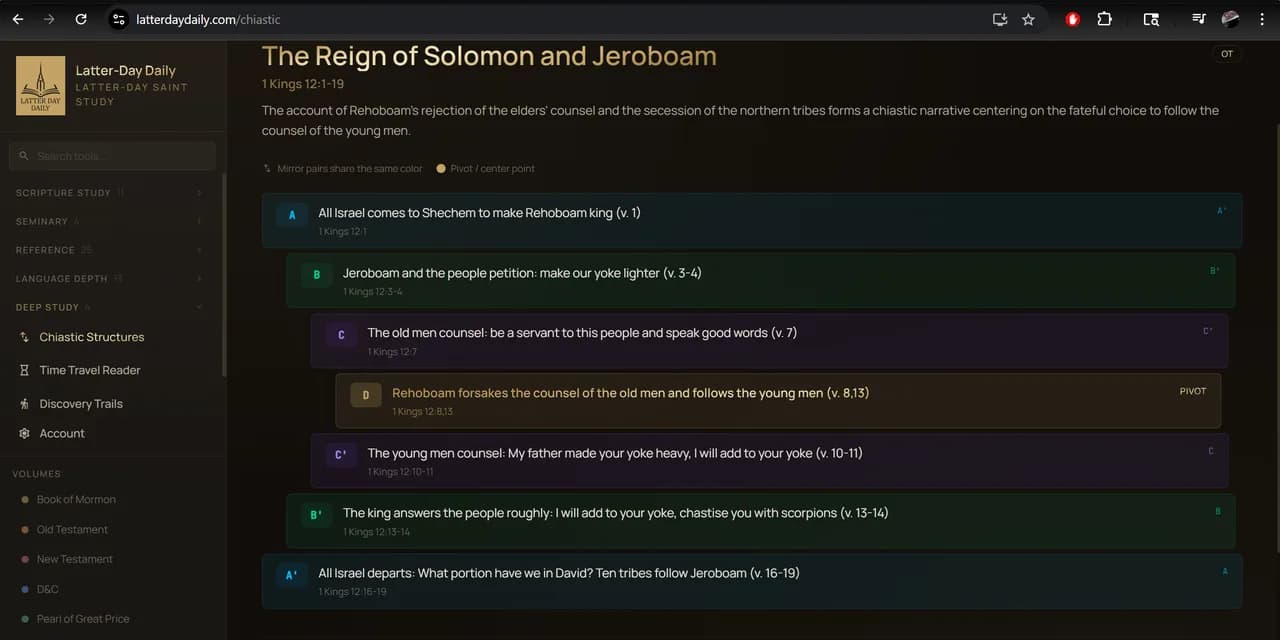
Chiasmus is an ancient literary structure in which a series of ideas is presented and then repeated in reverse order, forming a mirror pattern often labeled A-B-C-D-C'-B'-A'. The central element (D) is typically the most important point the author wants to emphasize. This pattern was a hallmark of Hebrew, Greek, and other ancient Near Eastern writing traditions.
In 1967, a young missionary named John W. Welch recognized chiastic structures in the Book of Mormon while studying in Germany. This discovery was significant because chiasmus was a sophisticated literary technique deeply embedded in ancient Hebrew writing but virtually unknown in early 19th-century America. The presence of complex, multi-layered chiastic patterns in the Book of Mormon has become one of the most studied aspects of the text's literary composition.
The most famous example is Alma 36, where the entire chapter forms one grand chiasmus with the pivot point at verses 17-18 -- the moment Alma cries out to Jesus Christ and experiences his transformative conversion. The structure is remarkably precise: themes of bondage, suffering, the angel's appearance, and fear mirror in exact reverse order around this central turning point.
Latter-Day Daily's Chiastic Structures tool lets you explore chiasmi across all five volumes of scripture. Each structure is displayed with color-coded mirror pairs so you can instantly see how elements correspond. You can study the pivot text, compare structures across different books, and understand how ancient authors used this pattern to embed meaning at the structural level of their writing.
How It Works
1
Browse by volume or book
Select a scripture volume and book to see all identified chiastic structures within it, from simple two-pair patterns to complex multi-layer arrangements.
2
Visualize the mirror structure
Each chiasmus is displayed with color-coded pairs showing how elements A and A', B and B', etc. correspond. The central pivot text is highlighted.
3
Study the meaning
Read the actual verse text for each element, see how the pivot point reveals the author's central message, and explore cross-references.
Key Features
All Five Volumes
Chiastic structures identified across the Book of Mormon, Old Testament, New Testament, Doctrine and Covenants, and Pearl of Great Price.
Color-Coded Mirror Pairs
Each element pair (A/A', B/B', etc.) is displayed in matching colors for instant visual recognition of the mirrored structure.
Pivot Text Analysis
The central turning point of each chiasmus is highlighted, showing the core message the author embedded in the structure.
Scholarly Context
Understand each chiasmus in its literary and historical context, with references to scholarly research on the structure.
Frequently Asked Questions
What is chiasmus in the Book of Mormon?
Chiasmus in the Book of Mormon refers to passages where ideas are presented in a specific order and then repeated in reverse (A-B-C...C'-B'-A'). Hundreds of chiastic structures have been identified in the Book of Mormon since John W. Welch's initial discovery in 1967. The most famous example is Alma 36, a full-chapter chiasmus pivoting on Alma's conversion experience.
What is the most famous chiasmus in scripture?
Alma 36 is widely considered the most impressive chiasmus in the Book of Mormon, with over a dozen precisely mirrored elements spanning the entire chapter. In the Bible, notable examples include Leviticus 24:13-23, Isaiah 60:1-22, and the structure of the entire book of Deuteronomy. The psalm structures in the Old Testament are also rich with chiastic patterns.
Why does chiasmus matter for scripture study?
Chiasmus matters because the central pivot point of a chiastic structure reveals what the ancient author considered most important. Understanding the structure helps you see the intended emphasis of a passage, which may not be obvious when reading linearly. Chiasmus also demonstrates the literary sophistication and deliberate composition of scriptural texts.
What is the difference between chiasmus and parallelism?
Parallelism presents ideas in the same order (A-B-C, A'-B'-C'), while chiasmus presents them in reverse order (A-B-C, C'-B'-A'). Both are common in Hebrew poetry. Chiasmus adds an additional dimension by creating a central pivot point that carries the passage's most important meaning. Many passages contain elements of both patterns.
Did Joseph Smith know about chiasmus?
Chiasmus was not widely known in the English-speaking world during Joseph Smith's lifetime. The first major English-language work on chiasmus in the Bible was published by John Jebb in 1820 and was an obscure academic text. The discovery of chiasmus in the Book of Mormon in 1967 by John W. Welch was noteworthy precisely because the pattern was not something a 19th-century author would have been likely to deliberately construct.
Start Using Chiastic Structures
Full access to Chiastic Structures and 40+ other study tools.
Starting at $7/mo or $69.99/yr
Already have an account? Sign in