Isaiah 1-12 Study Guide -- Come Follow Me 2026 Week 34
Key Takeaway
Isaiah 1-12 opens with one of the most dramatic prophetic calls in scripture and climaxes with the Immanuel prophecy and the shoot from Jesse. Week 34 of Come Follow Me 2026 covers Isaiah's most foundational chapters.
Isaiah 1-12 is the foundation of the entire book. These twelve chapters contain Isaiah's prophetic commission, the most famous Messianic prophecy in the Old Testament, and some of the most quoted verses in all of scripture. Week 34 of Come Follow Me 2026 gives us the opportunity to study them carefully.
Isaiah 1-5: The Indictment
The book opens as a lawsuit. The Hebrew word "riv" (legal controversy, covenant lawsuit) structures Isaiah 1:2-20 as God prosecuting His covenant people before the bar of heaven. "Hear, O heavens, and give ear, O earth: for the Lord hath spoken, I have nourished and brought up children, and they have rebelled against me" (Isaiah 1:2). God calls the cosmos itself as witness -- a legal formula common in ancient Near Eastern covenant documents. The covenant violation is not just ritual failure; it is the abandonment of justice for the poor, the widow, and the orphan (Isaiah 1:17).
Free Scripture Study Tools
Explore the scriptures with Latter-Day Daily
Interlinear readers, word studies, timeline, maps, Come Follow Me guides, and 40+ more tools — all free.
Start for freeIsaiah 5 contains the parable of the vineyard -- one of the Old Testament's most compact and devastating allegories. God planted Israel as a choice vine, built a hedge and tower to protect it, and waited for grapes. He got only "wild grapes" (Hebrew: "be'ushim," stinking things). The parable ends with God abandoning the vineyard to desolation. Jesus will reprise this parable in Matthew 21 -- his audience knew immediately what it meant.
Isaiah 6: The Call
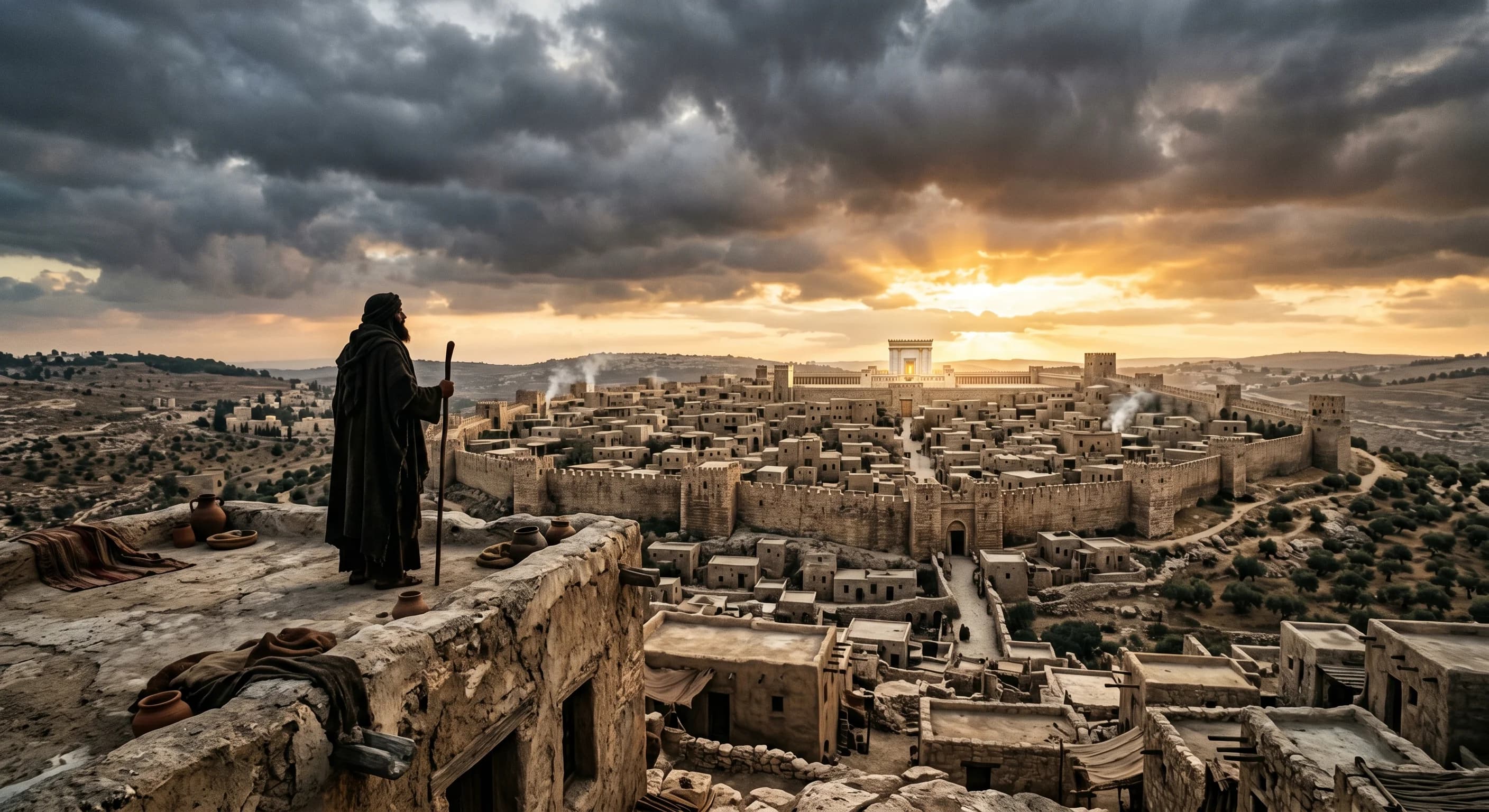
Chapter 6 is the theological center of the opening section. Isaiah sees the Lord "high and lifted up" in the temple, attended by seraphim who cover their faces and cry "Holy, holy, holy" (Isaiah 6:2-3). The threefold repetition of "holy" (Hebrew: "qadosh") is the Hebrew superlative -- there is no word for "holiest," so repetition carries the weight. This is the only time in the Hebrew Bible that a divine attribute is repeated three times in succession.
Isaiah's response is collapse: "Woe is me! for I am undone; because I am a man of unclean lips, and I dwell in the midst of a people of unclean lips: for mine eyes have seen the King, the Lord of hosts" (Isaiah 6:5). The problem is not that Isaiah is especially wicked -- he is a prophet. The problem is the absolute holiness of God, before which any human inadequacy becomes visible. The seraph's solution -- a live coal from the altar touching Isaiah's lips -- is a purification from the same fire that represents God's holiness. What destroys the unclean purifies the penitent.
The commission that follows is one of the most unusual in prophetic literature. God sends Isaiah to preach to a people who will not listen, whose hearts are already hardened. Isaiah is not promised success -- he is promised faithfulness. This is the call of every latter-day servant: to declare the truth whether or not the audience receives it.
Isaiah 7-12: The Messianic Chapters
Isaiah 7 introduces the Immanuel prophecy. King Ahaz of Judah is terrified by a military coalition of Israel and Syria. God offers him a sign, any sign he chooses. Ahaz refuses, feigning piety. God gives the sign anyway: a young woman ("almah" in Hebrew) will conceive and bear a son named Immanuel -- "God with us." The sign applies in the immediate historical context (the coalition will fall before the child grows up) but also reaches forward to the virgin birth of Christ, as Matthew 1:23 explicitly applies it.
Isaiah 9:6-7 contains the most quoted Messianic prophecy in the Christian canon: "For unto us a child is born, unto us a son is given: and the government shall be upon his shoulder: and his name shall be called Wonderful, Counsellor, The mighty God, The everlasting Father, The Prince of Peace." Each of these Hebrew titles (Pele-Joez-El-Gibbor-Abi-Ad-Sar-Shalom) carries specific theological weight. "El Gibbor" (Mighty God) and "Abi-Ad" (Father of Eternity) are divine titles, declaring the child's identity as God incarnate.
Isaiah 11 gives the vision of the shoot from Jesse -- the Branch who will arise from the stump of the Davidic line after its apparent destruction. The Spirit of the Lord will rest upon him in seven dimensions (wisdom, understanding, counsel, might, knowledge, fear of the Lord, and -- in the Septuagint -- piety). The millennial peace that follows (the wolf lying down with the lamb) is the result of the earth being "full of the knowledge of the Lord, as the waters cover the sea" (Isaiah 11:9).
Study Questions for Week 34
What does Isaiah's temple vision (chapter 6) teach about approaching God's holiness in worship? How does the Immanuel prophecy speak to both Isaiah's immediate audience and to us? What does it mean that the shoot from Jesse will govern with wisdom and fear of the Lord rather than military power? How do the woes of Isaiah 5 apply to our own generation?
Frequently Asked Questions
Go deeper with Latter-Day Daily
Interlinear Hebrew & Greek, word origins, Come Follow Me, maps, timelines, and 40+ more tools. Free to start — Scholar plan unlocks everything.
Related Study Tools
Interlinear Reader
Read Isaiah 6 and 9:6 in the original Hebrew, word by word.
Etymology Explorer
Study 'qadosh' (holy), 'almah' (young woman/virgin), 'Immanuel' (God with us), and the titles in Isaiah 9:6.
Names of Christ
See how Isaiah's Messianic titles (Wonderful Counsellor, Prince of Peace) are fulfilled in Christ.
Chiastic Structures
Explore the chiastic structure of the vineyard parable and the Immanuel sign passage.
Parallel Passages
Compare Isaiah 7:14 and 9:6-7 with their New Testament and Book of Mormon fulfillments.
Related Posts
Isaiah 13-35 Study Guide -- Come Follow Me 2026 Week 35
Isaiah 13-35 moves from oracles against specific nations to an apocalyptic vision of worldwide judgment and restoration. Week 35 of Come Follow Me 2026 contains some of Isaiah's most stunning poetry.
Isaiah 36-55 Study Guide -- Come Follow Me 2026 Week 36
Isaiah 36-55 contains the most beloved poetry in the Old Testament: 'Comfort ye, comfort ye my people.' It also contains Isaiah 53 -- the most explicit Old Testament prophecy of Christ's atoning suffering.
Isaiah 56-66 Study Guide -- Come Follow Me 2026 Week 37
Isaiah 56-66 closes the book with a vision of gathered Israel, the true fast of Isaiah 58, the glory of Zion in Isaiah 60, and the new heaven and new earth. Week 37 of Come Follow Me 2026 culminates Isaiah's prophetic vision.
Weekly scripture insights
Get study guides delivered to your inbox each week.