Loading...
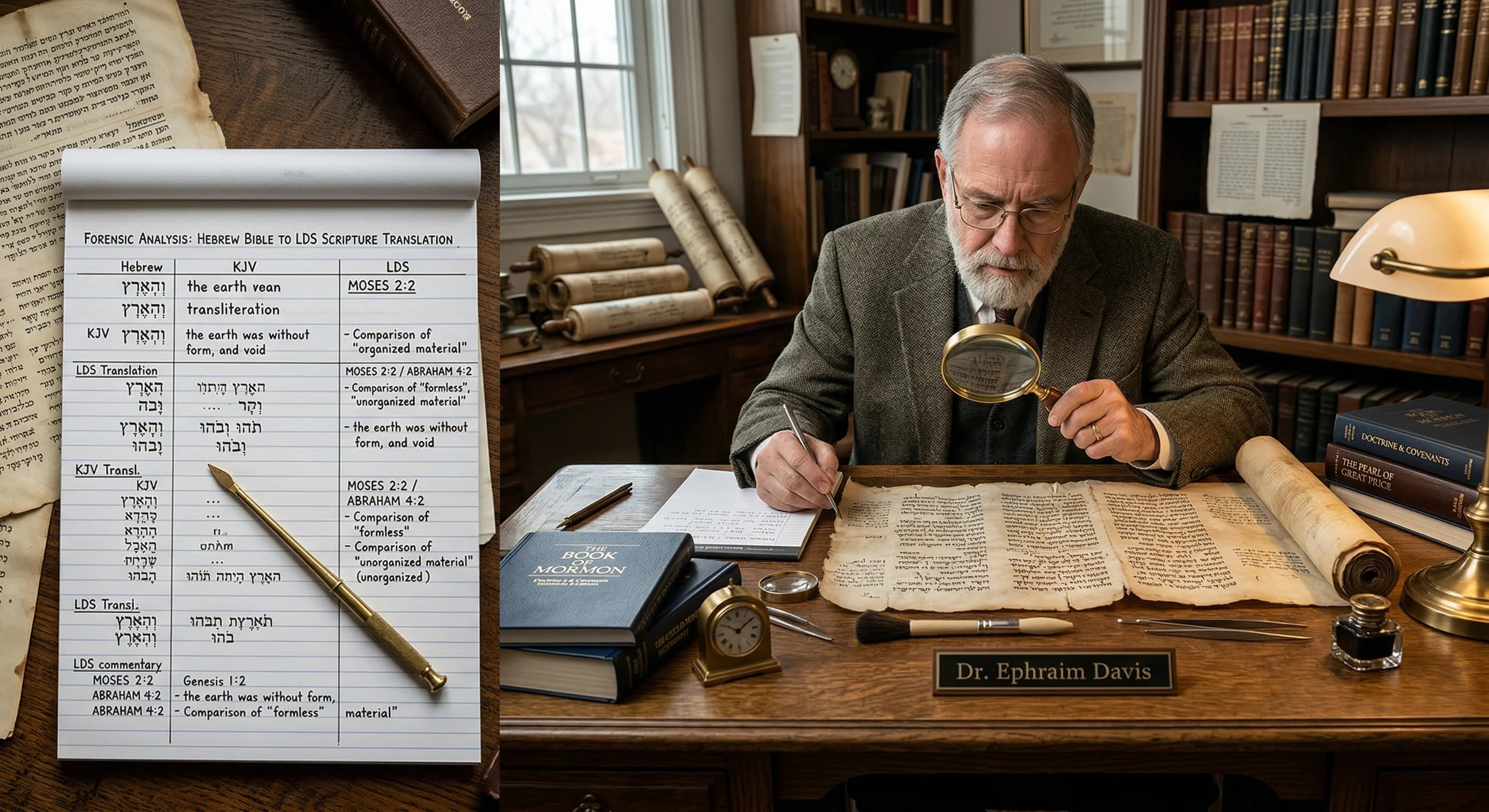
KJV Translation Analysis and JST Comparison
Go behind the English text. Compare King James Version translation choices against the original Hebrew and Greek, see Joseph Smith Translation corrections, and understand what was changed, what was lost, and what the original language actually says.
What is Translation Forensics?
Every English Bible is a translation, and every translation involves choices. When the King James translators worked in 1611, they made thousands of decisions about how to render Hebrew and Greek words into English. Some of those decisions were brilliant. Others obscured the original meaning, either because of the limitations of 17th-century English, theological bias, or genuine ambiguity in the source text. Translation Forensics examines those choices.
The Joseph Smith Translation (JST) represents another layer of this analysis. Joseph Smith made inspired corrections to the KJV text, sometimes restoring meaning that had been lost in translation, other times adding prophetic context that the ancient text implied but did not state explicitly. Comparing the KJV, JST, and original Hebrew or Greek side by side reveals a three-dimensional view of scripture that no single text can provide.
For example, in Genesis 1:1, the Hebrew word 'bara' is typically translated 'created,' but its semantic range includes 'shaped,' 'formed,' and 'organized.' The JST does not change this verse, but in other Genesis passages, Joseph Smith's revisions align remarkably with what modern Hebrew scholarship has since clarified about the original text. These convergences are some of the most interesting discoveries in LDS scriptural scholarship.
Latter-Day Daily's Translation Forensics tool puts the KJV, JST, original Hebrew/Greek, and alternate renderings in a single view for any passage. You can see where the KJV chose one English word when the original carried broader meaning, where the JST corrected a mistranslation, and where modern scholarship has shed new light on ancient vocabulary. It transforms passive Bible reading into active textual investigation.
How It Works
1
Select a passage
Navigate to any Old Testament or New Testament passage. Passages with JST corrections or significant translation issues are flagged for easy browsing.
2
Compare side by side
View the KJV text, Joseph Smith Translation (where it differs), original Hebrew or Greek, and alternate translation renderings in parallel columns.
3
Analyze the differences
See annotations explaining why translations differ, what the original language conveys, and how the JST correction changes the meaning of the passage.
Key Features
KJV + JST Comparison
Side-by-side display of King James Version text and Joseph Smith Translation corrections with differences highlighted.
Original Language Analysis
Hebrew and Greek source text for every verse, showing what the original actually says beyond the English translation.
Translation Notes
Annotations explaining translation choices, alternate renderings, and places where the English diverges from the original meaning.
Passage Search
Search for specific passages or browse curated lists of the most significant translation issues and JST corrections.
Frequently Asked Questions
What is the Joseph Smith Translation (JST)?
The Joseph Smith Translation is a revision of the King James Bible made by the Prophet Joseph Smith between 1830 and 1833. It includes corrections, restorations, and clarifications to the biblical text made through prophetic inspiration. Many JST changes appear as footnotes in the LDS edition of the King James Bible, and longer passages are included in the appendix.
How accurate is the King James Version?
The KJV is a remarkably faithful translation from the texts available in 1611. However, all translations involve interpretive choices. Some Hebrew and Greek words have ranges of meaning that no single English word captures. The KJV also reflects 17th-century English conventions that can obscure meaning for modern readers. Translation Forensics shows you exactly where these issues occur.
Can I see the original Hebrew and Greek text?
Yes. Translation Forensics displays the original Hebrew (Old Testament) or Greek (New Testament) text alongside the KJV and JST. Each original-language word links to its Strong's concordance entry, etymology, and other occurrences across scripture.
What are the most significant JST changes?
Some of the most significant JST changes include Genesis 1 (creation account), Genesis 14 (Melchizedek passage greatly expanded), Exodus 33 (Moses sees God), Matthew 4 (temptation account), and Matthew 24 (Joseph Smith-Matthew). The Translation Forensics tool flags all passages with JST corrections for easy browsing.
Is this tool useful for Bible study outside the LDS context?
Yes. The KJV-to-original-language comparison and translation analysis are valuable for anyone studying the Bible in English, regardless of denomination. The JST comparison is specifically relevant to Latter-day Saint study, but the original-language analysis is universally applicable.
Start Using Translation Forensics
Full access to Translation Forensics and 40+ other study tools.
Starting at $7/mo or $69.99/yr
Already have an account? Sign in