How to Find Chiastic Structures in Old Testament Scripture
Key Takeaway
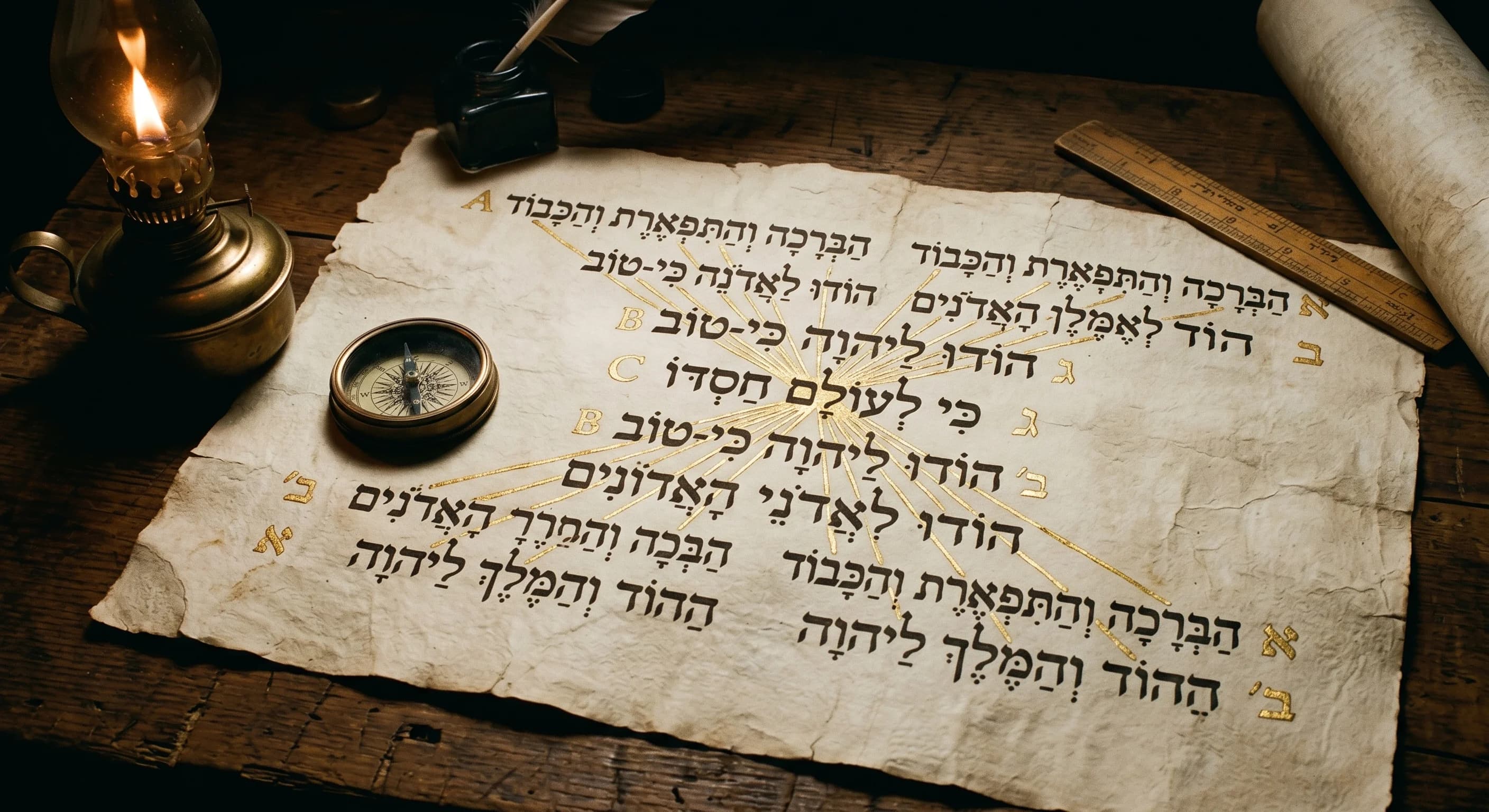
Chiasmus -- inverted parallelism -- is one of the most common literary structures in the Old Testament. Learning to find chiastic patterns reveals the theological center of any passage and transforms how you read scripture.
Chiasmus is the backbone of Hebrew poetry. Ancient Israelite authors -- whether writing psalms, prophetic oracles, legal codes, or narrative -- structured their texts in patterns of inverted parallelism where the first element mirrors the last, the second mirrors the second-to-last, and so on, converging at a central pivot that carries the theological weight of the passage. Once you can recognize this structure, you never read the Old Testament the same way.
The Basic Pattern
The simplest chiasm follows an A-B-B'-A' structure: - A: first element - B: second element - B': element echoing B - A': element echoing A
Free Scripture Study Tools
Explore the scriptures with Latter-Day Daily
Interlinear readers, word studies, timeline, maps, Come Follow Me guides, and 40+ more tools — all free.
Start for freeIn the Genesis Flood narrative, the entire account from Genesis 6:10 to 9:19 is structured as an extended chiasm with the rainbow covenant at its center. As the flood waters rise (A through G), the center turns at God's "remembering" Noah (Genesis 8:1), and then every element is reversed as the waters recede (G' through A'). The theological center -- the thing the entire structure is built around -- is God's memory: "And God remembered Noah" (Genesis 8:1). Memory, in Hebrew, is not passive recollection. It is active intervention. The flood narrative is about a God who does not forget His covenant people.
Identifying Chiasms: Practical Steps
Step 1: Mark repetitions. Read through a passage and underline every word, phrase, or concept that appears more than once. In a chiastic text, these will appear in both the first half and the second half of the passage.
Step 2: Look for reversal. Are the repeated elements appearing in the same order or in reverse order? Linear repetition (ABAB) is parallelism. Reversed repetition (ABBA) is chiasm.
Step 3: Find the center. In a complete chiasm, one element appears without a mirror -- a single element at the turning point rather than a paired element. This is the center, and it is almost always the theological claim the author is making.
Step 4: Test the structure. Does the center of the proposed chiasm carry the passage's main idea? If yes, you likely have a genuine chiasm. If the center seems arbitrary or trivial, you may be seeing a coincidental pattern rather than a deliberate structure.
Chiasms in Old Testament Key Passages
Genesis 1 (Creation): The seven-day creation account has a chiastic structure built around the Sabbath. Days 1-3 create the realms (light/darkness, waters/sky, land/sea), while days 4-6 fill them (lights for day/night, birds/fish, land animals/humanity). Day 7 is the unpaired center -- the theological summit -- not because rest is inactivity but because completion and blessing are God's highest declaration about creation.
Psalm 22 (My God, My God, Why Hast Thou Forsaken Me): The psalm moves from the cry of abandonment to praise, with the pivot at "For he hath not despised nor abhorred the affliction of the afflicted; neither hath he hidden his face from him" (Psalm 22:24). The center of the psalm that begins with "My God, my God, why hast thou forsaken me?" is the declaration that God has NOT forsaken him. Christ's opening cry from the cross (Matthew 27:46) quotes the first verse; the central declaration is the theological answer.
Isaiah 55 (Ho, Every One That Thirsteth): Isaiah 55's chiasm is organized around the command to "seek the LORD" (v. 6) as its center. The invitation to come and eat (vv. 1-2), the covenant promises (vv. 3-5), and the call to return (vv. 6-7) all converge at the invitation to seek while He may be found. Everything before and after expands on that central urgency.
Leviticus 19 (Holiness Code): The holiness code in Leviticus 19 -- "Be ye holy: for I the Lord your God am holy" -- is structured as a chiasm centered on "thou shalt love thy neighbour as thyself" (19:18). All the specific commandments surrounding it (proper sacrifice, harvest gleaning, honest weights, care for the deaf and blind) are paired before and after the central love command. Jesus, when asked for the greatest commandment, is not inventing a priority -- he is identifying the center of a chiasm Israel's law was already built around.
Using a Chiastic Structure Detector
Manually identifying chiasms is time-consuming, especially in longer passages. A digital chiastic structure tool can automate the first step -- identifying repeated words, phrases, and concepts -- and present the potential structure visually, allowing you to evaluate whether the pattern is intentional. Latter-Day Daily's Chiastic Structures tool highlights paired elements across Old Testament passages, identifies the proposed center, and lets you adjust the analysis for passages where structural interpretation varies among scholars.
The value is not just efficiency but scale: you can test whether a proposed chiasm in Isaiah 40-55 is consistent across all twenty chapters, or whether Leviticus 1-7's sacrificial laws have an overall chiastic structure (they do -- the guilt offering appears at the exact center). Patterns that would take hours to identify manually emerge immediately.
Why Finding the Center Matters
When you identify the center of a chiasm, you find the author's thesis. In Alma 36, the center is the name of Jesus Christ. In the Flood narrative, the center is God's covenant memory. In Leviticus 19, the center is love of neighbor. In every case, the literary structure is a theological statement: this is what everything else is organized around. This is what matters most.
Reading Old Testament scripture with chiastic awareness means you are no longer reading the text -- you are reading with the text, attending to its architecture the way you would attend to the structure of a cathedral rather than just walking past the door. The structure itself is a sermon.
Frequently Asked Questions
Go deeper with Latter-Day Daily
Interlinear Hebrew & Greek, word origins, Come Follow Me, maps, timelines, and 40+ more tools. Free to start — Scholar plan unlocks everything.
Related Study Tools
Chiastic Structures
Find and map chiastic patterns across Old Testament passages with highlighted paired elements.
Interlinear Reader
Read passages in Hebrew to identify the repeated root words that form chiastic pairs.
Etymology Explorer
Trace Hebrew roots to see which words in a passage share the same root and create chiastic pairs.
Parallel Passages
Compare chiastic passages in the Old Testament with their Book of Mormon and New Testament counterparts.
AI Scripture Companion
Ask for help identifying chiastic structures in specific passages you are studying.
Related Posts
Genesis 24-33 Study Guide -- "Let God Prevail" (Jacob and Esau)
Jacob's story is the story of transformation. From the scheming supplanter who stole a birthright to the man who wrestled with God and became Israel, Genesis 24-33 shows that God works with imperfect people.
Isaiah 13-35 Study Guide -- Come Follow Me 2026 Week 35
Isaiah 13-35 moves from oracles against specific nations to an apocalyptic vision of worldwide judgment and restoration. Week 35 of Come Follow Me 2026 contains some of Isaiah's most stunning poetry.
Genesis 42-50 Study Guide -- "God Meant It unto Good"
Joseph's reunion with his brothers and his declaration -- "ye thought evil against me; but God meant it unto good" -- is one of the Old Testament's most powerful statements of divine providence.
Weekly scripture insights
Get study guides delivered to your inbox each week.