Loading...
Words That Appear Only Once in Scripture
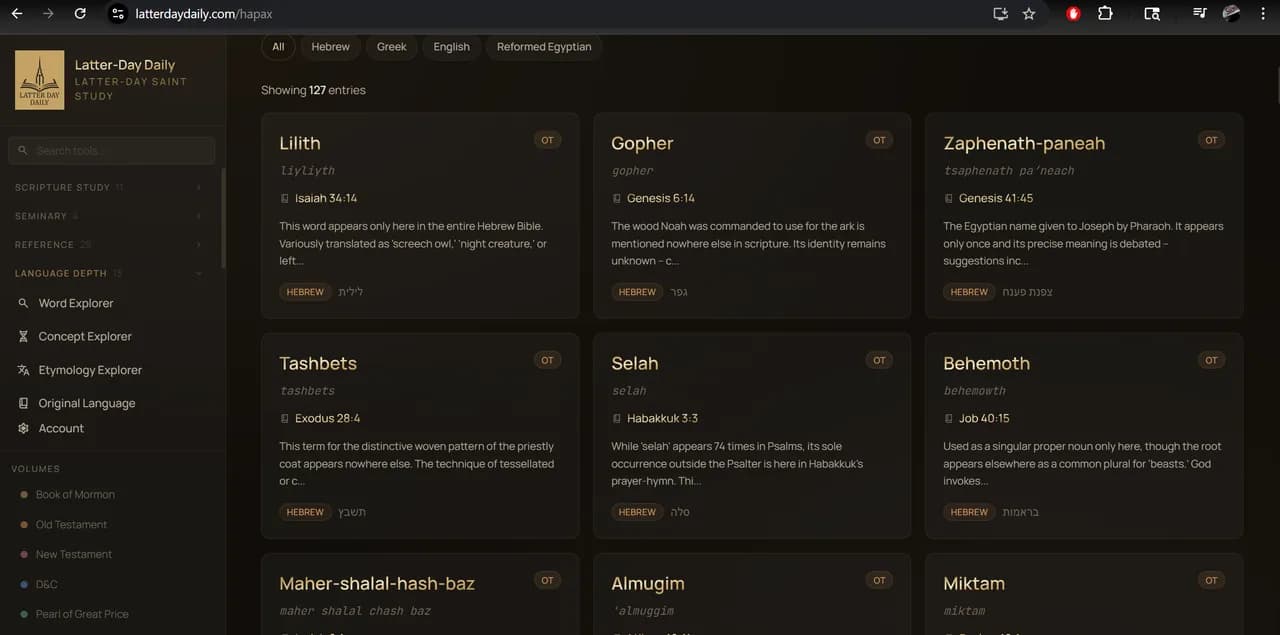
Hapax legomena are words that occur exactly once in a body of text. Explore these rare, singular words across the Book of Mormon, Old Testament, New Testament, Doctrine and Covenants, and Pearl of Great Price -- and discover what makes them significant.
What is a Hapax Legomenon?
A hapax legomenon (plural: hapax legomena) is a word that appears only once in a given body of text. The term comes from the Greek phrase meaning 'said once.' In biblical studies, hapax legomena are words that occur only once in the entire Hebrew Old Testament or Greek New Testament. These rare words have fascinated scholars for centuries because they present unique challenges for translation and interpretation.
When a word appears only once in scripture, translators cannot compare its usage across multiple passages to determine its meaning. They must rely on cognate languages, context, and ancient translations like the Septuagint to make educated guesses. This means that hapax legomena are often the most uncertain words in our English Bibles -- the places where translation is closest to interpretation.
The Hebrew Old Testament contains approximately 1,500 hapax legomena, while the Greek New Testament has around 700. Some are famous: the Hebrew word 'tappuach' in Song of Solomon 2:3 (usually translated 'apple tree') appears only once and its exact identification remains debated. The Greek word 'epiousios' in the Lord's Prayer (Matthew 6:11, 'daily bread') is so rare it may have been coined by the Gospel writer.
Latter-Day Daily extends hapax legomena analysis beyond the Bible to include all five volumes of LDS scripture. You can explore words that appear only once in the Book of Mormon, only once across all standard works combined, or only once in a specific volume. Each entry includes the original language context (where applicable), the full verse, and analysis of why this particular word is significant and what it tells us about the text.
How It Works
1
Browse by volume
Select a scripture volume to see all hapax legomena within it, or search across all five volumes to find words that appear only once in the entire LDS canon.
2
Explore each word
Each hapax legomenon shows the word, its original Hebrew or Greek form (where applicable), the verse where it appears, and its significance.
3
Understand the implications
Learn why certain words appear only once, what translation challenges they present, and what they reveal about the text's composition and vocabulary.
Key Features
All Five Volumes
Hapax legomena identified across the Book of Mormon, Old Testament, New Testament, Doctrine and Covenants, and Pearl of Great Price.
Original Language Links
Hebrew and Greek hapax legomena include the original word, transliteration, and Strong's concordance reference for deeper study.
Searchable Database
Search for specific words or browse the full list. Filter by volume, language, or significance category.
Statistical Analysis
See how hapax legomena distribution compares across volumes, revealing patterns in vocabulary richness and authorial style.
Frequently Asked Questions
What is a hapax legomenon?
A hapax legomenon (from Greek, meaning 'said once') is a word that appears exactly once in a given body of text. In biblical studies, it refers to words found only once in the Hebrew Old Testament or Greek New Testament. These rare words are significant because their meaning must often be inferred from context rather than confirmed by multiple usages.
How many hapax legomena are in the Bible?
The Hebrew Old Testament contains approximately 1,500 hapax legomena, and the Greek New Testament contains around 700. Together, these represent a significant portion of the total vocabulary in scripture and include some of the most debated translation choices in the Bible.
Are there hapax legomena in the Book of Mormon?
Yes. The Book of Mormon contains words that appear only once within its text and words that appear only once across all LDS standard works. Latter-Day Daily identifies and catalogs these rare words, showing their context and significance within the broader scriptural canon.
Why do hapax legomena matter for scripture study?
Hapax legomena matter because they represent the most uncertain points in translation. When a word appears only once, translators have less evidence for its precise meaning. Understanding which words in your Bible are hapax legomena helps you identify places where the English translation may not fully capture the original meaning -- and where deeper study is most rewarding.
What is the most famous hapax legomenon in the Bible?
One of the most discussed is 'epiousios' in Matthew 6:11, translated as 'daily' in 'Give us this day our daily bread.' This Greek word appears nowhere else in ancient literature and may have been coined specifically for this prayer. Scholars continue to debate whether it means 'daily,' 'necessary,' 'for tomorrow,' or 'supernatural.'
Start Using Hapax Legomena
Full access to Hapax Legomena and 40+ other study tools.
Starting at $7/mo or $69.99/yr
Already have an account? Sign in