Hebrew Root Words That Unlock the Old Testament
Key Takeaway
Ten Hebrew roots connect hundreds of Old Testament passages in ways English translations cannot show. Learning these roots does not require knowing Hebrew -- just knowing where to look.
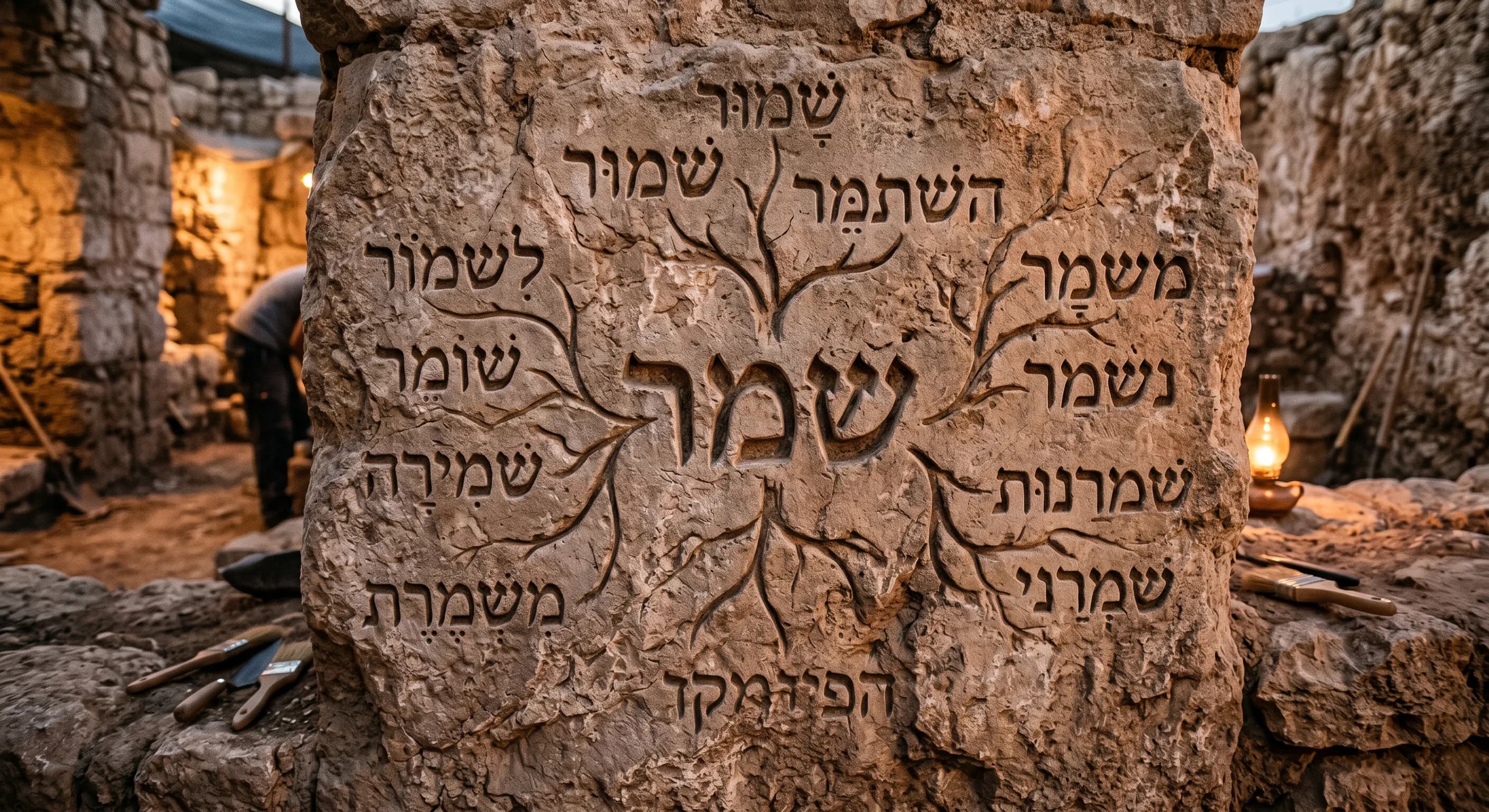
Biblical Hebrew is a root-based language. Every word descends from a root of three consonants, and words sharing the same root are linguistically related in ways that create meaning across the text. English translations often use different words for the same Hebrew root, hiding connections that ancient Hebrew speakers would have recognized immediately. Learning even ten key roots transforms how you read the Old Testament.
1. Sh-L-M (Wholeness, Peace, Completeness)
Root: shin-lamed-mem. Related words: shalom (peace), shalem (whole, complete), shillem (to repay/restore), Jerusalem (sometimes read as "city of peace" or "city of completeness"). When the prophet says "there is no peace (shalom) for the wicked" (Isaiah 48:22), the issue is not tranquility but wholeness -- the wicked cannot be complete because they are cut off from the source of all completion. Every occurrence of shalom in the Old Testament carries this fuller sense.
Free Scripture Study Tools
Explore the scriptures with Latter-Day Daily
Interlinear readers, word studies, timeline, maps, Come Follow Me guides, and 40+ more tools — all free.
Start for free2. Q-D-Sh (Holy, Set Apart, Sacred)
Root: qoph-dalet-shin. Related words: qadosh (holy), qodesh (holiness), miqdash (sanctuary/temple), kiddushin (betrothal -- the act of setting a person apart as exclusively yours). The temple is the miqdash, the set-apart place. The Sabbath is qadosh, set apart from ordinary time. The prohibition of mixing wool and linen in priestly garments reflects the same root -- the sacred must not be mixed with the common. Holiness in Hebrew is not a moral quality first -- it is a relational status: belonging exclusively to God.
3. B-R-K (Bless, Kneel, Praise)
Root: bet-resh-kaf. Related words: barakh (to bless), berakah (blessing), berakhot (plural blessings), birkayim (knees). The connection between blessing and kneeling is embedded in the root. To bless someone is to kneel before them -- to acknowledge their dignity and call down divine favor upon them. When God "blessed" the Sabbath (Genesis 2:3), he knelt before it, as it were, and honored it with sacred purpose.
4. D-B-R (Word, Speak, Command, Thing)
Root: dalet-bet-resh. Related words: davar (word, thing, matter), diber (to speak), midbar (wilderness, literally "the place of the word"). The identification of word and thing in Hebrew is significant -- there is no abstract concept of "language" separate from "reality." When God speaks, things happen. The wilderness (midbar) is etymologically "the place of the word" -- the place where God speaks without intermediary. Moses receives Torah in the wilderness; Elijah hears the still small voice in the wilderness; Christ is tested in the wilderness.
5. N-P-Sh (Soul, Breath, Appetite, Being)
Root: nun-peh-shin. Related words: nefesh (soul, living being, appetite), nephesh khayyah (living soul, Genesis 2:7). When Genesis 2:7 says God breathed into Adam "the breath of life; and man became a living soul," the word is nefesh -- not an immortal spiritual substance separable from the body, but the whole animated being. Nefesh can mean appetite (Proverbs 23:2) or desire (Psalm 27:12) as well as soul. In Hebrew, the soul is not imprisoned in the body -- it is the body alive with divine breath.
6. Kh-S-D (Covenant Loyalty, Steadfast Love)
Root: khet-samekh-dalet. Related word: hesed. This root has no adequate English equivalent. It describes the loyal, faithful, steadfast love that covenant partners owe each other -- not because of emotion but because of commitment. God's hesed toward Israel (Exodus 34:6-7, Psalm 136) is not sentiment -- it is the relentless faithfulness of a God who will not break covenant even when His people do. The modern Jewish value of "gemilut hasadim" (acts of loving-kindness) derives from this root.
7. Sh-U-B (Return, Repent, Restore)
Root: shin-vav-bet. Related words: shuv (to return, to turn back), teshuvah (repentance). This is the Hebrew word for repentance -- not a legal transaction but a physical movement. To repent is to turn around, to reverse direction, to return to where you came from. The prophet's constant call "shuvah Yisrael" (return, O Israel) is a call home, not to a courtroom. The Prodigal Son parable is the New Testament equivalent -- he "came to himself" and turned toward his father's house.
8. A-M-N (Faithful, True, Trustworthy)
Root: alef-mem-nun. Related words: amen (so be it), emunah (faith, faithfulness), emet (truth), ne'eman (faithful). When you say "amen" at the end of a prayer, you are using this root -- you are saying "this is true, this is reliable, I bind myself to this." Emunah (faith) in Hebrew is not primarily intellectual assent to propositions -- it is relational trust, the same trust that a child places in a parent or a soldier places in a commander. The Hebrews did not separate "believing" from "trusting."
9. G-A-L (Redeem, Buy Back, Kinsman-Redeemer)
Root: gimmel-alef-lamed. Related words: ga'al (to redeem), go'el (kinsman-redeemer), ge'ulah (redemption). The go'el in ancient Israel was the closest male relative who had both the right and the duty to redeem -- to buy back -- a family member in distress: from debt-slavery, from loss of land, from the need for a heir. Boaz acts as go'el for Naomi and Ruth. Isaiah applies this title to God: "Thus saith the Lord, your redeemer (go'el), the Holy One of Israel" (Isaiah 43:14). Christ is the ultimate Go'el -- the nearest kin who buys us back at the cost of his own life.
10. Ts-D-Q (Righteousness, Justice, Righteous Act)
Root: tsade-dalet-qoph. Related words: tsaddiq (righteous person), tsedaqah (righteousness, justice, charity), tsedek (right, straight). The Hebrew concept of righteousness is not primarily about personal morality -- it is about right relationships. A tsaddiq person acts rightly toward God, toward neighbors, and toward the community. Tsedaqah, translated both "righteousness" and "charity" in different contexts, reveals that in Hebrew, giving to the poor is not optional generosity -- it is simply doing what is right. The prophet Amos condemns Israel for selling the tsaddiq (righteous/innocent person) for silver (Amos 2:6) -- justice and charity are the same obligation.
How to Use These Roots
When you encounter any of these roots in your scripture study, notice all the places the same root appears in the passage. When a psalm uses both "shalom" and "shalem" in adjacent verses, the wordplay is intentional. When an oracle both "blesses" (barakh) and "kneels" (birkayim), the imagery is connected. Hebrew scripture study rewards the reader who notices these connections -- and modern tools make it possible to trace every root across the entire text without knowing the language yourself.
Frequently Asked Questions
Go deeper with Latter-Day Daily
Interlinear Hebrew & Greek, word origins, Come Follow Me, maps, timelines, and 40+ more tools. Free to start — Scholar plan unlocks everything.
Related Study Tools
Etymology Explorer
Trace any Hebrew root through all its occurrences and English translations across scripture.
Interlinear Reader
See the Hebrew root behind every word in Old Testament passages, word by word.
Word Explorer
Search for any of these Hebrew roots and see every verse where they appear.
Hebrew Alphabet
Learn the Hebrew letters to recognize root consonant patterns in transliterations.
Hapax Legomena
Explore words that appear only once in the Old Testament -- often the most theologically loaded terms.
Related Posts
Genesis 24-33 Study Guide -- "Let God Prevail" (Jacob and Esau)
Jacob's story is the story of transformation. From the scheming supplanter who stole a birthright to the man who wrestled with God and became Israel, Genesis 24-33 shows that God works with imperfect people.
Genesis 42-50 Study Guide -- "God Meant It unto Good"
Joseph's reunion with his brothers and his declaration -- "ye thought evil against me; but God meant it unto good" -- is one of the Old Testament's most powerful statements of divine providence.
Isaiah 13-35 Study Guide -- Come Follow Me 2026 Week 35
Isaiah 13-35 moves from oracles against specific nations to an apocalyptic vision of worldwide judgment and restoration. Week 35 of Come Follow Me 2026 contains some of Isaiah's most stunning poetry.
Weekly scripture insights
Get study guides delivered to your inbox each week.