Loading...
Learn the Hebrew Alphabet with Pictographs and Gematria
Explore all 22 letters of the Hebrew alphabet with their ancient pictographic forms, symbolic meanings, numeric gematria values, pronunciation guides, and connections to Old Testament scripture and Latter-day Saint doctrine.
What is the Hebrew Alphabet Tool?
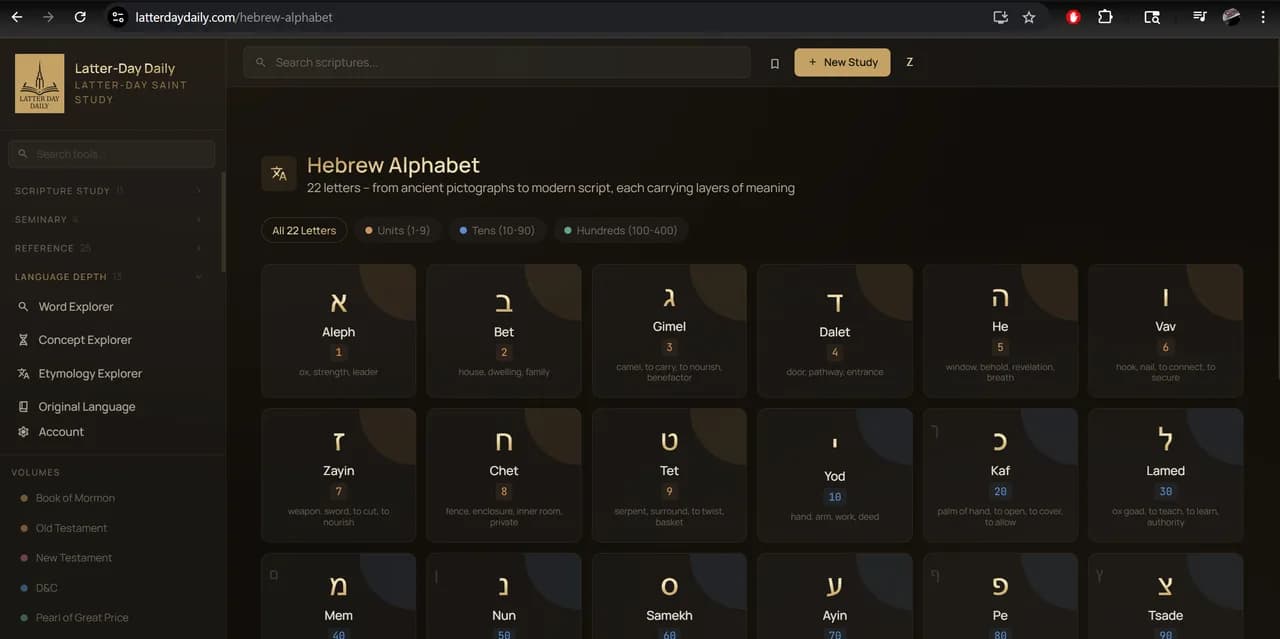
The Hebrew alphabet, known as the Aleph-Bet, consists of 22 consonant letters that have been used to write the Hebrew language for over three thousand years. Each letter is far more than a phonetic symbol. In the ancient world, every Hebrew letter originated as a pictograph -- a small picture representing a concrete object. Aleph was an ox head symbolizing strength and leadership. Bet was a house representing family and dwelling. Gimel was a camel signifying journey and provision. The Hebrew Alphabet tool presents all 22 letters with their original pictographic forms, modern script, and the symbolic meanings embedded in each one.
Beyond pictographic meaning, each Hebrew letter carries a numeric value in the system known as gematria. Aleph is 1, Bet is 2, Gimel is 3, and so forth through the units, tens, and hundreds. Gematria has been used for millennia by Jewish scholars to explore connections between words that share the same numeric total, and it can illuminate surprising relationships in the biblical text. The Hebrew Alphabet tool organizes letters by their numeric category -- units (1-9), tens (10-90), and hundreds (100-400) -- and displays each letter's gematria value prominently.
For Latter-day Saints who study the Old Testament, understanding the Hebrew alphabet opens a window into the language in which the prophets wrote. Psalm 119, the longest chapter in the Bible, is an acrostic poem with eight verses for each of the 22 Hebrew letters. The book of Lamentations follows a similar pattern. When you know the meaning of each letter, these acrostic structures reveal layers of intentional artistry and theological depth. The Hebrew Alphabet tool includes example words for each letter drawn from actual scripture, with their transliteration, meaning, and verse reference.
Each letter entry also includes a spiritual significance section that connects the letter's symbolic meaning to broader scriptural themes. The letter Dalet, for example, means 'door' -- evoking the Savior's declaration 'I am the door' in John 10:9, as well as the temple veil as a doorway between the earthly and the divine. These connections are drawn with care and grounded in established biblical scholarship, offering a devotional dimension to what might otherwise be a purely academic exercise.
How It Works
1
Browse all 22 letters
View the complete Hebrew alphabet displayed as a visual grid. Each card shows the Hebrew letter, its name, pictographic form, pronunciation, meaning, and gematria value.
2
Select a letter for details
Click any letter to see its full profile including the ancient pictograph, spiritual significance, and example Hebrew words from scripture with transliteration and meaning.
3
Filter by category
Filter letters by their gematria category -- units, tens, or hundreds -- to study groups of letters together and see how numeric values are structured in the Hebrew system.
Key Features
Ancient Pictographic Origins
See the original pictograph for every Hebrew letter alongside its modern form, revealing the concrete image from which each abstract letter evolved.
Gematria Values
Every letter displayed with its numeric value in the gematria system, organized by units, tens, and hundreds for systematic study of Hebrew numerology.
Scripture Example Words
Each letter includes Hebrew words from the Old Testament that begin with it, complete with transliteration, English meaning, and verse reference.
Spiritual Significance
Thoughtful connections between each letter's symbolic meaning and scriptural themes, grounded in biblical scholarship and Latter-day Saint perspective.
Frequently Asked Questions
How many letters are in the Hebrew alphabet?
The Hebrew alphabet has 22 consonant letters. Five of these letters -- Kaf, Mem, Nun, Pe, and Tsade -- have special final forms used when they appear at the end of a word. Hebrew is written from right to left. The original script contained no vowels; vowel points (nikkud) were added later by the Masoretes between the 6th and 10th centuries to preserve correct pronunciation.
What is gematria in Hebrew?
Gematria is the practice of assigning numeric values to Hebrew letters and using those values to find connections between words. Each Hebrew letter has a fixed numeric value: Aleph is 1, Bet is 2, and so on through the units, tens, and hundreds. When two Hebrew words have the same total numeric value, traditional Jewish interpretation sees a meaningful connection between them. The Hebrew Alphabet tool displays each letter's gematria value for reference.
What are the Hebrew letter pictographs?
Before the Hebrew alphabet evolved into its modern square script, each letter was a small picture representing a concrete object. Aleph was an ox head (strength), Bet was a house (family), Gimel was a camel (journey), Dalet was a door (pathway), and so on. These pictographic origins date to the Proto-Sinaitic script of roughly 1800 BC. The Hebrew Alphabet tool shows both the ancient pictographic form and the modern letter for all 22 characters.
Why is the Hebrew alphabet important for Bible study?
The Old Testament was written in Hebrew, and understanding its alphabet deepens Bible study in several ways. It reveals the meaning behind names (Adam means 'man' from 'adamah' meaning earth). It unlocks acrostic structures in Psalms and Lamentations. It connects to gematria patterns that Jewish and Christian scholars have studied for centuries. And it brings you closer to the actual language of the prophets.
What is Psalm 119 and why does it use the Hebrew alphabet?
Psalm 119 is the longest chapter in the Bible with 176 verses. It is an acrostic poem divided into 22 sections, one for each letter of the Hebrew alphabet. Every verse in each section begins with the same Hebrew letter. This structure served as both a literary device and a teaching tool, connecting the psalm's theme of devotion to God's law with the completeness symbolized by the full alphabet from Aleph to Tav.
Start Using Hebrew Alphabet
Full access to Hebrew Alphabet and 40+ other study tools.
Starting at $7/mo or $69.99/yr
Already have an account? Sign in