Chiastic Structures: The Hidden Mirror Patterns Woven Through Scripture
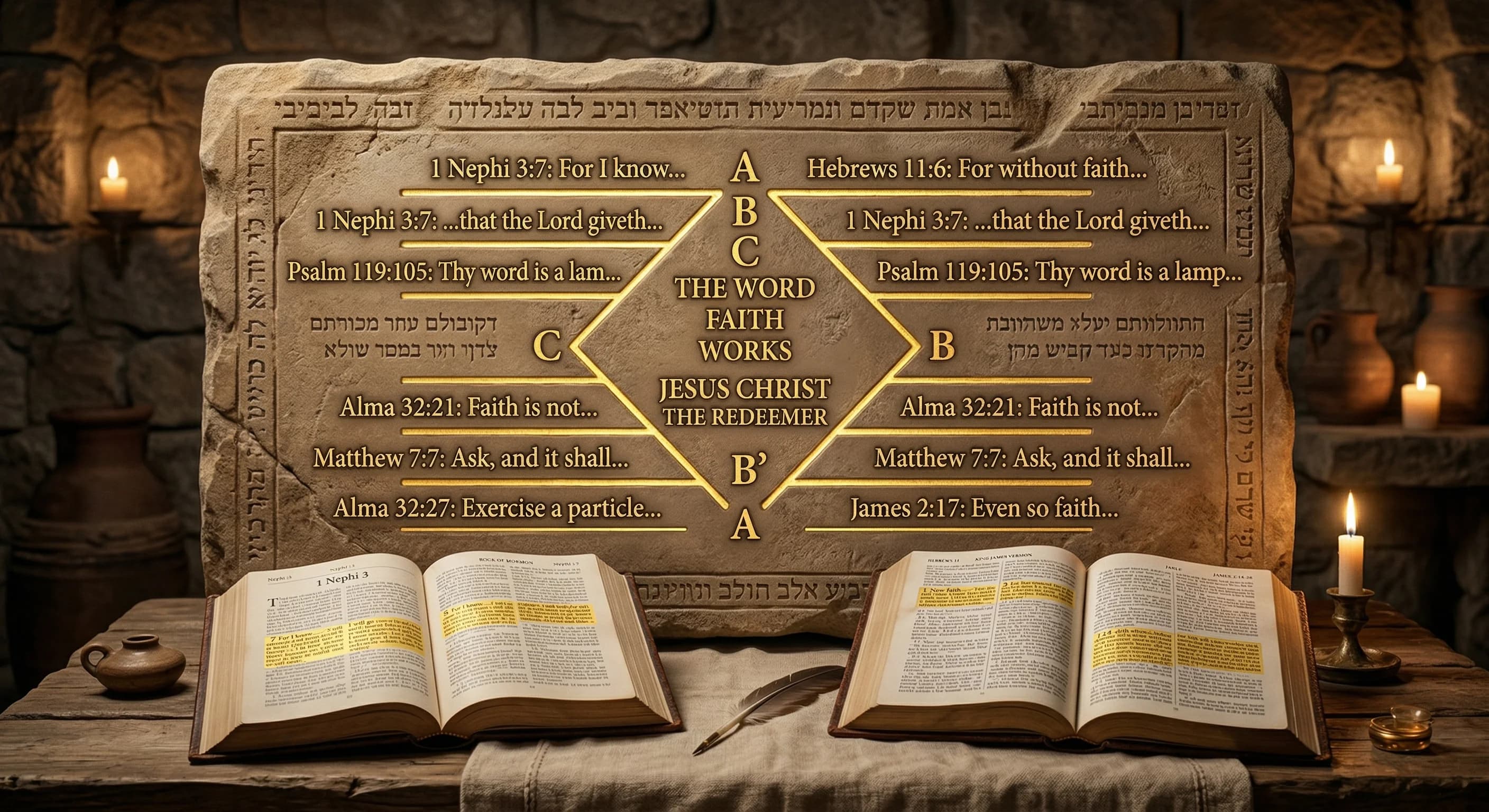
Key Takeaway
Ancient Hebrew writers structured their most important messages in chiastic patterns -- ideas arranged in a mirror structure that pivots around a central theme. The Book of Mormon contains some of the most elaborate chiasms ever documented, and you can explore them visually on Scripture Deep.
Chiasmus is a literary structure in which a series of ideas are presented and then repeated in reverse order, forming a mirror pattern often labeled A-B-C...C'-B'-A'. The central pivot point carries the author's most important message. This structure was a hallmark of ancient Hebrew, Greek, and Mesoamerican writing -- and it appears hundreds of times throughout scripture. Understanding chiasmus does not just reveal an elegant literary device; it tells you what the author considered most important, because the center of the chiasm is always the theological heart of the passage.
The most famous chiastic structure in the Book of Mormon is Alma 36, where Alma the Younger recounts his conversion to his son Helaman. The chapter opens with Alma urging Helaman to trust in God (A), then describes his rebellion and the suffering that followed (B), his memory of his father's teachings about Christ (C), and at the very center -- the pivot of the entire chapter -- Alma cries out, "O Jesus, thou Son of God, have mercy on me" (verse 18). From that center, the chapter unfolds in reverse: his suffering is replaced by joy (B'), and he concludes by testifying that God is trustworthy (A'). The structure is not accidental. It contains over a dozen matched pairs across 30 verses, a feat that would be extraordinarily difficult to fabricate without deliberate planning.
Why does this matter for Latter-day Saints? When John Welch first identified the Alma 36 chiasmus in 1967, it drew attention to a form of literary evidence that Joseph Smith almost certainly did not know about. Chiasmus was not widely discussed in Western scholarship until the mid-20th century, well over a hundred years after the Book of Mormon was published. The presence of sophisticated chiastic patterns -- not just in Alma but throughout Mosiah, Helaman, and 1 Nephi -- is consistent with authorship by people steeped in Hebrew literary tradition.
Free Scripture Study Tools
Explore the scriptures with Latter-Day Daily
Interlinear readers, word studies, timeline, maps, Come Follow Me guides, and 40+ more tools — all free.
Start for freeThe Chiastic Structures tool on Scripture Deep lets you explore these patterns visually. Each chiasm is displayed with its matched pairs highlighted and its center point identified, so you can see the mirror structure at a glance. You can examine well-documented examples from published scholarship or explore candidate chiasms identified through computational analysis. Not every proposed chiasm is equally convincing, and the tool lets you evaluate the evidence for yourself.
Beyond apologetics, chiasmus is a powerful devotional tool. When you recognize that the central pivot of a passage is the author's most important statement, it changes how you read. The center of Alma 36 is a cry for mercy. The center of Mosiah 5 is the covenant to take upon oneself the name of Christ. These are not buried details -- they are the structural and spiritual heart of the text.
Go deeper with Latter-Day Daily
40+ free tools for scripture study: interlinear Hebrew & Greek, word origins, Come Follow Me, maps, timelines, and more.
Related Study Tools
Related Posts
Chiasmus in the Book of Mormon -- A Complete Guide to Inverted Parallelism
Chiasmus is one of the most compelling literary patterns in the Book of Mormon. Understanding how inverted parallelism works transforms how you read Alma, Mosiah, and the entire Nephite record.
50 Archaic Bible Words Every Latter-day Saint Should Know
The King James Bible and the Book of Mormon share a vocabulary that has drifted far from modern usage. Knowing what these words actually meant in 1611 transforms how you read every chapter.
Preparing a Sacrament Meeting Talk: A Step-by-Step Guide
That phone call from the bishopric does not have to fill you with dread. Here is a step-by-step approach to preparing a sacrament meeting talk that is scriptural, personal, and worth listening to.
Weekly scripture insights
Get study guides delivered to your inbox each week.