Chiasmus in the Book of Mormon -- A Complete Guide to Inverted Parallelism
Key Takeaway
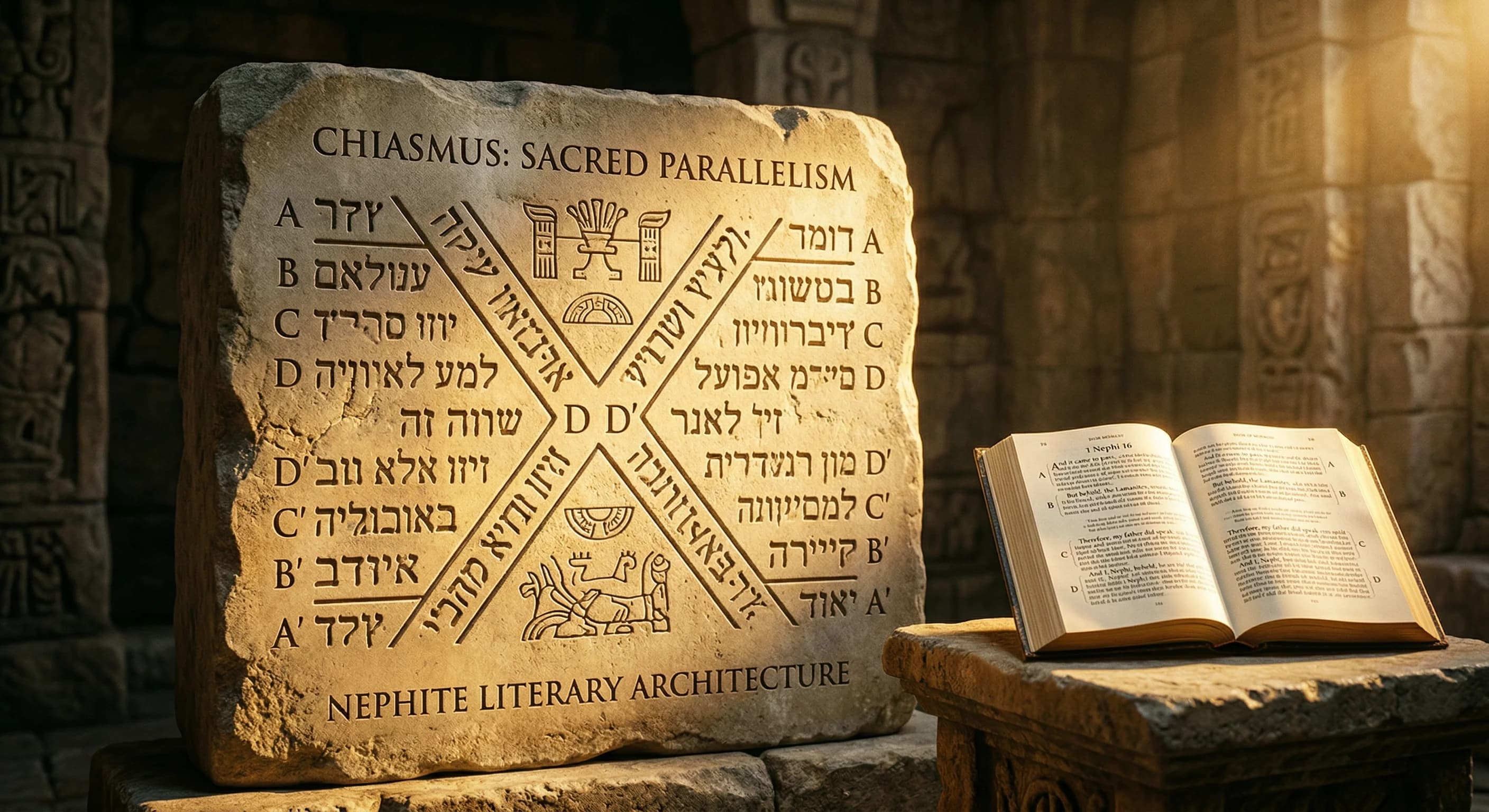
Chiasmus is one of the most compelling literary patterns in the Book of Mormon. Understanding how inverted parallelism works transforms how you read Alma, Mosiah, and the entire Nephite record.
In 1969, a young BYU student named John Welch sat in a chapel in Regensburg, Germany, listening to a missionary discussion about the Book of Mormon. He had recently learned about chiasmus -- an ancient literary structure common in Hebrew poetry -- and a thought struck him: if the Book of Mormon were truly an ancient text with Hebrew roots, it should contain chiastic patterns. He went home, opened to Alma 36, and found one of the most sophisticated chiasms ever documented in any literature. That discovery launched decades of scholarship and gave Book of Mormon readers a powerful lens for seeing what the text is actually doing.
Chiasmus is a form of inverted parallelism in which ideas are presented in a sequence and then repeated in reverse order. The name comes from the Greek letter chi, which is shaped like an X -- a visual representation of the crossing pattern. In its simplest form, chiasmus follows an A-B-B'-A' structure, where the first and last elements mirror each other, and the middle elements mirror each other. In more complex forms, the pattern can extend through dozens of elements, with the central point -- the turning point -- carrying the primary theological weight of the passage.
The roots of chiasmus run deep into the ancient Near East. Hebrew poets and prophets used it extensively, and once you learn to recognize it, you find it throughout the Old Testament. Leviticus 24:13-23 contains a chiasm built around the principle of proportional justice: "breach for breach, eye for eye, tooth for tooth" (Leviticus 24:20). The structure itself reinforces the message -- the punishment mirrors the crime, just as the literary form mirrors itself. Isaiah is saturated with chiastic patterns, as are the Psalms. The form served a mnemonic function in oral cultures, helping listeners remember long passages by embedding them in a symmetrical framework. But it also served a theological function: the center of a chiasm is where the author places the most important idea, the hinge on which everything turns.
Free Scripture Study Tools
Explore the scriptures with Latter-Day Daily
Interlinear readers, word studies, timeline, maps, Come Follow Me guides, and 40+ more tools — all free.
Start for freeAlma 36 is the most famous chiasm in the Book of Mormon, and it deserves careful attention. The chapter is Alma's personal testimony to his son Helaman, and its chiastic structure spans the entire chapter -- seventeen paired elements that converge on a single turning point. The outer layers establish the frame: Alma's exhortation to trust God, his reminder of the bondage and deliverance of their fathers, his description of his own rebellion and suffering. As the structure spirals inward, the elements become more intense and more personal. Alma recounts his encounter with the angel, his three days of torment, and his awareness that he had "murdered" many of God's children by leading them away from the truth (Alma 36:14). Then, at the precise center of the chiasm, comes the pivot: "I remembered also to have heard my father prophesy unto the people the coming of one Jesus Christ, a Son of God, to atone for the sins of the world" (Alma 36:17). The name of Jesus Christ sits at the mathematical center of the structure. Everything before it descends into darkness; everything after it ascends into light. The literary form enacts the doctrine: Christ is the turning point.
What makes this chiasm remarkable is not just its length but its precision. Each paired element matches its counterpart in specific vocabulary and thematic content. "Racked with eternal torment" in the descending half mirrors "joy as exceeding as was my pain" in the ascending half. The bondage of the Israelites in Egypt mirrors their deliverance. Alma's spiritual death mirrors his spiritual rebirth. The structure is too detailed and too consistent to be accidental, and it would have been extraordinarily difficult for Joseph Smith -- a twenty-three-year-old with limited education dictating the text without revision -- to construct deliberately in English. For many readers, this is one of the strongest internal evidences that the Book of Mormon is what it claims to be: an ancient text written by people steeped in the literary traditions of the Hebrew Bible.
Beyond Alma 36, chiastic patterns appear throughout the Book of Mormon at multiple scales. First Nephi 15:13-16 contains a concise chiasm centered on the Gentiles receiving the gospel and carrying it to the remnant of Lehi's seed. Mosiah 5:10-12 -- King Benjamin's covenant speech -- uses a chiasm to frame the consequences of keeping or breaking the covenant name. Mosiah 3:18-19 structures the contrast between the natural man and the spiritual child around the atoning blood of Christ. These are not isolated curiosities; they are evidence of a consistent literary sensibility running through the text, one that aligns with ancient Near Eastern practice rather than nineteenth-century American prose.
Recognizing chiasmus is not just an academic exercise -- it changes how you read. When you identify the center of a chiasm, you find the author's thesis, the idea around which everything else is organized. In Alma 36, the thesis is Jesus Christ as the turning point from darkness to light. In Mosiah 5:10-12, it is the covenant name and its binding power. In Leviticus 24, it is proportional justice. The structure tells you what the author considered most important, and that information is invisible if you read the passage linearly without recognizing the pattern.
To spot chiastic structures on your own, look for passages where the ending seems to echo the beginning, where themes appear in one order and then reappear in reverse. Mark the repeated words, phrases, and ideas. Map them outward from the center. Not every apparent chiasm is intentional -- parallelism can emerge from any structured writing -- but when the pattern extends through many elements with precise verbal correspondence, you are likely looking at a deliberate literary construction. The Chiastic Structures tool on this site automates much of this process, highlighting the paired elements and identifying the central pivot so you can see the architecture of the text at a glance.
The study of chiasmus in the Book of Mormon has produced a substantial body of scholarship over the past five decades, but the most important result is not academic. It is devotional. When you see that Alma placed the name of Jesus Christ at the exact center of his testimony -- not approximately, not roughly, but precisely -- you are seeing an author who understood that Christ is the center of everything. The structure is the sermon. And for modern readers willing to look closely, it still preaches.
Go deeper with Latter-Day Daily
40+ free tools for scripture study: interlinear Hebrew & Greek, word origins, Come Follow Me, maps, timelines, and more.
Related Study Tools
Related Posts
Chiastic Structures: The Hidden Mirror Patterns Woven Through Scripture
Ancient Hebrew writers structured their most important messages in chiastic patterns -- ideas arranged in a mirror structure that pivots around a central theme. The Book of Mormon contains some of the most elaborate chiasms ever documented, and you can explore them visually on Scripture Deep.
50 Archaic Bible Words Every Latter-day Saint Should Know
The King James Bible and the Book of Mormon share a vocabulary that has drifted far from modern usage. Knowing what these words actually meant in 1611 transforms how you read every chapter.
Preparing a Sacrament Meeting Talk: A Step-by-Step Guide
That phone call from the bishopric does not have to fill you with dread. Here is a step-by-step approach to preparing a sacrament meeting talk that is scriptural, personal, and worth listening to.
Weekly scripture insights
Get study guides delivered to your inbox each week.