Preparing a Sacrament Meeting Talk: A Step-by-Step Guide
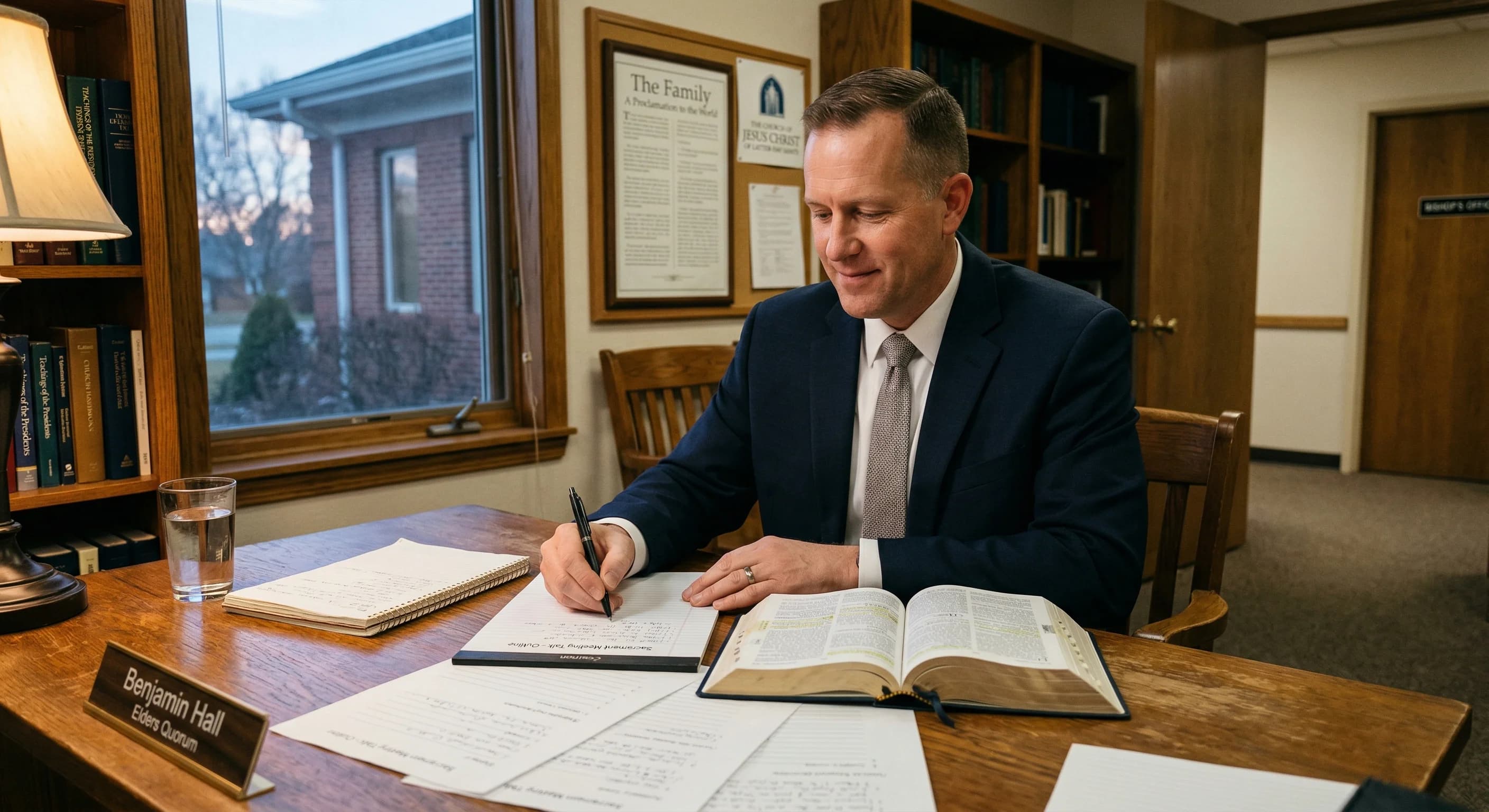
Key Takeaway
That phone call from the bishopric does not have to fill you with dread. Here is a step-by-step approach to preparing a sacrament meeting talk that is scriptural, personal, and worth listening to.
The bishop asks you to speak on repentance, and you have ten days. The temptation is to open a search engine, find a few general conference quotes, stitch them together with a personal story, and call it done. The result is a talk that sounds like every other talk. The congregation is polite but disengaged, and you leave the pulpit feeling like you missed something. There is a better way, and it starts with scripture rather than with conference talks or internet searches.
Begin with the Talk & Lesson Prep tool. Enter your assigned topic and the tool surfaces relevant scripture blocks, doctrinal themes, and structural suggestions. But here is the critical step most speakers skip: before you organize anything, sit with the scriptures themselves. Read Alma 42 on justice and mercy. Read Doctrine and Covenants 58:42-43 on what it means for the Lord to remember sins no more. Read Isaiah 1:18 -- "though your sins be as scarlet, they shall be as white as snow." Let the passages work on you before you try to work them into an outline. The difference between a talk that teaches and a talk that merely informs is whether the speaker was first taught by the text.
Next, use the Topical Guide to branch out from your initial scriptures. A search for "repentance" will return dozens of references, but do not try to use them all. Look for the two or three passages that surprised you, that said something you had not considered before. Those are the verses your audience has not considered either, and they are where your talk will come alive. King Benjamin's sermon in Mosiah 4:2 -- where the people fall to the earth and cry for the "atoning blood of Christ" -- is a passage that many members have not read carefully. A talk that walks the congregation through that moment, verse by verse, will hold attention in a way that a string of proof texts never will.
Free Scripture Study Tools
Explore the scriptures with Latter-Day Daily
Interlinear readers, word studies, timeline, maps, Come Follow Me guides, and 40+ more tools — all free.
Start for freeOnce you have your key scriptures, use Scripture Chains to trace the doctrinal thread across the standard works. Repentance in the Old Testament looks different from repentance in the Book of Mormon, which looks different from the Doctrine and Covenants, and those differences matter. The Hebrew word "teshuvah" means to turn or return -- it frames repentance as coming home rather than groveling in shame. Connecting that to Alma's experience in Alma 36:18-21, where his pain is replaced by "exquisite joy," gives your congregation a richer, multi-dimensional understanding. Scripture Chains maps these connections visually so you can see the doctrinal arc before you try to articulate it.
Structure the talk around three scripture passages rather than three abstract points. Each passage anchors a section: read it aloud, explain its context, share what it means to you personally, and then connect it to the lives of the people in the room. This is the pattern Christ himself used -- He quoted Isaiah and then said, "This day is this scripture fulfilled in your ears" (Luke 4:21). Scripture first, application second. A talk built this way has doctrinal weight and personal authenticity, and it gives the Spirit something concrete to work with in the hearts of your listeners.
One final note: practice reading your scriptures aloud before Sunday. The way you read a verse from the pulpit communicates as much as the verse itself. A passage read slowly, with understanding, invites the congregation into the text. A passage read hastily, as if it were just a stepping stone to your next point, tells the congregation the scripture is not important. Let the word of God carry the talk. Your job is not to be impressive -- it is to get out of the way and let the doctrine speak.
Go deeper with Latter-Day Daily
40+ free tools for scripture study: interlinear Hebrew & Greek, word origins, Come Follow Me, maps, timelines, and more.
Related Study Tools
Talk & Lesson Prep
Get scripture-based outlines, doctrinal themes, and structural guidance for any talk topic.
Topical Guide
Search hundreds of topics to find the right scriptures for your talk.
Scripture Chains
Trace a doctrinal theme across all four standard works to build a connected scriptural argument.
Related Posts
Doctrine and Covenants: Modern Revelation to the Church
The Doctrine and Covenants is one of four LDS standard works—a collection of revelations received primarily by Joseph Smith from 1828 to 1844, plus a few later revelations from succeeding prophets. Unlike historical narratives, it is direct revelation addressing 19th-century church organization, doctrine, and practice.
Word of Wisdom: The LDS Health Law and Why No Coffee
The Word of Wisdom is a health law revealed to Joseph Smith in 1833, prohibiting alcohol, tobacco, coffee, and tea, while encouraging whole grains, fruits, and vegetables. Members view it as a covenant practice that demonstrates self-mastery and trust in God, and studies show statistically lower rates of cancer and heart disease in LDS populations.
LDS pioneer history: trek west, Salt Lake Valley, 1847
After Joseph Smith's martyrdom in 1844, Brigham Young led the main body of Latter-day Saints westward. In February 1846, thousands evacuated Nauvoo in winter conditions, traveling across Iowa, Nebraska, and Wyoming. On July 24, 1847, Young and the vanguard company arrived in the Salt Lake Valley, and the Saints began building a new Zion in the desert.
Weekly scripture insights
Get study guides delivered to your inbox each week.