Teaching Sunday School with Confidence: Tools That Make the Difference
Key Takeaway
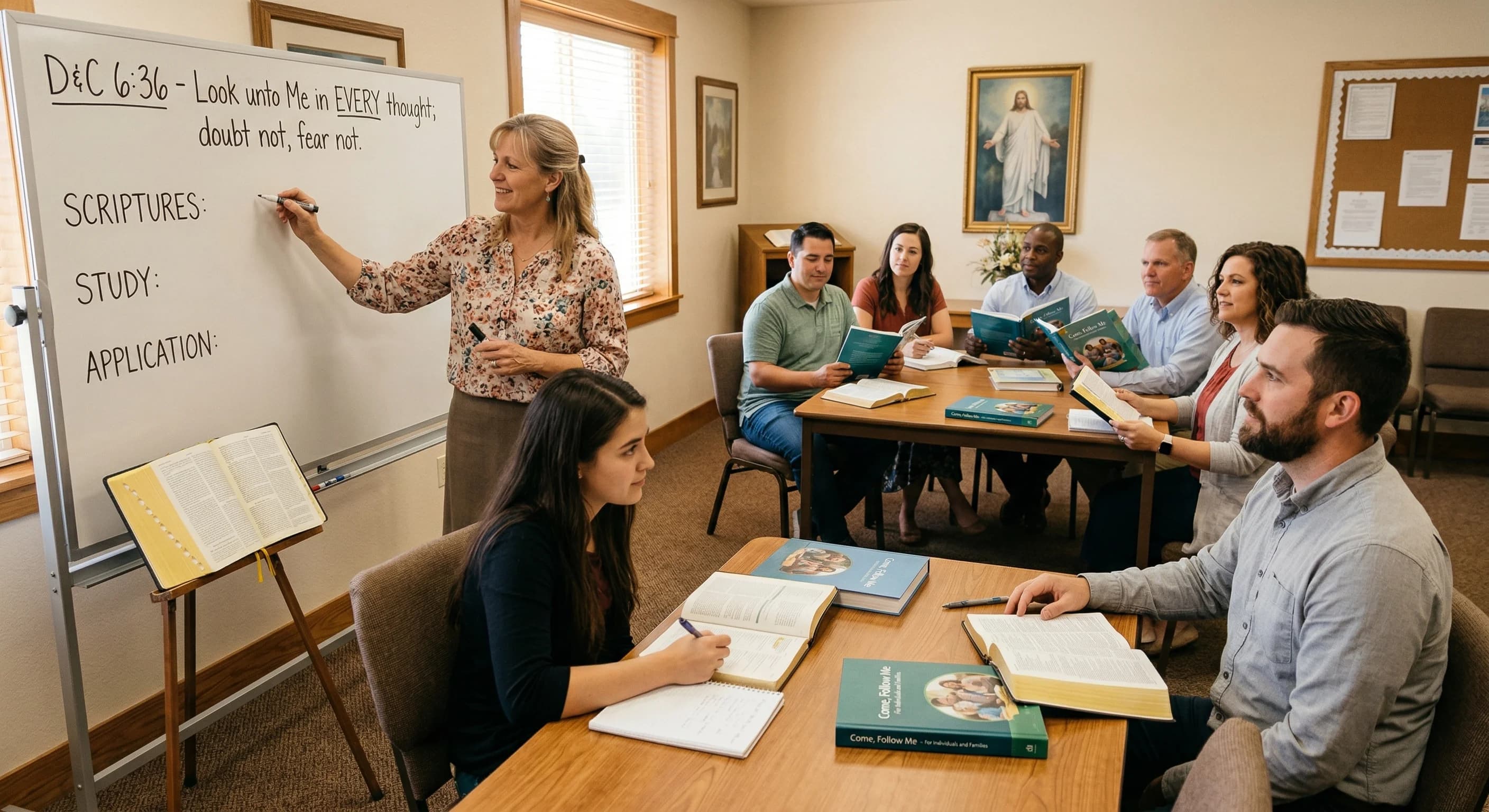
Good Sunday School teaching is not about knowing every answer. It is about asking the right questions and letting the scriptures do the heavy lifting. Here is how to prepare lessons that spark real discussion.
The best Sunday School teachers are not the ones who lecture for forty minutes. They are the ones who ask a question that makes the room go quiet for ten seconds before someone says, "I never thought about it that way." That kind of teaching does not happen by accident, and it does not require a seminary degree. It requires preparation that goes deeper than skimming the manual on Saturday night.
Start with the Come Follow Me schedule at the beginning of the week, not the end. Read the assigned chapters on Monday or Tuesday, without the manual, without commentary -- just you and the text. Write down what confuses you, what stands out, and what you wish you understood better. Those honest reactions are where your best discussion questions will come from, because if a passage puzzled you, it will puzzle your class too. When Abinadi asks Noah's priests, "Are you priests, and pretend to teach this people, and to understand the spirit of prophesying, and yet desire to know of me what these things mean?" (Mosiah 12:25), the sting is that they had read the scriptures but had not actually engaged with them. Your class will know the difference between a teacher who engaged and one who skimmed.
Chapter Summaries give you the structural overview you need to teach a coherent lesson rather than a fragmented one. When you are covering multiple chapters in a single week -- as often happens in the Old Testament curriculum -- it is easy to get lost in the details and miss the narrative arc. The summaries identify the key themes, turning points, and doctrinal anchors in each chapter so you can decide where to focus your limited class time. You cannot teach everything, and trying to is the fastest way to teach nothing. Choose one or two threads and pull them all the way through.
Free Scripture Study Tools
Explore the scriptures with Latter-Day Daily
Interlinear readers, word studies, timeline, maps, Come Follow Me guides, and 40+ more tools — all free.
Start for freeScripture Connections is where your lesson gains the kind of depth that keeps people thinking long after they leave the classroom. When your class is studying the Abrahamic covenant in Genesis 17, showing them how that covenant reappears in 2 Nephi 29, Doctrine and Covenants 132, and Abraham 2:9-11 transforms a historical narrative into a living, personal promise. The connections tool maps these relationships so you can trace a theme from the Old Testament into the Restoration and back again. Suddenly your class is not just learning about Abraham -- they are seeing themselves as participants in the same covenant.
A practical tip: prepare three discussion questions, but plan to use only two. The third is your backup if a discussion dies early, but more often you will find that a good question generates thirty minutes of conversation on its own. Frame questions around the text itself: "What do you think Lehi meant when he said 'there must needs be an opposition in all things' in 2 Nephi 2:11? Is he talking about suffering, or something broader?" That kind of question invites everyone in, from the lifelong student to the person who just started reading the Book of Mormon last month.
Finally, remember that your role as a teacher is to facilitate an encounter between your class members and the word of God. Doctrine and Covenants 42:14 is direct: "The Spirit shall be given unto you by the prayer of faith; and if ye receive not the Spirit ye shall not teach." The preparation tools exist to help you understand the material deeply enough that you can step back and let the Spirit lead the conversation. The best moments in Sunday School are the ones you did not plan -- but they only happen when you are prepared enough to recognize them.
Go deeper with Latter-Day Daily
40+ free tools for scripture study: interlinear Hebrew & Greek, word origins, Come Follow Me, maps, timelines, and more.
Related Study Tools
Come Follow Me
Weekly reading schedule and study guides aligned with the current curriculum.
Chapter Summaries
Concise summaries of every chapter highlighting key themes, events, and doctrinal points.
Scripture Connections
Discover how passages across all standard works connect to each other thematically and doctrinally.
Related Posts
Genesis 24-33 Study Guide -- "Let God Prevail" (Jacob and Esau)
Jacob's story is the story of transformation. From the scheming supplanter who stole a birthright to the man who wrestled with God and became Israel, Genesis 24-33 shows that God works with imperfect people.
Genesis 42-50 Study Guide -- "God Meant It unto Good"
Joseph's reunion with his brothers and his declaration -- "ye thought evil against me; but God meant it unto good" -- is one of the Old Testament's most powerful statements of divine providence.
Genesis 12-17, Abraham 1-2 Study Guide -- "The Abrahamic Covenant"
The Abrahamic covenant -- land, posterity, and priesthood blessing -- is the backbone of the entire Old Testament. Abraham 1-2 restores the personal story behind the covenant's most important recipient.
Weekly scripture insights
Get study guides delivered to your inbox each week.