Talk and Lesson Prep: Building Sacrament Talks and Sunday School Lessons with Confidence
Key Takeaway
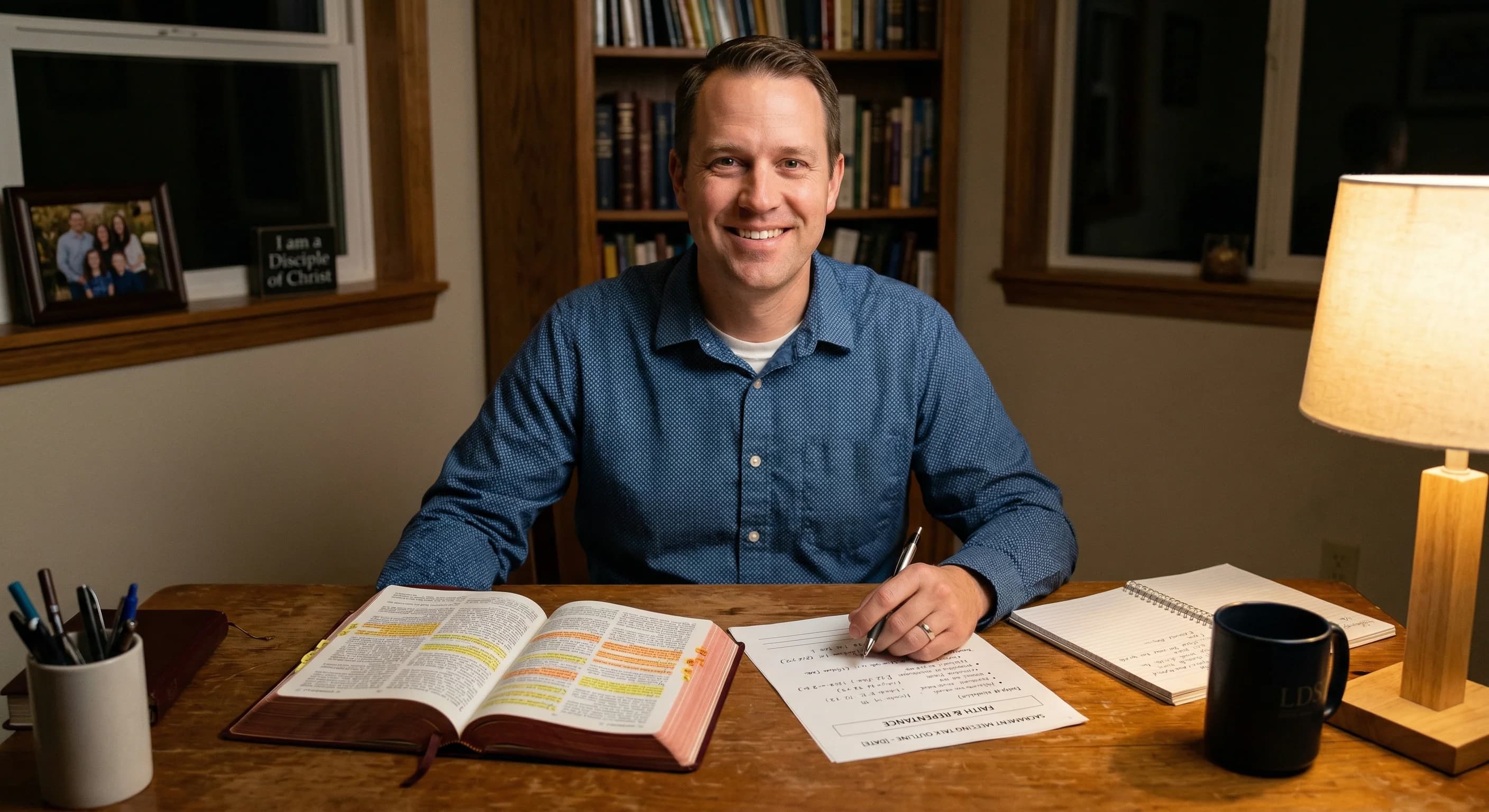
Whether you have been asked to speak in sacrament meeting or teach a Sunday School lesson, the hardest part is often figuring out where to start. The Talk and Lesson Prep tool provides a structured framework, suggests relevant scriptures, and helps you build a coherent message from a topic or assignment.
Most people who are asked to give a sacrament meeting talk face the same challenge: they know the topic, they have a few favorite scriptures, but they are not sure how to build those pieces into a cohesive message that holds together for ten or fifteen minutes. The Talk and Lesson Prep tool addresses this by providing a structured starting point. You enter your topic -- say, "faith and works" -- and the tool generates an outline that includes an introduction, main points with supporting scriptures, transitional ideas, and a conclusion that ties back to the central theme.
What makes this different from simply searching for scriptures on a topic is the way the tool connects references across volumes. If you are preparing a talk on covenants, it will not just pull verses from the Old Testament. It will link Abrahamic covenant passages in Genesis to Nephi's commentary in 2 Nephi 29, to the sacrament prayers in Moroni 4-5, and to modern-day covenant language in Doctrine and Covenants 84. These cross-volume connections are the kind of thing experienced gospel scholars do naturally, and the tool makes them accessible to anyone.
The lesson preparation mode works similarly but focuses on discussion-based structure. Instead of a linear talk outline, it suggests opening questions, key passages to read aloud, discussion prompts, and application challenges. If you are teaching from Come Follow Me, you can enter the week's reading assignment and get a lesson framework that covers the main themes while leaving room for the Spirit to guide the conversation.
Free Scripture Study Tools
Explore the scriptures with Latter-Day Daily
Interlinear readers, word studies, timeline, maps, Come Follow Me guides, and 40+ more tools — all free.
Start for freeOne feature that members have found particularly useful is the ability to adjust the depth of scriptural analysis. A Primary talk on prayer needs a simple, clear structure. An Elders Quorum lesson on the same topic can handle more nuanced cross-referencing and doctrinal depth. The tool lets you set the level so the output matches your audience and context. Every suggestion is a starting point -- the final talk or lesson is still yours, shaped by your personal experience and the promptings you receive as you prepare.
Go deeper with Latter-Day Daily
40+ free tools for scripture study: interlinear Hebrew & Greek, word origins, Come Follow Me, maps, timelines, and more.
Related Study Tools
Related Posts
Doctrine and Covenants: Modern Revelation to the Church
The Doctrine and Covenants is one of four LDS standard works—a collection of revelations received primarily by Joseph Smith from 1828 to 1844, plus a few later revelations from succeeding prophets. Unlike historical narratives, it is direct revelation addressing 19th-century church organization, doctrine, and practice.
Word of Wisdom: The LDS Health Law and Why No Coffee
The Word of Wisdom is a health law revealed to Joseph Smith in 1833, prohibiting alcohol, tobacco, coffee, and tea, while encouraging whole grains, fruits, and vegetables. Members view it as a covenant practice that demonstrates self-mastery and trust in God, and studies show statistically lower rates of cancer and heart disease in LDS populations.
LDS Priesthood: Authority to Act in God's Name
In Latter-day Saint theology, the priesthood is the authority to act in God's name and perform sacred ordinances. The Aaronic Priesthood (lesser) and Melchizedek Priesthood (higher) are two orders, held by men and boys. Both derive from divine restoration through angelic messengers, beginning with Joseph Smith in 1829.
Weekly scripture insights
Get study guides delivered to your inbox each week.