Scripture Stats -- Fascinating Facts About the Standard Works
Key Takeaway
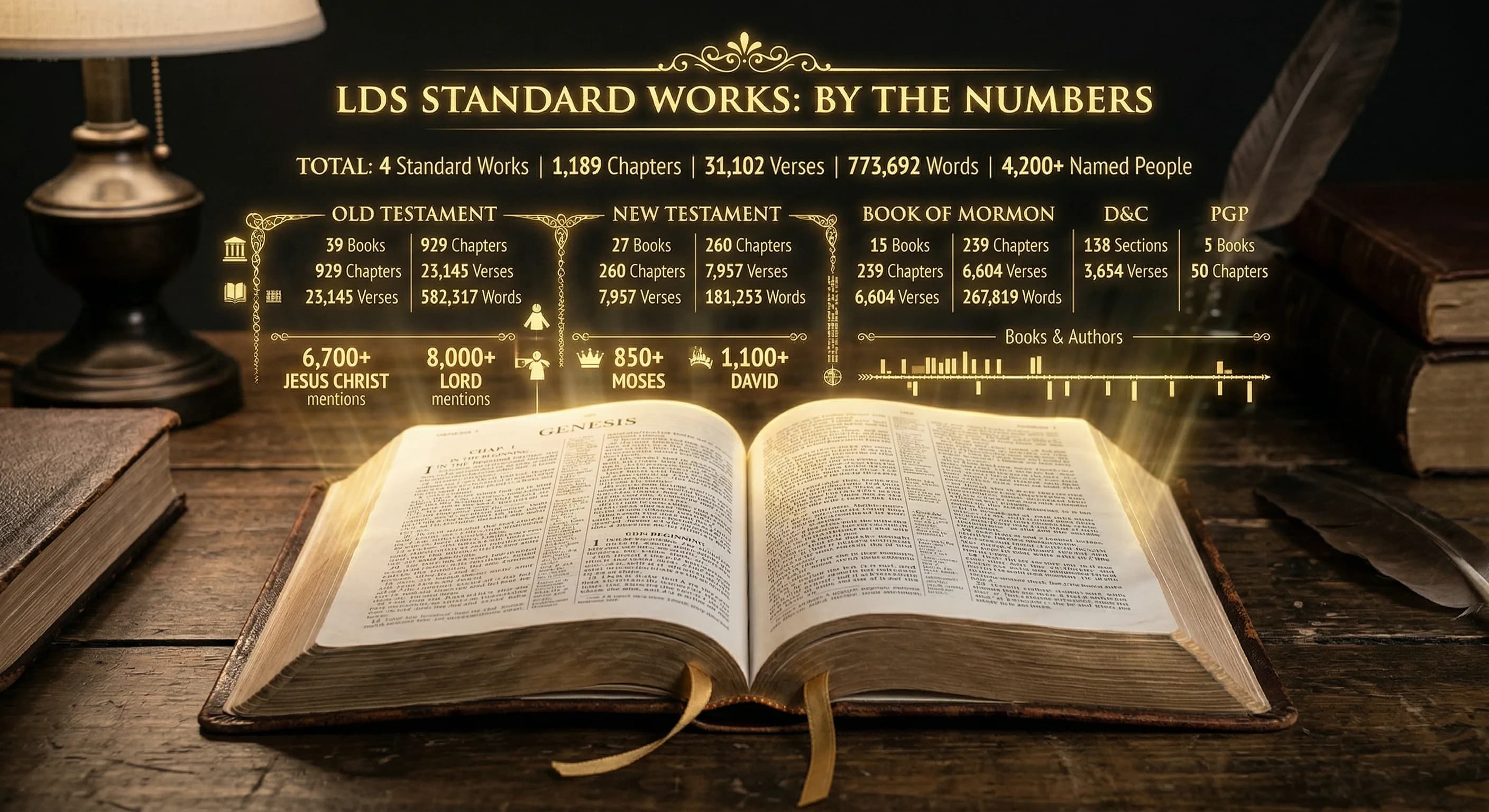
Numbers tell stories. The Latter-day Saint scriptural canon contains over 41,000 verses across five standard works, and the patterns hidden in those numbers shed light on emphasis, authorship, and divine design.
Most scripture readers never stop to consider the raw dimensions of the text they hold. The Bible alone contains 31,102 verses in the KJV -- 23,145 in the Old Testament and 7,957 in the New Testament. The Book of Mormon adds 6,604 verses. The Doctrine and Covenants contributes 3,654, and the Pearl of Great Price, the smallest standard work, adds 520. Together, these volumes comprise a library of over 41,000 verses that span thousands of years of prophetic witness.
Some of the most instructive statistics involve proportion. The book of Psalms is the longest book in the Bible by chapter count (150 chapters), yet the book of Jeremiah surpasses it in total word count. In the Book of Mormon, Alma is the longest book by a wide margin, containing roughly a third of the entire volume. This means that the period of the judges and the ministry of Alma the Younger receive more narrative attention than any other era in Nephite history -- a deliberate editorial choice by Mormon, who abridged the record.
Verse length varies dramatically. The shortest verse in the KJV is the well-known "Jesus wept" (John 11:35), at just two words. The longest verse in the Book of Mormon is found in Alma 36:2, which extends to over sixty words in a single sentence as Alma begins his testimony to his son Helaman. These extremes highlight the range of literary style within the canon: terse narrative on one end, expansive prophetic discourse on the other.
Free Scripture Study Tools
Explore the scriptures with Latter-Day Daily
Interlinear readers, word studies, timeline, maps, Come Follow Me guides, and 40+ more tools — all free.
Start for freeWord frequency analysis reveals theological priorities. The word "covenant" appears 319 times across the standard works. "Faith" appears over 500 times. "Jesus" or "Christ" appears in some form in nearly every chapter of the Book of Mormon, consistent with its stated purpose as "another testament of Jesus Christ." The Doctrine and Covenants uses the word "commandment" more frequently per verse than any other standard work, which fits its nature as a book of direct divine instruction to a modern church.
Scripture Stats makes these patterns accessible at a glance. Instead of reading passively, you can ask quantitative questions: Which books received the most editorial attention? Which prophets wrote the most? Where does the text spend its energy? The answers do not replace devotional reading, but they add a structural awareness that deepens every future encounter with the text.
Go deeper with Latter-Day Daily
40+ free tools for scripture study: interlinear Hebrew & Greek, word origins, Come Follow Me, maps, timelines, and more.
Related Study Tools
Related Posts
Psalm 23 in Hebrew -- A Word-by-Word Study of the Shepherd's Psalm
Psalm 23 is the most memorized passage in the Bible, yet its Hebrew vocabulary contains a depth of shepherd imagery, covenant language, and royal overtones that the English barely hints at.
Genesis 1:1 in Hebrew -- A Word-by-Word Interlinear Analysis
Seven Hebrew words open the entire Bible. Breaking down Genesis 1:1 word by word reveals theological depths that no English translation can fully convey -- from the plural elohim to the creative verb bara.
Preparing a Sacrament Meeting Talk: A Step-by-Step Guide
That phone call from the bishopric does not have to fill you with dread. Here is a step-by-step approach to preparing a sacrament meeting talk that is scriptural, personal, and worth listening to.
Weekly scripture insights
Get study guides delivered to your inbox each week.