Psalm 23 in Hebrew -- A Word-by-Word Study of the Shepherd's Psalm
Key Takeaway
Psalm 23 is the most memorized passage in the Bible, yet its Hebrew vocabulary contains a depth of shepherd imagery, covenant language, and royal overtones that the English barely hints at.
Nearly everyone who has attended a funeral or a Sunday worship service has heard Psalm 23 read aloud. Its six verses are among the most memorized in all of scripture, and their familiarity is both a gift and a problem. The words have become so comfortable that they wash over us without resistance, and the meanings embedded in the Hebrew settle to the bottom, unseen. A word-by-word study of the original language does not replace the psalm's devotional power -- it deepens it, revealing layers of meaning that David's audience would have recognized immediately.
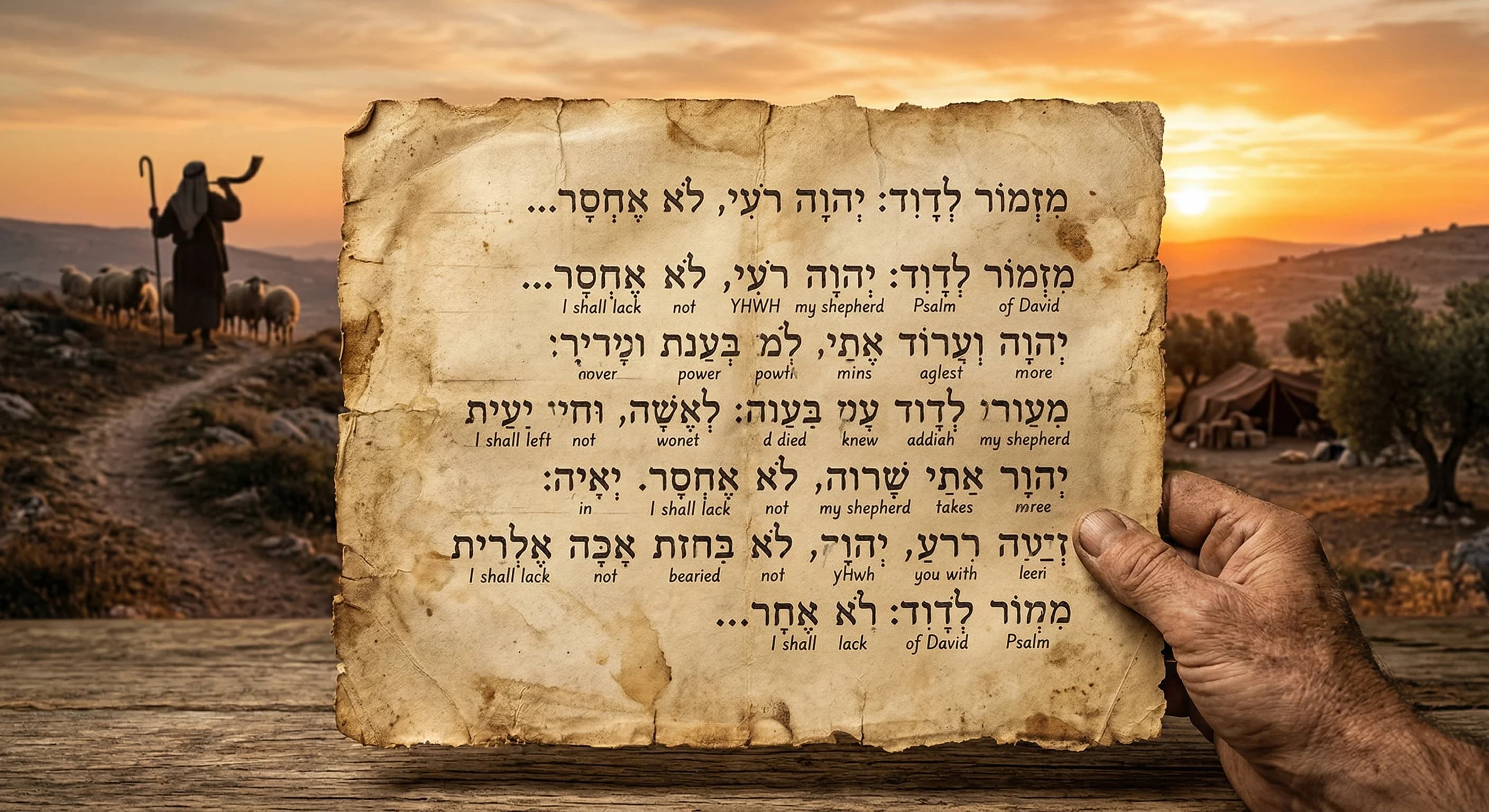
The psalm opens with "YHWH ro'i" -- "The LORD is my shepherd." The word "ro'eh" (shepherd) comes from the root "ra'ah," meaning to tend, to pasture, to feed. In the ancient Near East, "shepherd" was not merely an occupational title; it was the standard metaphor for kingship. Mesopotamian kings called themselves shepherds of their people. When David -- himself a literal shepherd before he became king -- writes "YHWH ro'i," he is making a political and theological claim simultaneously: the true king of Israel is not any human monarch but YHWH Himself. The possessive suffix "-i" (my) makes it personal. This is not an abstract theological proposition. It is a declaration of allegiance: my shepherd, my king, the one to whom I belong.
"Lo echsar" -- "I shall not want." The verb "chasar" means to lack, to be deficient, to be in need. The construction is emphatic: because YHWH is my shepherd, I will not lack anything. The word does not promise abundance in the modern prosperity-gospel sense; it promises sufficiency. A well-tended sheep does not go hungry, does not go thirsty, does not wander into danger. The shepherd's presence is the guarantee against deprivation. Ezekiel 34:11-16 expands this image at length: God Himself will search for His sheep, feed them in good pasture, bind up the broken, and strengthen the sick. Psalm 23 compresses that entire prophetic vision into two Hebrew words.
Free Scripture Study Tools
Explore the scriptures with Latter-Day Daily
Interlinear readers, word studies, timeline, maps, Come Follow Me guides, and 40+ more tools — all free.
Start for free"Bin'ot deshe yarbitzeni" -- "He maketh me to lie down in green pastures." The verb "rabatz" means to stretch out, to lie down, and it carries the connotation of resting in safety. Sheep do not lie down when they are anxious, hungry, or threatened. They lie down only when all their needs are met and they feel secure. The "green pastures" (deshe) are literally tender grass -- new growth, the most nutritious grazing. The image is of a shepherd who has found the best possible grazing ground and brought his flock to a place so safe that they can rest completely. For David, writing this psalm likely during a period of danger and uncertainty, the image is aspirational and confessional at once: this is what God does, even when my circumstances suggest otherwise.
"Al mei menuchot yenahaleini" -- "He leadeth me beside the still waters." The word "menuchot" (still, quiet) is related to "menucha," meaning rest or repose. These are not stagnant waters but calm ones -- gently flowing, safe for drinking. Sheep are instinctively afraid of rushing water; a shepherd must find streams where the current is slow enough for the animals to drink without panic. The verb "nahal" (to lead) is specific to leading animals to water -- it is not the general word for guidance but the pastoral word for bringing a flock to drink. Every detail in the Hebrew is drawn from the lived experience of shepherding.
"Yeshovev nafshi" -- "He restoreth my soul." The verb "shuv" (to return, to restore) is the same root that gives us "teshuvah," the Hebrew word for repentance. To restore the soul is to bring it back -- back from exhaustion, back from wandering, back from the edge. The word "nephesh" (soul) in Hebrew does not mean a disembodied spirit. It means the whole living self -- throat, breath, desire, life. When the shepherd restores the nephesh, he is restoring the entire person: body, desire, will, and vitality. This is not a spiritual abstraction. It is a shepherd finding a lost, exhausted animal and carrying it back to the flock.
"Gam ki elech b'gei tsalmavet" -- "Yea, though I walk through the valley of the shadow of death." The word "tsalmavet" is traditionally parsed as "tsel" (shadow) plus "mavet" (death), giving "shadow of death." Some modern scholars argue it is a single word meaning "deep darkness" or "utter gloom," related to an Akkadian cognate. Either reading works: the valley is the darkest, most dangerous place the sheep will ever pass through. But the critical word in this line is "b'gei" -- "through." The preposition insists that the valley is not a destination. It is a passage. The sheep walks through it, not into it. And the reason the sheep can walk through without fear is stated in the next clause: "ki atah immadi" -- "for you are with me." The Hebrew shifts here from third person ("He leads me") to second person ("You are with me"), a shift that signals intimacy. In the darkest moment, the psalmist stops talking about God and starts talking to God.
"Shivtecha umish'antecha hemah yenachamuni" -- "Thy rod and thy staff they comfort me." The "shevet" (rod) was a short club used for defense -- the shepherd's weapon against predators. The "mish'eneth" (staff) was the long, hooked stick used to guide sheep, pull them from ditches, and count them as they entered the fold. Together they represent both protection and guidance. The verb "nacham" (comfort) is the same root found in the name Nehemiah ("YHWH comforts") and in Isaiah 40:1 ("Comfort ye, comfort ye my people"). The comfort is not sentimental. It is the concrete reassurance that comes from knowing the shepherd is armed and attentive.
The psalm's final verse -- "Surely goodness and mercy shall follow me all the days of my life" -- uses the word "chesed" for "mercy," that untranslatable covenant term meaning loyal, steadfast, faithful love. And the verb "radaph" (follow, pursue) is startling: it is the same word used elsewhere for enemies pursuing in battle. David is saying that God's covenant love will chase him down, hunt him, pursue him relentlessly -- not to destroy but to bless. Alma 5:38-39 echoes this shepherd imagery in a Restoration context: "The good shepherd doth call you; yea, and in his own name he doth call you." The call of the shepherd is the pursuit of chesed -- covenant love that will not let go.
Every line of Psalm 23, read in Hebrew, is denser, more physical, more urgent than the English suggests. The psalm is not a gentle lullaby. It is a declaration of trust spoken in the face of real danger, by a man who understood both sheep and enemies, and who chose to trust his shepherd anyway.
Go deeper with Latter-Day Daily
40+ free tools for scripture study: interlinear Hebrew & Greek, word origins, Come Follow Me, maps, timelines, and more.
Related Study Tools
Interlinear Reader
Read Psalm 23 with the original Hebrew displayed alongside the English translation, word by word.
Word Explorer
Search for any word across all standard works and see every occurrence with context.
Root-Cognate Tree
Visualize how Hebrew root words like ra'ah and shuv branch into families of related terms.
Related Posts
Going Deeper: How Original Language Study Changes Everything
You do not need a seminary degree to benefit from the original languages of scripture. Even a basic understanding of Hebrew and Greek roots will change how you read every verse.
Original Language -- How Hebrew and Greek Root Words Open Up Scripture
English translations are remarkable achievements, but they inevitably compress the meaning of Hebrew and Greek words into single English equivalents. The Original Language tool lets you browse root words and see the full range of meaning behind the English.
50 Archaic Bible Words Every Latter-day Saint Should Know
The King James Bible and the Book of Mormon share a vocabulary that has drifted far from modern usage. Knowing what these words actually meant in 1611 transforms how you read every chapter.
Weekly scripture insights
Get study guides delivered to your inbox each week.