Loading...
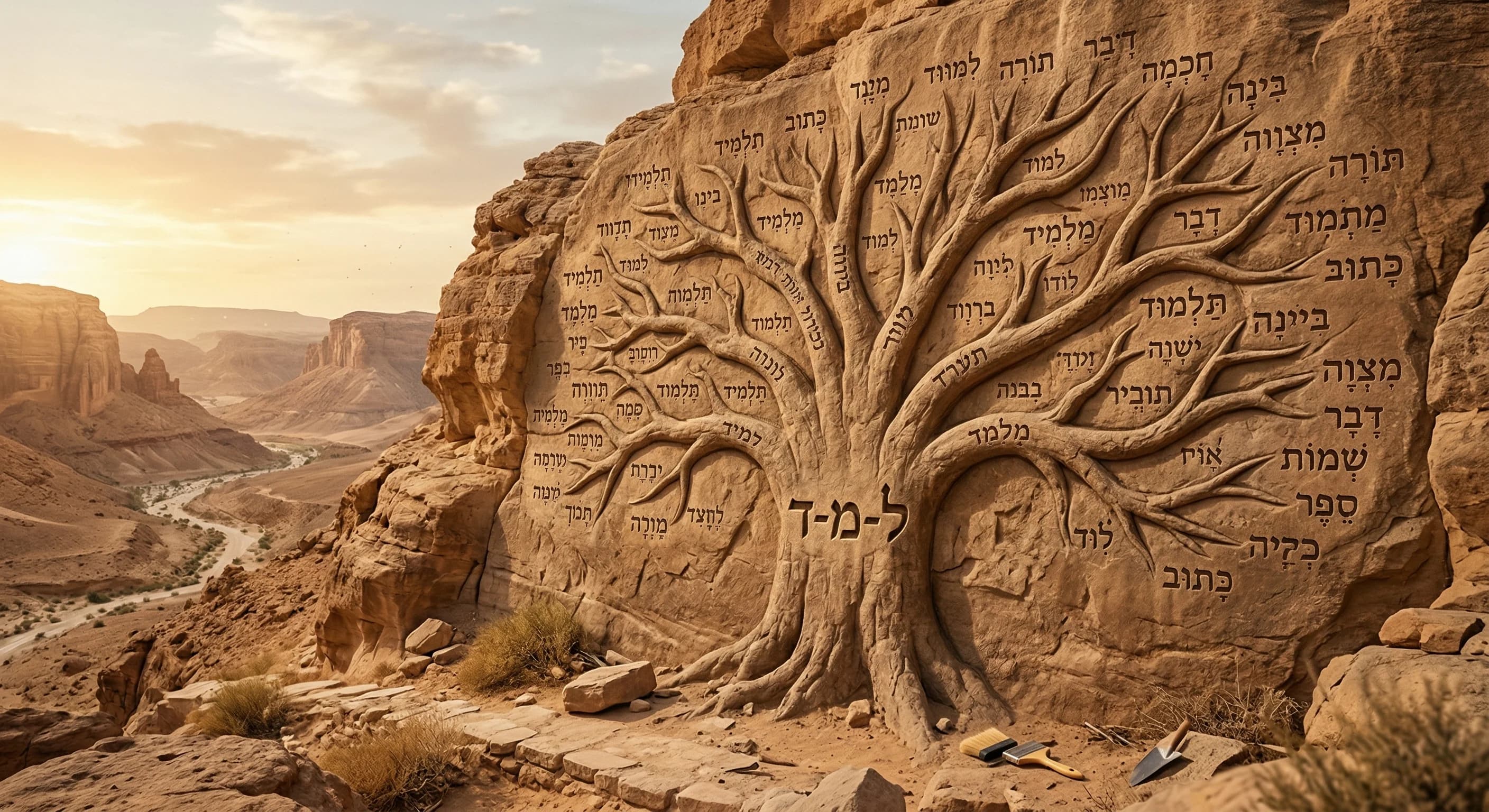
Root-Cognate Tree -- Word Family Visualization
See how a single ancient root word branches through Hebrew, Greek, Latin, Old English, and modern English in a visual tree. Trace the full journey of scriptural words from their earliest origins to the King James Bible.
What Is a Root-Cognate Tree?
A root-cognate tree is a visual diagram that shows how words in different languages are related through a common ancestor. Just as a family tree shows how people descend from shared ancestors, a cognate tree shows how words in Hebrew, Greek, Latin, Old English, and modern English branch from the same ancient root. Cognates are words in different languages that share a common etymological origin, even when they look and sound quite different on the surface.
Scripture study gains a remarkable dimension when you can see these word relationships visually. Take the English word 'holy,' for example: it traces back through Old English 'halig' to a Proto-Germanic root meaning 'whole' or 'uninjured.' Meanwhile, the Hebrew 'qadosh' (holy) comes from a root meaning 'set apart' or 'consecrated,' and the Greek 'hagios' carries the sense of 'sacred, devoted to God.' Each language reveals a different facet of holiness -- wholeness, separation, and sacred devotion -- and seeing them together in a single tree gives you a richer understanding than any one language alone.
For Latter-day Saints, tracing word families is particularly valuable because the Restoration draws on scripture written across thousands of years and multiple languages. The Old Testament's Hebrew, the New Testament's Greek, the Book of Mormon's English (translated from reformed Egyptian), and the Doctrine and Covenants' 19th-century English all use vocabulary that connects back to ancient roots. When you see how the word 'atonement' literally means 'at-one-ment' in English while the Hebrew 'kaphar' means 'to cover' and the Greek 'katallagé' means 'exchange' or 'reconciliation,' the doctrine of the Atonement opens up in ways that a single definition cannot achieve.
Latter-Day Daily's Root-Cognate Tree tool presents these word families as interactive branching visualizations. Each node on the tree shows a word in its language, its meaning, and where applicable its scripture references. Branches are color-coded by language -- Hebrew in amber, Greek in blue, Latin in rose, Old English and English in gold, Aramaic in purple, and Proto-Indo-European in green -- so you can instantly see how a word traveled through linguistic history to reach your English Bible.
How It Works
1
Search for a root word
Type any English, Hebrew, or Greek word to find its root-cognate tree. Browse the full list of available trees or search by meaning.
2
Explore the tree
Each tree displays the ancient root at the top, with branches flowing down through Hebrew, Greek, Latin, and English descendants. Expand or collapse branches to focus on specific paths.
3
Connect to scripture
Each word node that appears in scripture shows its verse references, letting you jump directly to passages where that cognate is used.
Key Features
Visual Branching Trees
Interactive tree diagrams show how a single root word branches across multiple languages, with color-coded nodes for each language family.
Multi-Language Coverage
Trees span up to seven language layers: Proto-Indo-European, Hebrew, Aramaic, Greek, Latin, Old English, and modern English.
Scripture References
Each word node links to its scripture occurrences, so you can see exactly where each cognate appears in the biblical text.
Searchable Index
Search the full collection of root-cognate trees by root word, meaning, or any descendant word in any language.
Frequently Asked Questions
What is a cognate in language study?
A cognate is a word in one language that shares a common etymological ancestor with a word in another language. For example, the English word 'mother,' the Latin 'mater,' the Greek 'meter,' and the Sanskrit 'matar' are all cognates descending from the same Proto-Indo-European root. In scripture study, recognizing cognates helps you understand how the same concept was expressed across the biblical languages.
How does tracing word roots help with Bible study?
Tracing word roots reveals meaning that a single translation hides. When you see that 'atonement' in English means 'at-one-ment' (reconciliation), while the Hebrew concept 'kaphar' means 'to cover' and the Greek 'katallagé' means 'exchange,' you gain three complementary views of the same doctrine. This multi-lingual perspective is especially valuable for Latter-day Saints who study the Atonement across multiple volumes of scripture.
What languages are included in the root-cognate trees?
The trees can include up to seven language layers: Proto-Indo-European (the theoretical ancestor of most European and some Asian languages), Hebrew, Aramaic, Greek, Latin, Old English, and modern English. Not every tree includes all layers -- the branches shown depend on the actual historical path each word family traveled.
Can I use this tool for Book of Mormon word study?
Yes. While the Book of Mormon text is in English, many of its key theological terms -- faith, repentance, covenant, atonement, grace -- have deep roots in Hebrew and Greek. The Root-Cognate Tree tool lets you trace those English words back to their ancient origins, enriching your understanding of the concepts the Book of Mormon teaches.
What is Proto-Indo-European and why does it appear in the trees?
Proto-Indo-European (PIE) is the reconstructed ancestral language from which most European languages and many Asian languages descend. It was likely spoken around 4500-2500 BC. PIE roots appear at the top of many cognate trees because they represent the oldest recoverable form of a word family. Seeing the PIE root helps you understand the most ancient layer of meaning beneath the English words you read in scripture.
Start Using Root-Cognate Tree
Full access to Root-Cognate Tree and 40+ other study tools.
Starting at $7/mo or $69.99/yr
Already have an account? Sign in