The Names of God in the Old Testament -- Hebrew Origins and Meaning
Key Takeaway
Each name God uses in the Old Testament reveals something about His nature, His covenant relationship with Israel, and the premortal role of Jesus Christ. The Hebrew tells us what the English cannot.
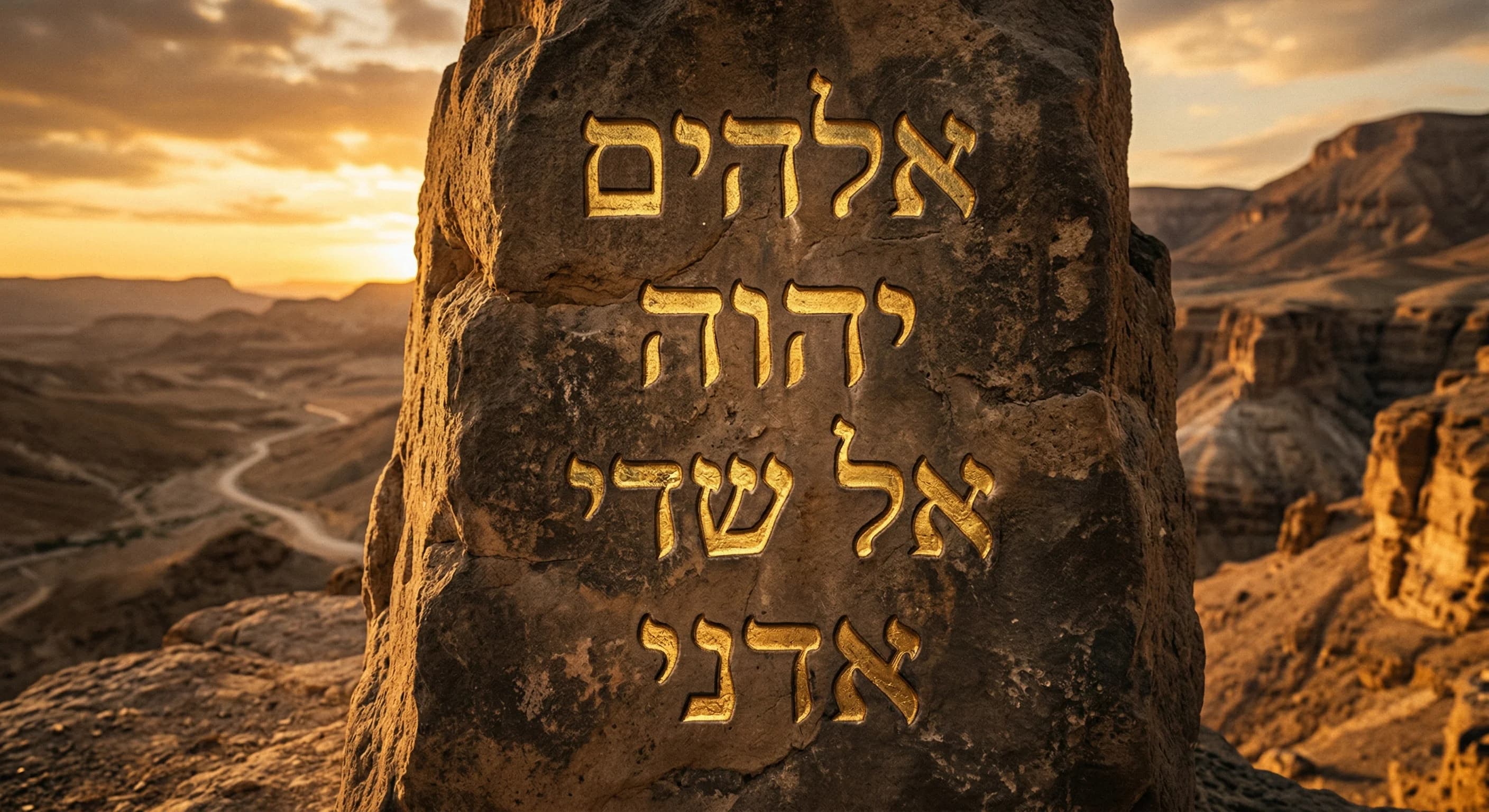
The Old Testament does not use a single name for God. It uses many, and the variation is not random. Each name surfaces in specific contexts, carries distinct theological weight, and reveals a different facet of the divine character. English translations flatten most of this -- rendering nearly everything as "God" or "LORD" -- but the Hebrew text preserves distinctions that matter enormously for serious scripture study and for Latter-day Saint theology in particular.
The most common name is Elohim, appearing over 2,500 times in the Hebrew Bible. Grammatically, Elohim is a plural noun -- the "-im" suffix is the standard Hebrew masculine plural -- yet it consistently takes singular verbs when referring to Israel's God. This grammatical tension has generated centuries of scholarly debate. Some argue it is a "plural of majesty," akin to the royal "we." Others see in it an echo of the divine council, the assembly of heavenly beings referenced in Psalm 82 and Job 1. For Latter-day Saints, the plural form resonates with the understanding that Elohim refers to God the Father and that the Godhead comprises distinct beings who act in unified purpose. The root of Elohim is "el," meaning "mighty one" or "power," so the name itself communicates divine strength and authority.
The most sacred name in the Hebrew Bible is the Tetragrammaton: YHWH, four consonants that appear nearly 7,000 times in the Old Testament. By at least the Second Temple period, Jews ceased pronouncing the name aloud out of reverence, substituting "Adonai" (my Lord) when reading scripture. The vowels of Adonai were later inserted into the consonants YHWH by Masoretic scribes, producing the hybrid form "Jehovah" -- a name that is linguistically artificial but theologically significant. The King James Version renders YHWH as "LORD" in small capitals, a convention most readers never notice. The name itself derives from the Hebrew root "hayah," meaning "to be" or "to exist." When Moses asks God's name at the burning bush, the answer in Exodus 3:14 is "Ehyeh Asher Ehyeh" -- often translated "I AM THAT I AM" but more precisely rendered "I will be what I will be." The name is not a static label. It is a declaration of active, ongoing presence: I am the one who is here, who was here, who will continue to be here.
Free Scripture Study Tools
Explore the scriptures with Latter-Day Daily
Interlinear readers, word studies, timeline, maps, Come Follow Me guides, and 40+ more tools — all free.
Start for freeFor Latter-day Saint readers, the identification of Jehovah (YHWH) as the premortal Jesus Christ is foundational. This doctrine, taught explicitly in the scriptures and confirmed in the 1916 First Presidency statement "The Father and The Son," means that every Old Testament appearance of YHWH -- speaking to Abraham, leading Israel through the wilderness, thundering from Sinai -- is an encounter with the premortal Christ. Abraham 2:8 makes this explicit: "My name is Jehovah, and I know the end from the beginning." When Isaiah writes "Immanuel" in Isaiah 7:14, meaning "God with us," the name carries a double weight: YHWH, the God who is present, will literally be present among His people in the flesh.
Adonai, meaning "my Lord" or "my Master," is a relational name. It acknowledges not merely that God is powerful but that He has authority over the speaker. The suffix "-ai" is a first-person possessive: my Lord. When Isaiah uses Adonai in his prophetic call -- "I saw Adonai sitting upon a throne, high and lifted up" (Isaiah 6:1) -- the name emphasizes sovereignty and the prophet's submission to divine authority. In later Jewish tradition, Adonai became the standard spoken substitute for YHWH, which means that every synagogue reading of the Torah reinforced the concept of God as personal master and sovereign lord.
El Shaddai appears in Genesis 17:1, where God introduces Himself to Abraham: "I am the Almighty God; walk before me, and be thou perfect." The Hebrew behind "Almighty" is "Shaddai," and its etymology is debated. Some scholars link it to the Akkadian "shadu" (mountain), giving the sense of "God of the Mountain" -- the immovable, unshakeable deity. Others connect it to the Hebrew "shad" (breast), suggesting "God who nourishes" or "God who sustains." The Septuagint translators rendered it as "Pantokrator" (All-Ruler), which is the word that survives into the New Testament book of Revelation. For Abraham, receiving this name at the moment of covenant making was significant: the God who makes promises is the God who has the power to fulfill them, whether that power is understood as mountainous strength or nurturing provision.
El Elyon, "God Most High," first appears in Genesis 14:18-22 in the enigmatic story of Melchizedek, king of Salem, who blesses Abraham in the name of "El Elyon, possessor of heaven and earth." Psalm 91:1-2 pairs the name with shelter and refuge: "He that dwelleth in the secret place of the most High shall abide under the shadow of the Almighty." The name positions God above all other powers -- above the gods of the nations, above the members of the divine council, above every rival claim to authority. In a polytheistic ancient Near East, this was not merely devotional language; it was a theological assertion that Israel's God occupied the supreme position in the cosmic hierarchy.
The name that perhaps carries the most philosophical weight is Ehyeh Asher Ehyeh, the self-identification God gives to Moses from the burning bush in Exodus 3:14. The standard English translation, "I AM THAT I AM," makes it sound like a statement about existence. But the Hebrew verb "hayah" is more dynamic than the English "to be." It connotes becoming, happening, being present in an active sense. God is not telling Moses about metaphysical existence; He is telling Moses about relationship. The sense is closer to: "I will be present with you as I will be present with you." It is a promise of presence before it is a statement of ontology. For a people about to enter the most harrowing chapter of their national story -- the plagues, the exodus, the wilderness -- the assurance that God will be actively present mattered more than an abstract definition of divinity.
Understanding these names transforms Old Testament reading. When Genesis shifts between Elohim and YHWH, the change often signals a shift in theological emphasis -- from God as cosmic creator to God as covenant partner. When a psalm addresses El Elyon, it is reaching for the highest possible frame of reference. When a prophet invokes Adonai, the posture is one of surrender and obedience. These are not interchangeable labels. They are a vocabulary of relationship, and the Hebrew preserves distinctions that English-speaking readers would never guess existed. Tools that surface the original language alongside the translation allow readers to see which name is being used in any given verse and to ask what that choice reveals about the passage's meaning.
Go deeper with Latter-Day Daily
40+ free tools for scripture study: interlinear Hebrew & Greek, word origins, Come Follow Me, maps, timelines, and more.
Related Study Tools
Etymology Explorer
Trace the Hebrew roots of God's names to uncover layers of theological meaning.
Names of Christ
Explore over 80 names and titles of Jesus Christ across all five volumes.
Interlinear Reader
Read scripture with the original Hebrew displayed alongside the English translation, word by word.
Related Posts
Genesis 24-33 Study Guide -- "Let God Prevail" (Jacob and Esau)
Jacob's story is the story of transformation. From the scheming supplanter who stole a birthright to the man who wrestled with God and became Israel, Genesis 24-33 shows that God works with imperfect people.
Genesis 42-50 Study Guide -- "God Meant It unto Good"
Joseph's reunion with his brothers and his declaration -- "ye thought evil against me; but God meant it unto good" -- is one of the Old Testament's most powerful statements of divine providence.
Genesis 12-17, Abraham 1-2 Study Guide -- "The Abrahamic Covenant"
The Abrahamic covenant -- land, posterity, and priesthood blessing -- is the backbone of the entire Old Testament. Abraham 1-2 restores the personal story behind the covenant's most important recipient.
Weekly scripture insights
Get study guides delivered to your inbox each week.