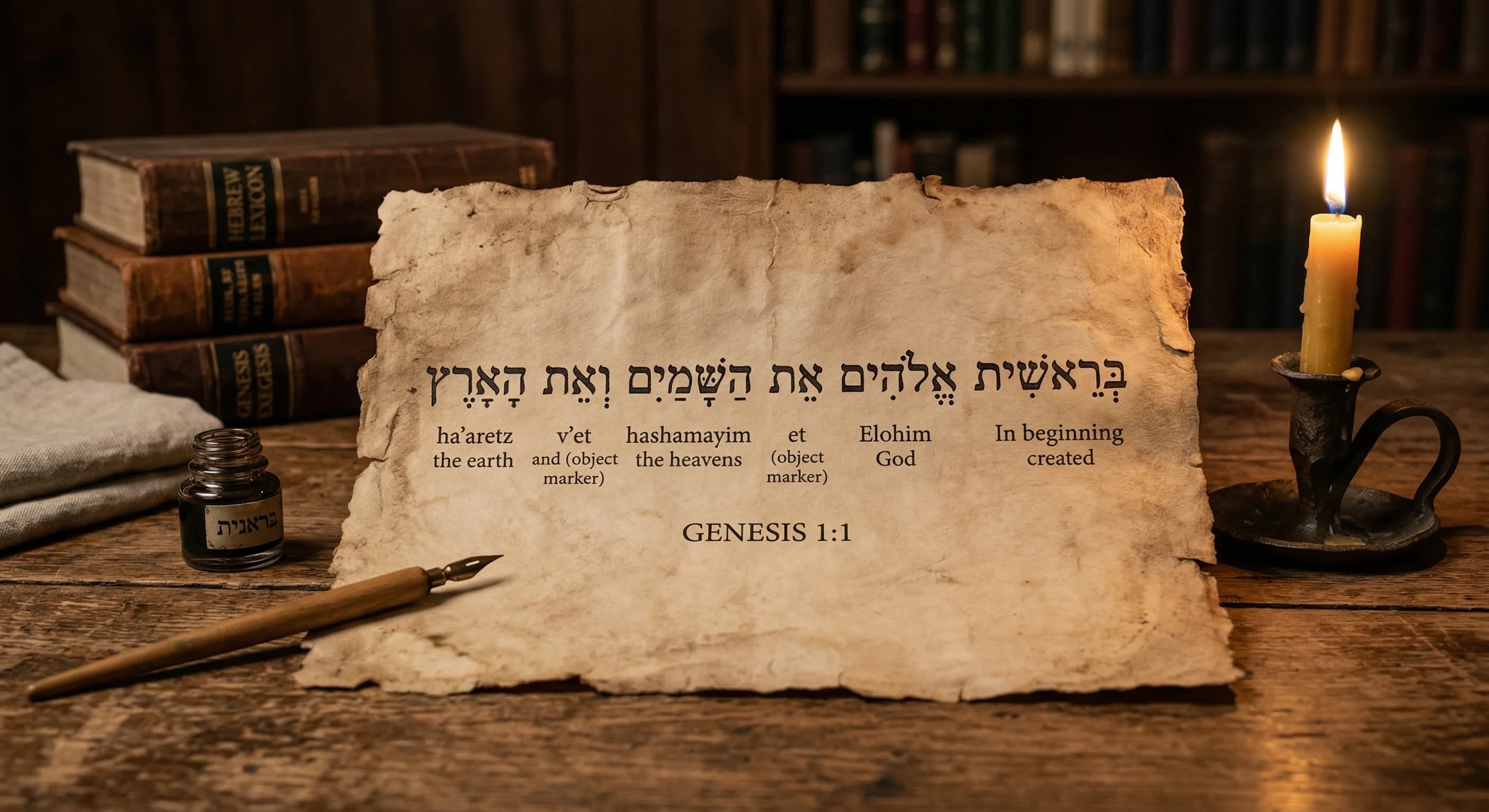
Genesis 1:1 in Hebrew -- A Word-by-Word Interlinear Analysis
Key Takeaway
Seven Hebrew words open the entire Bible. Breaking down Genesis 1:1 word by word reveals theological depths that no English translation can fully convey -- from the plural elohim to the creative verb bara.
Seven words in Hebrew open the entire biblical narrative. They are among the most analyzed, debated, and consequential words ever written: "Bereshit bara Elohim et hashamayim ve'et ha'aretz." In the King James Version, they become: "In the beginning God created the heaven and the earth." The English is majestic. The Hebrew is richer. Every word in this opening sentence carries theological weight that a careful reading can recover, and for Latter-day Saints, the Restoration's parallel creation accounts in Moses 2 and Abraham 4 add layers of meaning that make this verse one of the most rewarding in all of scripture to study at the word level.
"Bereshit" is the first word of the Bible and the Hebrew name for the entire book of Genesis. It is built from two elements: the prefix "be" (in, at, with) and "reshit" (beginning, first, chief). The root of reshit is "rosh," meaning head -- the same word that appears in "Rosh Hashanah" (head of the year). So bereshit does not merely mean "in the beginning" in a temporal sense. It carries connotations of primacy, of the chief thing, of the head of all that follows. Some scholars translate it as "In the beginning of" -- making it a construct form that would read "In the beginning of God's creating..." This grammatical reading is reflected in many modern translations and changes the verse from a statement about absolute origins to a statement about the beginning of a process. For Latter-day Saints, who understand creation as organization of existing matter rather than creation from nothing (ex nihilo), that distinction is significant. Abraham 4:1 reads "they went down at the beginning, and they, that is the Gods, organized and formed the heavens and the earth" -- a phrasing that aligns more closely with the construct reading of bereshit.
"Bara" is the verb, and it deserves close attention. In the Hebrew Bible, bara is used exclusively with God as its subject. Human beings never bara anything. The verb describes a divine creative act that has no precise human parallel. This has led many theologians to argue that bara implies creation from nothing -- since only God can do it, it must refer to something only God can do. But the lexical evidence is more nuanced. Bara appears in contexts where the raw material clearly pre-exists: in Isaiah 43:1, God bara the nation of Israel -- not from nothing, but from the descendants of Jacob. In Isaiah 65:18, God bara Jerusalem "a rejoicing" -- transforming its character, not producing it from the void. The verb emphasizes the divine agency and the newness of the result, not necessarily the absence of prior material. Abraham 4:1 uses "organized and formed" where Genesis 1:1 uses bara, and this is not a correction of the biblical text but an interpretation that the Hebrew itself can support. Bara is a divine verb of transformation and ordering, and the Restoration's reading falls within its semantic range.
Free Scripture Study Tools
Explore the scriptures with Latter-Day Daily
Interlinear readers, word studies, timeline, maps, Come Follow Me guides, and 40+ more tools — all free.
Start for free"Elohim" is the word translated "God," and it is grammatically plural. The "-im" suffix in Hebrew marks a masculine plural noun, just as "seraphim" is the plural of "seraph" and "cherubim" is the plural of "cherub." The verb bara, however, is grammatically singular -- "he created," not "they created." This mismatch has generated centuries of commentary. Traditional Jewish and Christian theology explains it as a plural of majesty or intensity: God is so great that a singular noun is insufficient. Some scholars see it as a vestige of earlier polytheistic usage absorbed into Israelite monotheism. For Latter-day Saints, the plural form of Elohim resonates with the Restoration's teaching of a Godhead consisting of separate, distinct beings. Abraham 4 makes the plurality explicit: "the Gods" organized the heavens and the earth. The Hebrew plural in Genesis 1:1 does not prove the Latter-day Saint reading, but it is consistent with it in a way that the traditional monotheistic explanation must work harder to accommodate.
"Et" is the direct object marker, a small word with no English equivalent. It has no meaning of its own -- it simply signals that what follows is the direct object of the verb. But in Jewish mystical tradition, the word et (spelled aleph-tav) has been invested with enormous significance because aleph is the first letter of the Hebrew alphabet and tav is the last. "Et hashamayim ve'et ha'aretz" -- God created aleph-to-tav, the heavens and aleph-to-tav the earth. Everything from first to last. The parallel in Revelation 1:8 -- "I am Alpha and Omega, the beginning and the ending" -- uses the first and last letters of the Greek alphabet to make an equivalent claim. Whether the author of Genesis intended this connection is debatable, but the textual resonance is striking: the first sentence of the Bible contains, in its direct object markers, an implicit claim about the totality of divine creation.
"Hashamayim" (the heavens) and "ha'aretz" (the earth) form a merism -- a figure of speech in which two opposite or complementary terms are used to express totality. "Heaven and earth" means everything: the visible and the invisible, the above and the below, the entire created order. The definite article "ha" (the) on both nouns is noteworthy. God did not create "a heaven" and "an earth" -- He created the heaven and the earth, the specific, definitive cosmic order. Shamayim is itself a dual or plural form (the "-ayim" ending), suggesting "the heights" or "the upper waters," which connects to the cosmology of verse 2 where the Spirit of God moves upon the face of the waters. Ha'aretz -- the earth, the land, the ground -- will become the word for the Promised Land throughout the Hebrew Bible, linking creation to covenant geography.
Verses 2 and 3 extend the picture. "Ve'ha'aretz hayetah tohu vavohu" -- "and the earth was without form, and void." Tohu vavohu is one of the most evocative phrases in Hebrew, describing primordial chaos, emptiness, and formlessness. It appears only twice more in the Hebrew Bible (Isaiah 34:11, Jeremiah 4:23), both times describing divine judgment that reduces a land to pre-creation chaos. The creation narrative, then, is not a story of production from nothingness but of ordering from chaos -- a reading that again aligns with Abraham 4:2: "the earth, after it was formed, was empty and desolate." The Spirit of God (ruach Elohim) moves upon the face of the deep (tehom), and then comes the first divine speech act: "Yehi or" -- "Let there be light." The verb is jussive, expressing a command or wish: "Let light exist." And it does. "Vayehi or" -- "And light existed." The symmetry of yehi/vayehi -- the command and its fulfillment in the same verbal root -- is the foundation of the entire creation pattern that follows. God speaks, and reality conforms.
For Latter-day Saints, reading Genesis 1:1-3 alongside Moses 2:1-5 and Abraham 4:1-5 reveals not a contradiction but a conversation between texts. Moses emphasizes the role of the Only Begotten ("by mine Only Begotten I created these things"), while Abraham emphasizes the collaborative council of the Gods. Neither replaces Genesis; both deepen it. And the Hebrew words themselves -- bereshit, bara, Elohim, tohu vavohu, ruach, or -- remain the foundation on which all three accounts build. Learning to read those seven opening words is not just a linguistic exercise. It is an entry point into the deepest questions scripture asks: who God is, what creation means, and what our place in the ordered cosmos might be.
Go deeper with Latter-Day Daily
40+ free tools for scripture study: interlinear Hebrew & Greek, word origins, Come Follow Me, maps, timelines, and more.
Related Study Tools
Interlinear Reader
Read scripture with the original Hebrew or Greek displayed alongside the English text, word by word.
Hebrew Alphabet
Learn the twenty-two letters of the Hebrew alphabet and begin recognizing words in their original form.
Etymology Explorer
Trace any scriptural word back to its Hebrew or Greek roots to uncover layers of meaning.
Related Posts
Genesis 24-33 Study Guide -- "Let God Prevail" (Jacob and Esau)
Jacob's story is the story of transformation. From the scheming supplanter who stole a birthright to the man who wrestled with God and became Israel, Genesis 24-33 shows that God works with imperfect people.
Genesis 42-50 Study Guide -- "God Meant It unto Good"
Joseph's reunion with his brothers and his declaration -- "ye thought evil against me; but God meant it unto good" -- is one of the Old Testament's most powerful statements of divine providence.
Genesis 12-17, Abraham 1-2 Study Guide -- "The Abrahamic Covenant"
The Abrahamic covenant -- land, posterity, and priesthood blessing -- is the backbone of the entire Old Testament. Abraham 1-2 restores the personal story behind the covenant's most important recipient.
Weekly scripture insights
Get study guides delivered to your inbox each week.