Root-Cognate Tree -- How Word Families Reveal Connections Across Languages
Key Takeaway
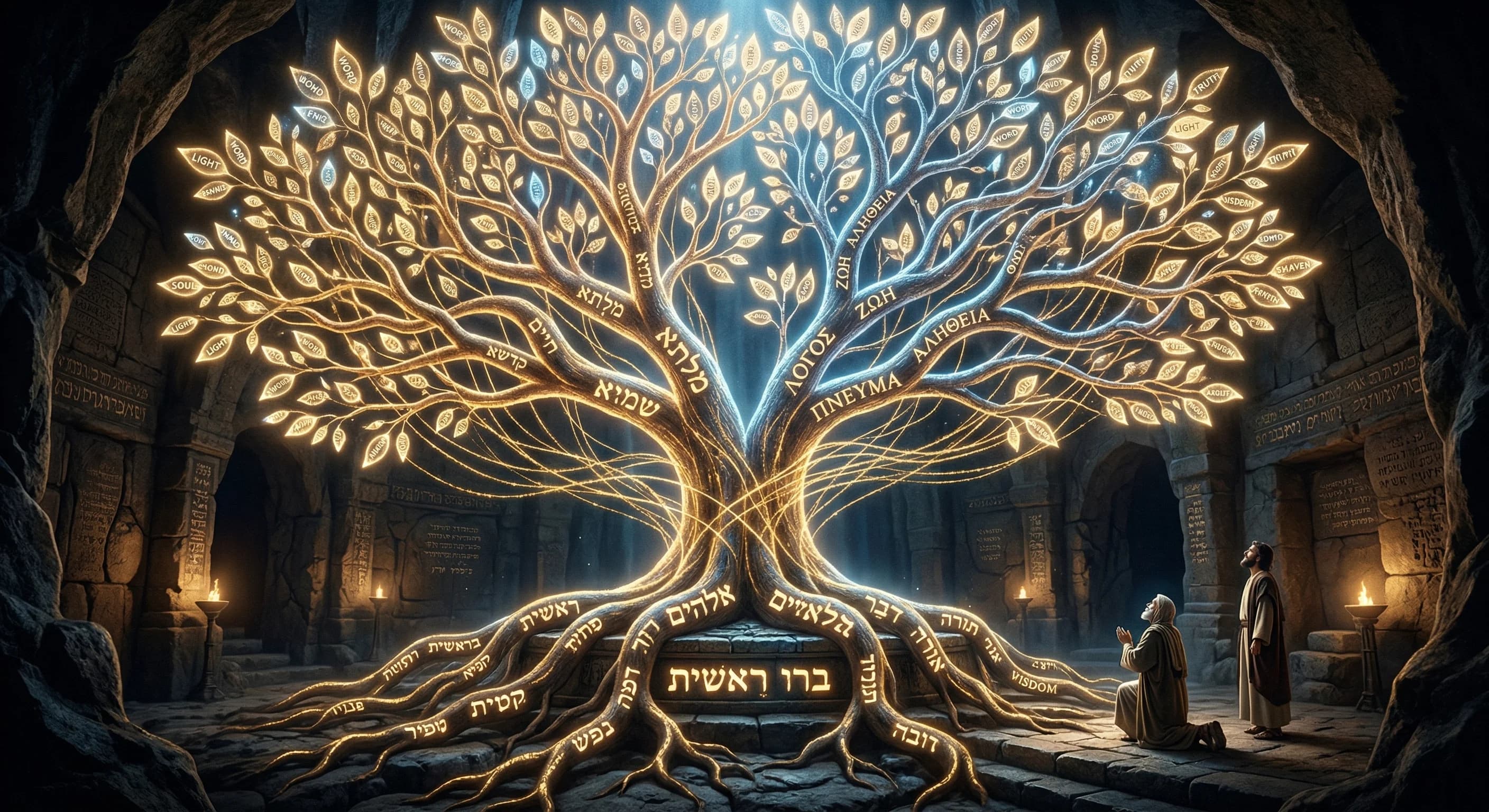
Words do not exist in isolation. They belong to families. The Root-Cognate Tree visualizes how a single root branches into related words across Hebrew, Aramaic, and Greek, revealing connections that deepen your understanding of scripture.
Words do not exist in isolation. They belong to families, sharing roots that carry core meanings across dozens of derived forms. The Root-Cognate Tree visualizes these family relationships, showing how a single Hebrew or Greek root branches into nouns, verbs, adjectives, and related terms -- sometimes even crossing into Aramaic and other Semitic languages. The result is a map of meaning that enriches every passage where those words appear.
Take the Hebrew root "q-d-sh," which carries the core meaning of "set apart" or "holy." From this single root grow "qadosh" (holy), "qodesh" (holiness, sanctuary), "miqdash" (temple), "qiddush" (sanctification), and "qadesh" (one who is consecrated). When you see this family tree, passages light up across the entire Old Testament. God's command to Israel -- "Ye shall be holy, for I the Lord your God am holy" (Leviticus 19:2) -- is not an abstract moral instruction. It is a call to be "qadosh," set apart in the same way that the "miqdash" (temple) is set apart. The temple and personal holiness share the same root because they share the same essential nature. For Latter-day Saints, this connection between personal holiness and temple worship resonates with the Restoration's emphasis on temple ordinances as the means of sanctification.
The cognate tree also reveals cross-language connections. The Hebrew "mashiach" (anointed one) and the Greek "christos" (Christ) are not the same word, but they translate the same concept. The tree shows both branches growing from the act of anointing -- Hebrew "mashach" and Greek "chrio" -- and traces where each term appears in its respective testament. When Daniel 9:25-26 prophesies the coming of "mashiach nagid" (the anointed prince) and the New Testament identifies Jesus as "christos," the cognate tree makes the linguistic bridge visible and concrete.
Free Scripture Study Tools
Explore the scriptures with Latter-Day Daily
Interlinear readers, word studies, timeline, maps, Come Follow Me guides, and 40+ more tools — all free.
Start for freeAramaic cognates add another layer. Parts of Daniel and Ezra are written in Aramaic, not Hebrew, and Aramaic shares many roots with Hebrew but sometimes shifts the meaning. The Aramaic "bar" (son) corresponds to the Hebrew "ben," and when Jesus refers to himself as "bar enash" (Son of Man) in the tradition behind the Greek "huios tou anthropou," the Aramaic resonance reaches back to Daniel 7:13, where "one like a bar enash" comes before the Ancient of Days. The Root-Cognate Tree makes these cross-language connections navigable, turning what would otherwise require years of seminary training into an accessible visual exploration.
Go deeper with Latter-Day Daily
40+ free tools for scripture study: interlinear Hebrew & Greek, word origins, Come Follow Me, maps, timelines, and more.
Related Study Tools
Related Posts
Latter-day Saints vs. Seventh-day Adventists: Beliefs and Practices
Latter-day Saints and Seventh-day Adventists are both 19th-century American religious movements with emphasis on health, scripture study, and distinctive lifestyle practices.
Chiasmus in the Book of Mormon -- A Complete Guide to Inverted Parallelism
Chiasmus is one of the most compelling literary patterns in the Book of Mormon. Understanding how inverted parallelism works transforms how you read Alma, Mosiah, and the entire Nephite record.
Chiastic Structures: The Hidden Mirror Patterns Woven Through Scripture
Ancient Hebrew writers structured their most important messages in chiastic patterns -- ideas arranged in a mirror structure that pivots around a central theme. The Book of Mormon contains some of the most elaborate chiasms ever documented, and you can explore them visually on Scripture Deep.
Weekly scripture insights
Get study guides delivered to your inbox each week.