Book of Mormon and Old Testament: Parallel Passages and Hidden Connections
Key Takeaway
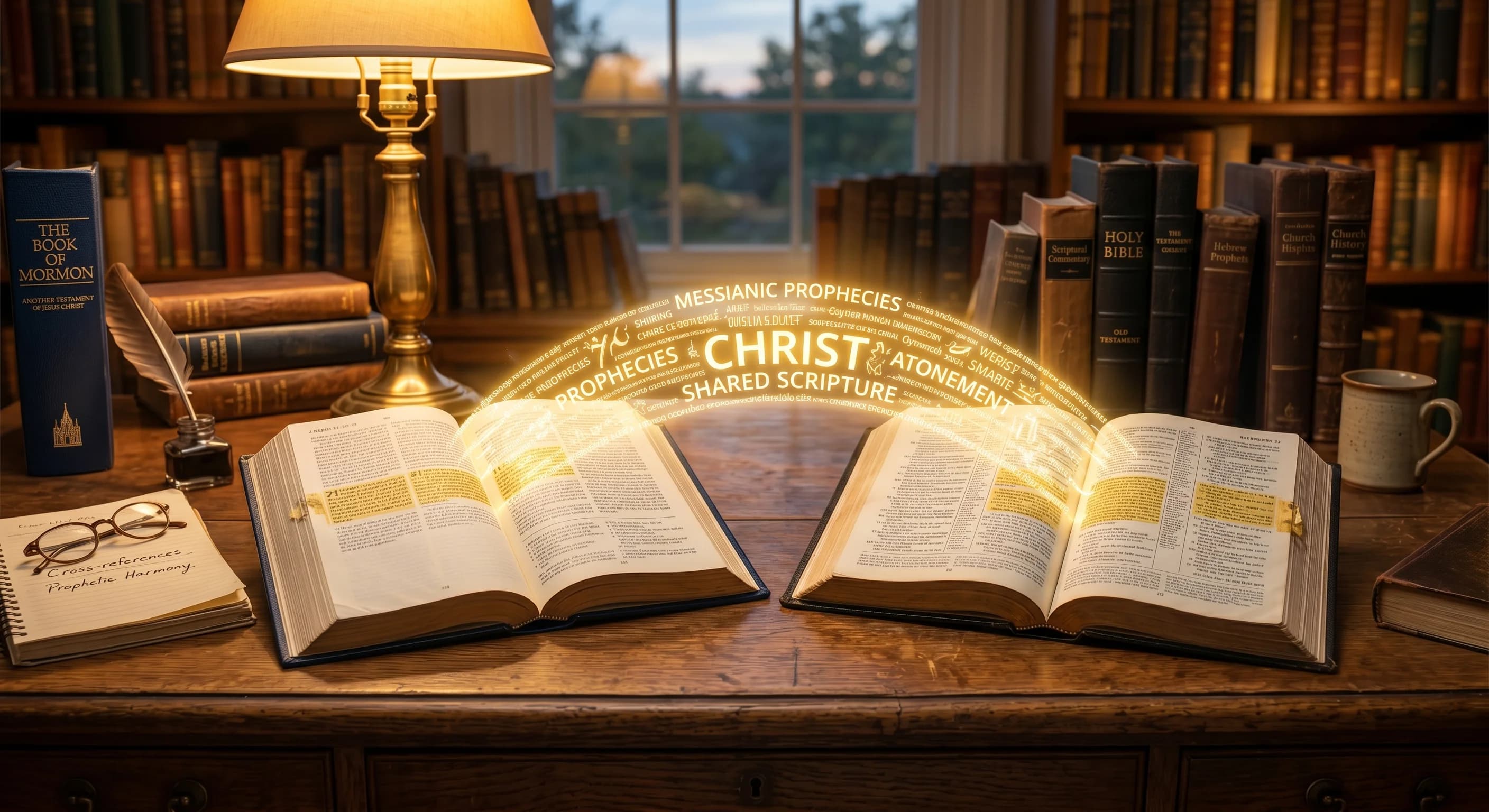
The Book of Mormon and the Old Testament are in constant dialogue. Nephi, Jacob, Abinadi, and other prophets quote, apply, and interpret Old Testament texts in ways that clarify both volumes and reveal what the original Hebrew contained.
The Book of Mormon is often studied as a standalone volume, but it is impossible to fully understand without the Old Testament. Nephi, Jacob, Abinadi, and numerous other prophets were steeped in the Hebrew scriptures -- they quoted Isaiah extensively, applied Mosaic covenant categories, and interpreted their own experiences through Old Testament frameworks. Understanding how the Book of Mormon uses the Old Testament does two things simultaneously: it deepens your reading of the Book of Mormon, and it reveals what the Old Testament authors originally meant.
The Brass Plates as Hebrew Bible
The book that Nephi retrieves from Laban contains "the scriptures" available to Lehi's family -- roughly equivalent to the Old Testament through the time of Jeremiah (approximately 600 BC), including many writings "which were not found in the record of the Jews" (1 Nephi 13:23). The Brass Plates contained "the five books of Moses," the "record of the Jews, and also a genealogy of his forefathers" and "the prophecies of many prophets, down to the commencement of the reign of Zedekiah" (1 Nephi 5:11-13). This is essentially the Old Testament plus additional prophetic writings lost from the Hebrew Bible.
Free Scripture Study Tools
Explore the scriptures with Latter-Day Daily
Interlinear readers, word studies, timeline, maps, Come Follow Me guides, and 40+ more tools — all free.
Start for freeNephi's direct access to this text explains why he quotes Isaiah so freely and interprets it with such confidence -- he was reading from a Hebrew source that preserved Isaiah more completely than the texts available to later translators. This may explain some differences between the Isaiah chapters in the Book of Mormon and the Masoretic text that underlies our current Hebrew Old Testament.
1 Nephi 20-21: Isaiah 48-49 with Differences
First Nephi 20 and 21 contain Isaiah 48 and 49, but with notable variations from the KJV. Most of these differences are small, but several are theologically significant. 1 Nephi 20:1 adds "or out of the waters of baptism" to a verse that in Isaiah reads only "which are called by the name of Israel" -- a restoration of plain and precious content clarifying that covenant identity is connected to ordinance. 1 Nephi 21:1 contains an entire phrase absent from Isaiah 49:1: "and me hath the Lord called from the womb; from the bowels of my mother hath he made mention of my name" -- a restoration of a phrase that appears to have been lost.
Mosiah 14: Abinadi's Isaiah 53
Abinadi quotes Isaiah 53 verbatim in Mosiah 14, then provides inspired commentary in Mosiah 15. His interpretation of the Suffering Servant passage is doctrinally illuminating -- he applies it specifically to Christ as both Father and Son, explaining how Christ is the "Father" of those who receive the gospel (Mosiah 15:10-11) while also being the Son of God. This is not a contradiction but a clarification: in one sense, Christ is Father because he has "begotten" the spiritually reborn through his atoning sacrifice; in another sense, he is Son because he is the offspring of the eternal Father.
2 Nephi 2: The Fall Reframed Through Genesis 3
Lehi's sermon to Jacob in 2 Nephi 2 is one of the most theologically sophisticated passages in the Book of Mormon, and it is essentially a commentary on Genesis 2-3. "Adam fell that men might be; and men are, that they might have joy" (2 Nephi 2:25) is a direct interpretation of the Fall narrative that no other tradition has offered. Where most Christian theology reads the Fall as catastrophe, 2 Nephi 2 reads it as necessary forward movement. The Hebrew "yada" (to know, Genesis 3:22) -- experiential, not merely intellectual knowledge -- makes this interpretation linguistically coherent: to "know good and evil" requires living in a world where both are real.
Alma 34: The Infinite Atonement and Levitical Sacrifice
Amulek's sermon in Alma 34 explains the necessity of an infinite atonement by contrasting it with the Levitical sacrificial system: "Now there is not any man that can sacrifice his own blood which will atone for the sins of another" (Alma 34:11). The Levitical system -- the entire sacrificial code of Leviticus -- was, as Amulek explains, a shadow pointing toward the one infinite sacrifice. Reading Leviticus with this Book of Mormon commentary in mind transforms every chapter of sacrificial law: every burnt offering, every sin offering, every wave offering is a rehearsal for the atonement it could not accomplish.
3 Nephi 24-25: Malachi 3-4 Restored
The resurrected Christ delivers the entire fourth and fifth chapters of Malachi verbatim to the Nephites (3 Nephi 24-25), declaring that these were not previously available to them. This is theologically significant: Malachi wrote his prophecies after Lehi's family left Jerusalem (Malachi is typically dated to approximately 430 BC, and Lehi left around 600 BC). The Book of Mormon's quotation of Malachi confirms its divine origin -- the resurrected Christ supplied scriptures the Nephites could not otherwise have had.
The Malachi passage includes the prophecy of Elijah's return (Malachi 4:5-6), which Moroni quotes to Joseph Smith in 1823. The connection from Malachi's pen to the Nephites' record to Moroni's visit to Joseph to the restoration of temple work creates a prophetic thread spanning 2,500 years.
Connections in Both Directions
The Book of Mormon illuminates the Old Testament, and the Old Testament illuminates the Book of Mormon. When you read Exodus and then read Mosiah -- where Limhi and Alma's people escape their respective Lamanite bondages -- you see the Exodus pattern operating as a conscious literary and theological framework. When you read Isaiah 6 (the seraphim, the coal, "Here am I") and then read Lehi's vision of the tree of life and Nephi's expanded interpretation (1 Nephi 11-14), you see a prophet who had meditated so deeply on Isaiah's temple vision that his own visions were shaped by it.
The two books are not simply corroborating witnesses -- they are in genuine dialogue, each reading the other, each illuminating dimensions that the other leaves in shadow. Studying them together, with attention to the specific passages each quotes and applies, reveals an integrated prophetic tradition that spans millennia and multiple continents.
Frequently Asked Questions
Go deeper with Latter-Day Daily
Interlinear Hebrew & Greek, word origins, Come Follow Me, maps, timelines, and 40+ more tools. Free to start — Scholar plan unlocks everything.
Related Study Tools
Parallel Passages
Compare Old Testament passages with their Book of Mormon quotations and variations side by side.
Scripture Connections
Find cross-references connecting Old Testament verses to Book of Mormon passages.
Interlinear Reader
Read Isaiah chapters in Hebrew and compare with the Book of Mormon's quotations.
Chiastic Structures
Find the Hebrew chiastic patterns preserved in Book of Mormon quotations of Isaiah.
Scripture Chains
Build chains connecting Old Testament covenant passages with their Book of Mormon fulfillments.
Related Posts
50 Archaic Bible Words Every Latter-day Saint Should Know
The King James Bible and the Book of Mormon share a vocabulary that has drifted far from modern usage. Knowing what these words actually meant in 1611 transforms how you read every chapter.
Hebrew Literary Patterns in the Book of Mormon: Evidence of Ancient Authorship
Chiasmus, Hebraisms, and Hebrew poetic structures that Joseph Smith could not have known in 1829 appear throughout the Book of Mormon. Understanding these patterns provides evidence of ancient Hebrew authorship and enriches the reading experience.
Chiasmus in the Book of Mormon -- A Complete Guide to Inverted Parallelism
Chiasmus is one of the most compelling literary patterns in the Book of Mormon. Understanding how inverted parallelism works transforms how you read Alma, Mosiah, and the entire Nephite record.
Weekly scripture insights
Get study guides delivered to your inbox each week.