Isaiah's Hebrew Poetry -- Parallelism, Wordplay, and Literary Art in the Prophets
Key Takeaway
Isaiah is poetry, not prose, and reading it as prose is like reading song lyrics as a legal brief. Recognizing the Hebrew literary structures transforms Isaiah from an opaque text into a work of deliberate, layered art.
More readers have given up on Isaiah than on any other book of scripture. The chapters are dense, the imagery is layered, and the syntax -- especially in the King James translation -- can feel impenetrable. But much of the difficulty disappears once you recognize a basic fact: Isaiah is poetry. Hebrew poetry operates by different rules than English poetry, and understanding those rules is the single most effective key to unlocking Isaiah's meaning.
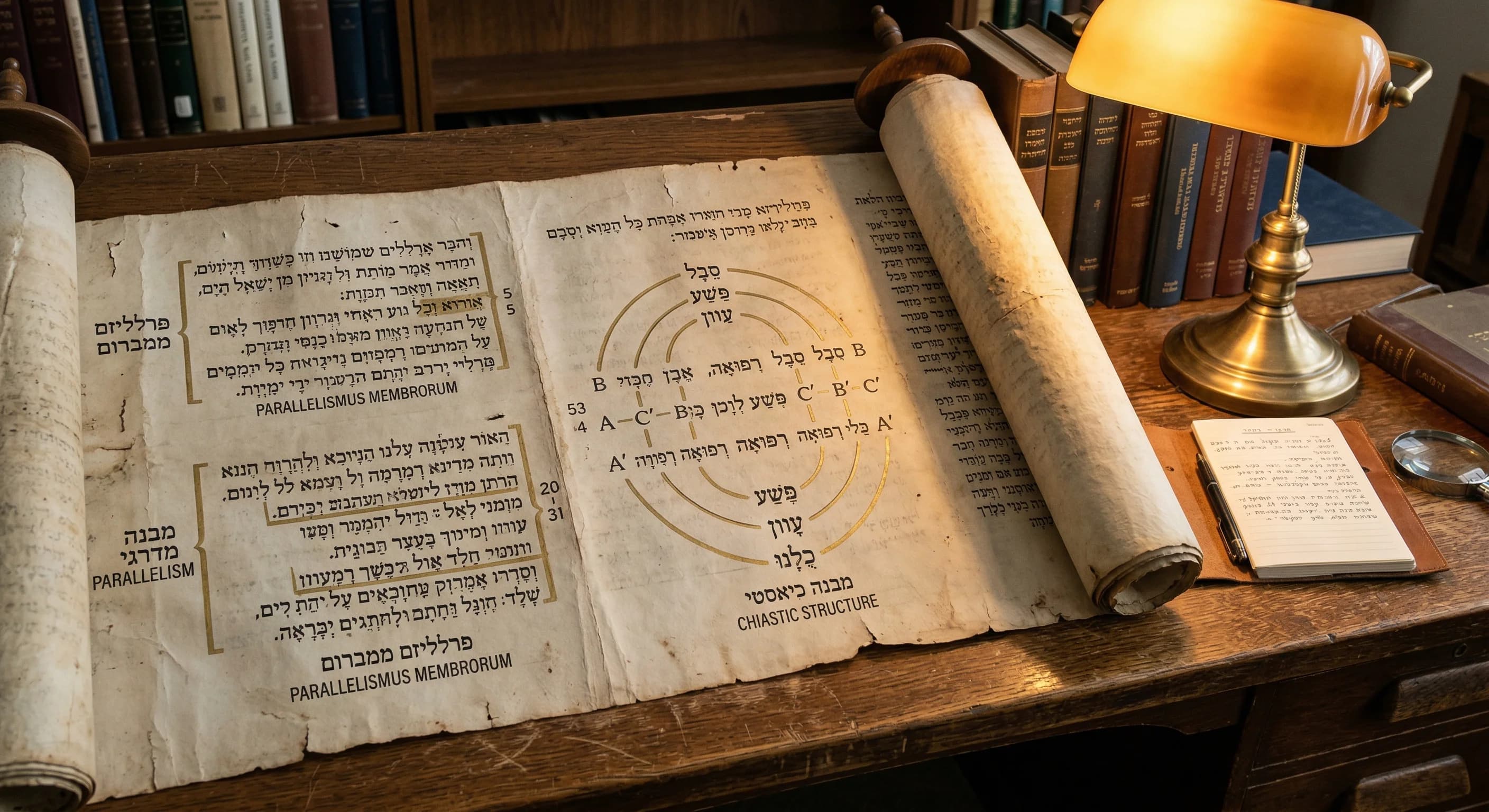
The foundational device of Hebrew poetry is parallelism -- the practice of saying something in one line and then saying it again, differently, in the next. Robert Lowth, an eighteenth-century bishop and scholar, first classified Hebrew parallelism into three types, and his categories remain useful nearly three centuries later. Synonymous parallelism says the same thing twice in different words. Isaiah 1:18 is a classic example: "Though your sins be as scarlet, they shall be as white as snow; though they be red like crimson, they shall be as wool." The second line restates the first with new imagery -- snow and wool instead of scarlet and crimson -- but the meaning is the same. The repetition is not redundancy. It is emphasis, intensification, and invitation. The reader is meant to hold both images simultaneously and let them illuminate each other.
Antithetic parallelism sets two lines in opposition, where the second line contrasts with or negates the first. Isaiah 55:8-9 is the prime example: "For my thoughts are not your thoughts, neither are your ways my ways, saith the LORD. For as the heavens are higher than the earth, so are my ways higher than your ways, and my thoughts than your thoughts." The contrast between divine and human thinking is stated and then expanded with a spatial metaphor -- the distance between heaven and earth. The parallelism forces the reader to feel the gap, not just acknowledge it intellectually. The literary structure is doing theological work: the form of the statement reinforces its content.
Free Scripture Study Tools
Explore the scriptures with Latter-Day Daily
Interlinear readers, word studies, timeline, maps, Come Follow Me guides, and 40+ more tools — all free.
Start for freeSynthetic (or constructive) parallelism builds across lines, with each line adding to or extending the idea of the previous one rather than restating or contrasting it. Isaiah 40:31 demonstrates this: "But they that wait upon the LORD shall renew their strength; they shall mount up with wings as eagles; they shall run, and not be weary; and they shall walk, and not faint." The progression moves from soaring to running to walking -- seemingly a descent in intensity, but actually an ascent in difficulty. It is easy to be spiritually exhilarated in a moment of revelation (mounting up); it is harder to sustain effort over time (running without weariness); it is hardest of all to endure the ordinary, daily grind without collapsing (walking without fainting). The synthetic parallelism builds toward the climax, which is not the most dramatic image but the most demanding one.
Beyond parallelism, Isaiah employs wordplay that is invisible in English but devastating in Hebrew. The most famous example is Isaiah 5:1-7, the Song of the Vineyard. God plants a vineyard (Israel), tends it carefully, and expects it to produce good grapes. Instead it produces wild, worthless fruit. The climax of the parable, in verse 7, turns on two Hebrew puns: God looked for "mishpat" (justice) but found "mispach" (bloodshed); He looked for "tsedaqah" (righteousness) but heard "tse'aqah" (a cry of distress). The words in each pair differ by a single consonant. In Hebrew, the puns are sharp and bitter -- God expected something that sounded almost exactly like what He got, but the difference between the two is the difference between a just society and a violent one. This wordplay cannot be translated into English. It can only be explained, and knowing that it exists changes how you read the passage. The prophet is not writing abstract theology. He is writing with the precision and bite of a satirist who knows that his audience will hear the puns and wince.
Isaiah also uses inclusio, a structural device in which a passage begins and ends with the same word, phrase, or image, creating a literary frame. Isaiah 1:2-20, for example, opens with a call to heaven and earth as witnesses and returns to the courtroom imagery of judgment throughout, forming a unified legal oracle. Recognizing the inclusio tells the reader where a unit begins and ends -- a crucial skill in Isaiah, where chapter divisions (added centuries later) often cut across the prophet's own literary structures. What looks like a disconnected series of oracles is frequently a carefully composed sequence held together by inclusio, keyword repetition, and thematic echoes.
Merismus is another device Isaiah uses regularly: stating two extremes to imply everything in between. When Isaiah 44:6 records God saying, "I am the first, and I am the last," the claim is not merely about chronology. It is a merismus asserting that God encompasses all of time -- first, last, and everything between. Similarly, "heaven and earth" in Isaiah's prophecies is a merismus for the entire created order. English readers who take these as literal, limited statements miss the rhetorical sweep. The Hebrew audience would have understood immediately that the extremes include the whole.
For Latter-day Saint readers, the presence of Isaiah's poetry in the Book of Mormon is significant. When Nephi quotes Isaiah extensively in 2 Nephi 12-24 (corresponding to Isaiah 2-14) and again in 2 Nephi 15 (Isaiah 5, the vineyard song), the poetic structures are preserved. The parallelism, the imagery, and in many cases the KJV wording are carried intact into the Nephite record. This matters because it means the brass plates -- the scriptural record Lehi's family carried from Jerusalem -- contained Isaiah's text in a form that preserved its literary artistry. When Nephi says, "My soul delighteth in the words of Isaiah" (2 Nephi 25:5), he is delighting not only in the prophecies but in the craft. Isaiah's message and his medium are inseparable.
Recognizing these structures changes how you read. A passage that seems repetitive is actually building an argument through synonymous parallelism. A passage that seems contradictory may be using antithetic parallelism to force a choice. A passage that seems to trail off may be using synthetic parallelism to build toward a climax in the final line, not the first. And a passage that seems disconnected may be held together by an inclusio that you missed because the chapter break fell in the middle of it.
Isaiah wrote for people who would hear his words read aloud in a culture that valued verbal artistry as a sign of prophetic authority. The literary structures are not ornamental. They are how the message works. Stripping them away by reading Isaiah as flat prose is like removing the melody from a song and reading the lyrics as a legal document. The meaning survives, but the power does not. Tools that highlight the poetic structures, surface the Hebrew wordplay, and map the parallel lines give modern readers access to what ancient audiences experienced naturally -- and they reveal an Isaiah who is not opaque but precise, not repetitive but relentless, and not difficult for the sake of difficulty but difficult because the truth he is communicating is that complex.
Go deeper with Latter-Day Daily
40+ free tools for scripture study: interlinear Hebrew & Greek, word origins, Come Follow Me, maps, timelines, and more.
Related Study Tools
Related Posts
How to Build a Daily Scripture Study Habit with Digital Tools
Consistency matters more than marathon sessions. Here is how to build a daily scripture study habit that actually sticks, using digital tools that meet you where you are.
Teaching Sunday School with Confidence: Tools That Make the Difference
Good Sunday School teaching is not about knowing every answer. It is about asking the right questions and letting the scriptures do the heavy lifting. Here is how to prepare lessons that spark real discussion.
50 Archaic Bible Words Every Latter-day Saint Should Know
The King James Bible and the Book of Mormon share a vocabulary that has drifted far from modern usage. Knowing what these words actually meant in 1611 transforms how you read every chapter.
Weekly scripture insights
Get study guides delivered to your inbox each week.