Translation Compare -- How Side-by-Side Bible Versions Reveal Hidden Nuance
Key Takeaway
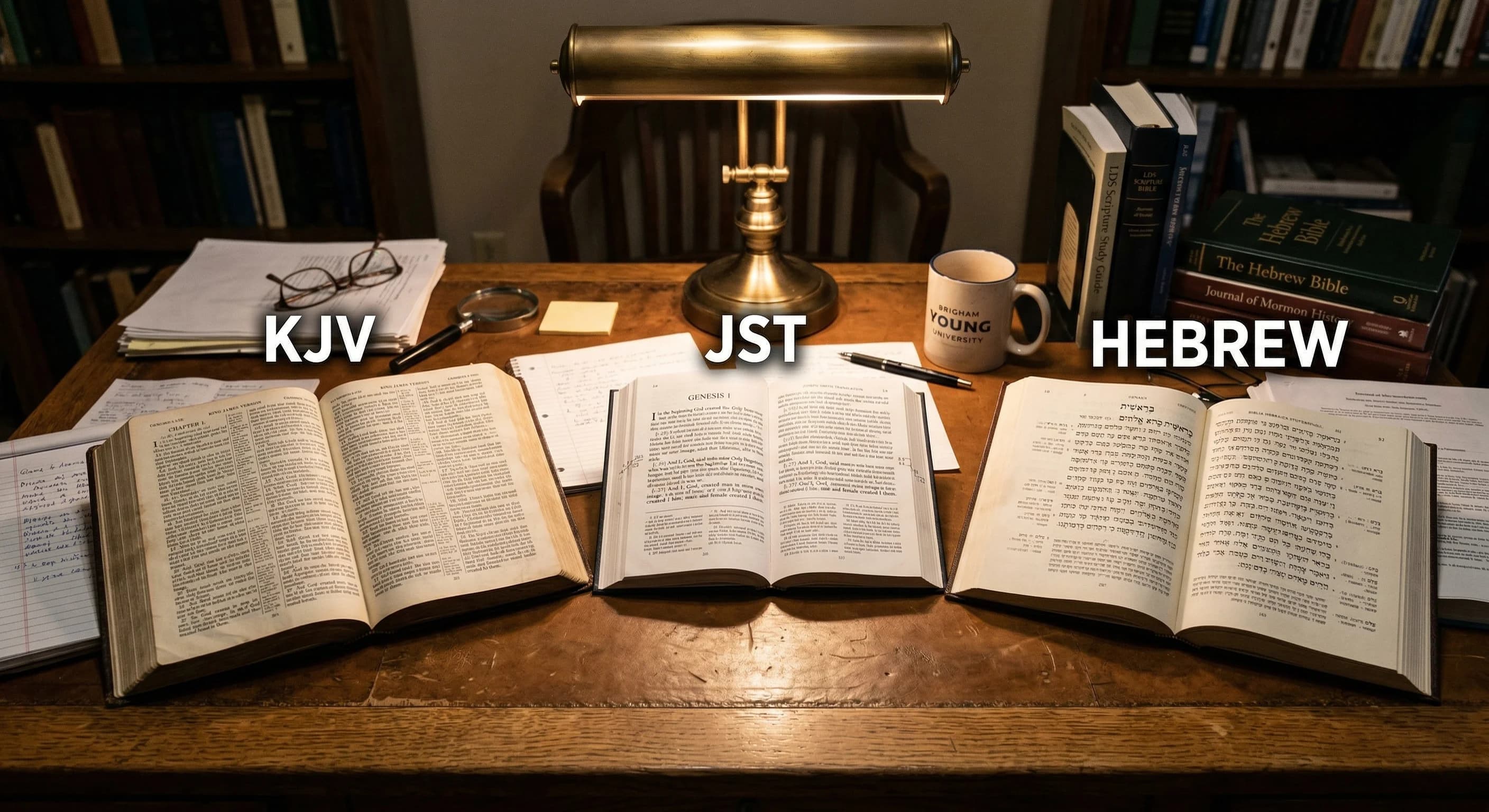
No single Bible translation captures every shade of meaning in the original text. Placing KJV, NIV, ESV, JST, Hebrew, and Greek side by side exposes choices translators made and the doctrinal weight those choices carry.
Every Bible translation is an act of interpretation. Translators must choose between literal fidelity to the source language and readability in the target language, and those choices shape how millions of readers understand God's word. Comparing translations side by side is not an exercise in finding fault with any one version -- it is a method for recovering the full range of meaning embedded in the original Hebrew and Greek.
Consider Isaiah 7:14. The KJV reads, "a virgin shall conceive," while the ESV and NIV also use "virgin." The Hebrew word, however, is "almah," which means "young woman" rather than the more specific "betulah" (virgin). The Septuagint translators chose the Greek "parthenos" (virgin), a decision that shaped centuries of Christian theology. The JST retains "virgin" but adds clarifying context that anchors the prophecy in its messianic fulfillment. Seeing all of these renderings at once reveals the layered history behind a single verse.
Another instructive example is Romans 3:25, where Paul writes about Christ as a "propitiation" (KJV and ESV) or "sacrifice of atonement" (NIV). The underlying Greek word, "hilasterion," also appears in the Septuagint as the translation of the Hebrew "kapporeth" -- the mercy seat atop the Ark of the Covenant. Paul was not simply describing a legal transaction; he was pointing his readers back to the Day of Atonement ritual in Leviticus 16. A single translation can obscure this connection, but a side-by-side comparison across languages brings it into focus.
Free Scripture Study Tools
Explore the scriptures with Latter-Day Daily
Interlinear readers, word studies, timeline, maps, Come Follow Me guides, and 40+ more tools — all free.
Start for freeThe Joseph Smith Translation adds another dimension that no other comparison tool can provide. In passages like Genesis 50 and Matthew 24, the JST does not merely correct wording -- it restores entire paragraphs of prophetic content. When you compare the KJV of Matthew 24:1 with the JST (Joseph Smith -- Matthew 1:1), the restructured text changes the flow of Christ's Olivet Discourse and clarifies which events pertain to the destruction of Jerusalem and which to the Second Coming.
Using Translation Compare regularly trains the eye to notice patterns: where the KJV preserves a more literal reading, where modern translations clarify grammar, and where the JST adds Restoration-specific doctrine. Over time, this practice turns casual readers into students who instinctively ask, "What does the original say?" -- the first question of serious scripture study.
Go deeper with Latter-Day Daily
40+ free tools for scripture study: interlinear Hebrew & Greek, word origins, Come Follow Me, maps, timelines, and more.
Related Study Tools
Related Posts
Isaiah's Hebrew Poetry -- Parallelism, Wordplay, and Literary Art in the Prophets
Isaiah is poetry, not prose, and reading it as prose is like reading song lyrics as a legal brief. Recognizing the Hebrew literary structures transforms Isaiah from an opaque text into a work of deliberate, layered art.
Joseph Smith's First Vision: God appears in 1820
In the spring of 1820, a teenage Joseph Smith entered a grove of trees near his home in Palmyra, New York, to pray about which church to join. He reported seeing God the Father and Jesus Christ, who appeared in a pillar of light and told him his sins were forgiven and that he should join no existing church. This vision became the foundational event of the Latter-day Saint restoration.
Translation Forensics: Where the KJV Diverges from the Hebrew and Greek
The KJV translators made thousands of choices -- some brilliant, some constrained by the English of their era, and some that obscure the original meaning. Translation Forensics lays the KJV alongside the Hebrew and Greek so you can see exactly where the translation helps and where it misleads.
Weekly scripture insights
Get study guides delivered to your inbox each week.