The Three Great Covenants of the Old Testament: Abrahamic, Mosaic, and Davidic
Key Takeaway
Three covenants form the backbone of the Old Testament: the covenant with Abraham (land, posterity, priesthood), with Moses (national covenant at Sinai), and with David (eternal dynasty). Understanding them is the key to reading the prophets.
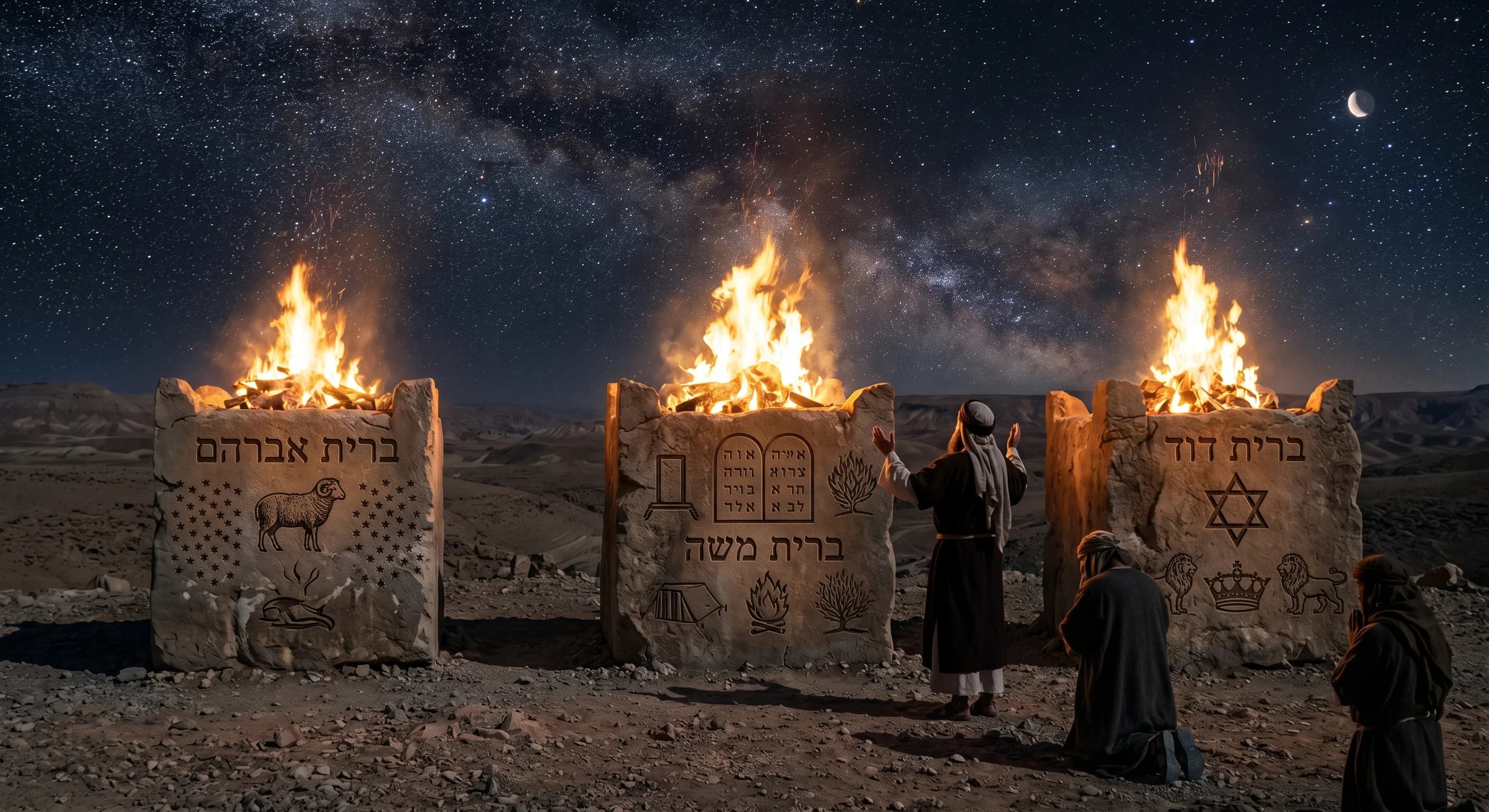
The Old Testament is not a random collection of ancient texts. It is a covenant document -- a record of the agreements God made with His people, the conditions attached to those agreements, and the consequences of keeping or breaking them. Three covenants form the backbone: the Abrahamic covenant (Genesis 12-17), the Mosaic covenant (Exodus 19-24), and the Davidic covenant (2 Samuel 7). Every prophet, every narrative, and every legal code in the Old Testament references at least one of these covenants. Understanding all three is the key to reading the prophets.
The Abrahamic Covenant: Land, Posterity, Priesthood Blessing
God calls Abraham out of Ur and makes a series of promises that are progressively clarified across five chapters (Genesis 12, 13, 15, 17, and 22). The covenant contains three interconnected promises:
Free Scripture Study Tools
Explore the scriptures with Latter-Day Daily
Interlinear readers, word studies, timeline, maps, Come Follow Me guides, and 40+ more tools — all free.
Start for freeLand: A specific geographic territory would be given to Abraham's descendants as an eternal inheritance. This promise was partially fulfilled under Joshua and David, remained partially unfulfilled through the exile, and awaits ultimate fulfillment in the Millennium. The Restoration teaches that the New Jerusalem will be built in the Americas, but the Old Jerusalem will also be redeemed -- both are dimensions of the Abrahamic land promise.
Posterity: Abraham's descendants would be "as the stars of heaven, and as the sand which is upon the sea shore" (Genesis 22:17). At the time of the promise, Abraham had no children. The promise required miracle (Isaac's birth), patience (centuries of waiting), and ultimately faith that God's arithmetic operated on a different scale than human calculation. Paul explains in Galatians 3:29 that "if ye be Christ's, then are ye Abraham's seed, and heirs according to the promise" -- the posterity is not only biological but covenantal.
Priesthood Blessing: Through Abraham's seed, "shall all the families of the earth be blessed" (Genesis 12:3). Abraham 2:9-11 clarifies that the blessing is the gospel itself -- the right to administer the priesthood, perform saving ordinances, and carry the plan of salvation to all nations. This is why Latter-day Saints trace their authority through the Abrahamic line. The blessing to all nations is the missionary mandate embedded in the original covenant.
The Mosaic Covenant: The National Covenant at Sinai
The Mosaic covenant is Israel's national constitution. At Sinai, God enters into a formal covenant relationship with the entire nation of Israel, not just with individual patriarchs. The structure follows the pattern of ancient Near Eastern suzerainty treaties (covenants between a great king and a vassal nation): a historical prologue (what God has done for Israel -- the Exodus), the stipulations (the commandments), the blessings for obedience (Deuteronomy 28:1-14), and the curses for disobedience (Deuteronomy 28:15-68).
The Mosaic covenant is conditional in a way the Abrahamic covenant is not. The Abrahamic covenant's ultimate promises depend only on God's faithfulness. The Mosaic covenant's blessings depend on Israel's obedience. This distinction explains why the Babylonian exile was possible -- Israel broke the Mosaic covenant so thoroughly that the covenant's curses (exile, national destruction, famine) were invoked. But even in exile, the Abrahamic promises remained operative. The exile was a Mosaic consequence, not an Abrahamic abandonment.
The Mosaic covenant included specific ordinances -- sacrifice, the Aaronic priesthood, the tabernacle and later temple -- that were types and foreshadowings of Christ. Paul calls the law "our schoolmaster to bring us unto Christ" (Galatians 3:24). Latter-day Saint theology understands the law of Moses as a preparatory gospel, designed to keep Israel in covenant relationship until the fullness of the gospel could be restored through Christ.
The Davidic Covenant: The Eternal Dynasty
2 Samuel 7 contains God's covenant with David -- one of the most consequential passages in the entire Old Testament. David wants to build a house (temple) for God. God responds by turning the language around: "I will build thee a house" (2 Samuel 7:11). The "house" God promises David is not a building but a dynasty -- an eternal royal line.
The promises of the Davidic covenant: David's son Solomon will build the temple. David's royal line will endure forever. If David's descendants sin, they will be disciplined but not permanently rejected. And ultimately: "I will establish the throne of his kingdom for ever" (2 Samuel 7:13).
The Davidic covenant created the Messianic expectation that defines the rest of the Old Testament. When the Davidic dynasty fell to Babylon in 586 BC, the prophets' response was not that God's covenant had failed -- it was that the ultimate Davidic king was still coming. Isaiah's "shoot from Jesse" (Isaiah 11:1), Jeremiah's "righteous Branch" (Jeremiah 23:5), Ezekiel's vision of the prince-shepherd (Ezekiel 34:23-24) -- all project the Davidic covenant's fulfillment forward to a Messiah who would reign forever. The angel Gabriel quotes this covenant directly in announcing the birth of Jesus: "He shall be great... and the Lord God shall give unto him the throne of his father David: And he shall reign over the house of Jacob for ever; and of his kingdom there shall be no end" (Luke 1:32-33).
The Covenants and the New Covenant
Jeremiah 31:31-34 prophesies a "new covenant" that will differ from the Mosaic covenant in one fundamental way: it will be written on hearts rather than stone. The law's external form will be internalized -- people will love righteousness rather than merely comply with its demands. The New Testament (the word "testament" means "covenant") is named after this promise. Paul's entire argument in Hebrews develops the contrast between the old covenant's types and shadows and the new covenant's realities.
Latter-day Saint covenant theology understands the new covenant as the fullness of the gospel, restored through Joseph Smith. The higher law given in the Sermon on the Mount, the new and everlasting covenant of marriage and priesthood, and the fullness of temple ordinances all represent the new covenant written on hearts that Jeremiah saw.
Practical Application
Every Old Testament story can be located within this three-covenant framework. When you read about Israel's disobedience and exile (Mosaic covenant failure), you understand why it happened. When you read the prophets' promises of restoration and gathering (Abrahamic covenant fulfillment), you understand the basis of their hope. When you read the Messianic psalms and prophecies (Davidic covenant projection), you understand why the entire prophetic tradition is organized around a coming king.
Frequently Asked Questions
Go deeper with Latter-Day Daily
Interlinear Hebrew & Greek, word origins, Come Follow Me, maps, timelines, and 40+ more tools. Free to start — Scholar plan unlocks everything.
Related Study Tools
Covenant Tracker
Track the Abrahamic, Mosaic, and Davidic covenants through every Old Testament book.
Scripture Chains
Build covenant-focused scripture chains from Genesis through the Restoration.
Names of Christ
See how the Davidic covenant's Messianic king is named and described in Old Testament prophecy.
Etymology Explorer
Study the Hebrew word 'berith' (covenant) and the specific language each covenant uses.
Parallel Passages
Compare Old Testament covenant passages with their New Testament and D&C fulfillments.
Related Posts
Genesis 24-33 Study Guide -- "Let God Prevail" (Jacob and Esau)
Jacob's story is the story of transformation. From the scheming supplanter who stole a birthright to the man who wrestled with God and became Israel, Genesis 24-33 shows that God works with imperfect people.
Genesis 42-50 Study Guide -- "God Meant It unto Good"
Joseph's reunion with his brothers and his declaration -- "ye thought evil against me; but God meant it unto good" -- is one of the Old Testament's most powerful statements of divine providence.
Exodus 1-6 Study Guide -- "I Have Remembered My Covenant"
Exodus begins with Israel in bondage and God declaring: "I have remembered my covenant." Moses's call at the burning bush and the revelation of God's name YHWH set the stage for the greatest deliverance in the Old Testament.
Weekly scripture insights
Get study guides delivered to your inbox each week.