Scripture Connections: Cross-References Across All 5 LDS Volumes
Key Takeaway
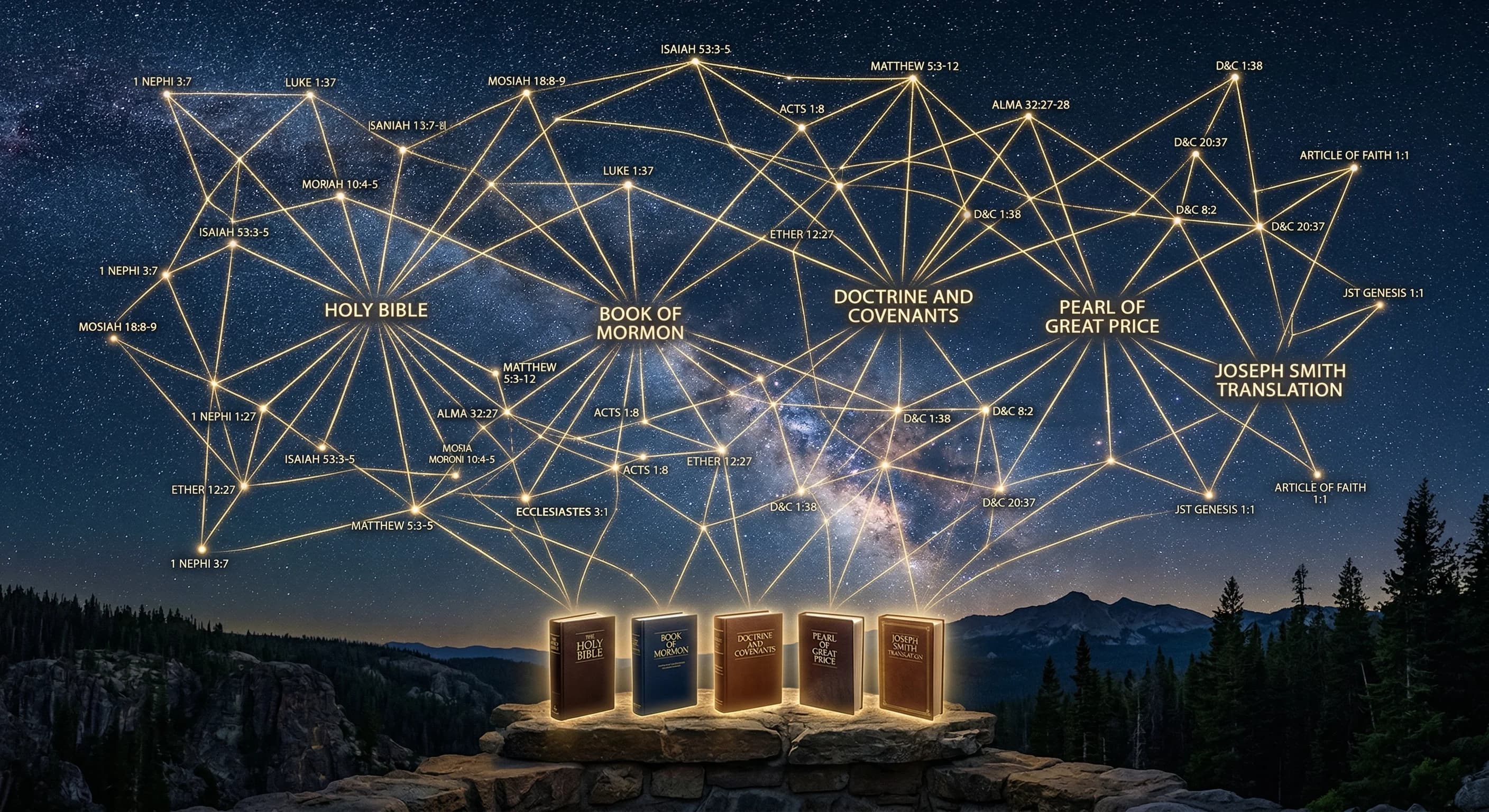
Scripture is not five separate books. It is one interconnected witness. The Scripture Connections tool maps cross-references and parallel passages across the entire canon, revealing a unity that transcends time and geography.
One of the most striking features of Latter-day Saint scripture is how tightly the five volumes are woven together. The Book of Mormon quotes Isaiah extensively. The Doctrine and Covenants echoes language from both the Old and New Testaments. The Pearl of Great Price restores passages that clarify Genesis. These connections are not accidental -- they are evidence of a single, consistent author behind the text: God working through many prophets across many centuries to deliver one unified message.
The Isaiah parallels are the most obvious example. Nephi includes large portions of Isaiah 2-14 and 48-54 in his record, sometimes with variations that shed light on the original Hebrew. Compare Isaiah 29:14, where the Lord promises "a marvellous work and a wonder," with 2 Nephi 27, where Nephi expands the prophecy to describe the coming forth of a sealed book and the role of an unlearned man. The Book of Mormon does not merely repeat Isaiah -- it interprets him, providing context that the biblical text alone does not supply.
Cross-references also reveal doctrinal threads that run beneath the surface. The phrase "the lamb of God" appears in Isaiah 53, John 1:29, and 1 Nephi 11:31-33. Each instance adds dimension. Isaiah prophesies of a suffering servant who is "brought as a lamb to the slaughter." John the Baptist identifies Jesus as that lamb. Nephi sees in vision the specific events of Christ's mortal ministry. Reading these passages in isolation gives you three data points. Reading them as connected witnesses gives you a single, vivid portrait of the Savior that spans seven centuries of prophecy and fulfillment.
Free Scripture Study Tools
Explore the scriptures with Latter-Day Daily
Interlinear readers, word studies, timeline, maps, Come Follow Me guides, and 40+ more tools — all free.
Start for freeThe Scripture Connections tool maps these relationships visually. Select any verse and see every cross-reference in the canon, organized by type: direct quotation, allusion, thematic parallel, or doctrinal connection. You can trace a single prophecy from its origin in the Old Testament through its fulfillment in the New Testament and its commentary in the Book of Mormon. The tool surfaces connections that even experienced readers might miss.
The more you explore these connections, the more you see the canon not as five separate books but as one continuous revelation. The prophets knew each other's words. They built on each other's testimony. And the Restoration brought the missing pieces back into place, completing a picture that had been fragmentary for centuries.
Go deeper with Latter-Day Daily
40+ free tools for scripture study: interlinear Hebrew & Greek, word origins, Come Follow Me, maps, timelines, and more.
Related Study Tools
Related Posts
Isaiah's Hebrew Poetry -- Parallelism, Wordplay, and Literary Art in the Prophets
Isaiah is poetry, not prose, and reading it as prose is like reading song lyrics as a legal brief. Recognizing the Hebrew literary structures transforms Isaiah from an opaque text into a work of deliberate, layered art.
50 Archaic Bible Words Every Latter-day Saint Should Know
The King James Bible and the Book of Mormon share a vocabulary that has drifted far from modern usage. Knowing what these words actually meant in 1611 transforms how you read every chapter.
What Does 'Charity' Really Mean? Lost Meanings in the King James Bible
When the King James Bible says charity, it does not mean what you think. The word's journey from Latin caritas through Greek agape to modern 'love' is a case study in how translation reshapes theology.
Weekly scripture insights
Get study guides delivered to your inbox each week.