Covenant Language in the Old Testament -- Berith, Hesed, and the Pattern of Promises
Key Takeaway
The Old Testament is fundamentally a covenant document. Understanding the Hebrew word berith and the ancient rituals of covenant making reveals patterns that run directly through LDS temple and baptismal practice.
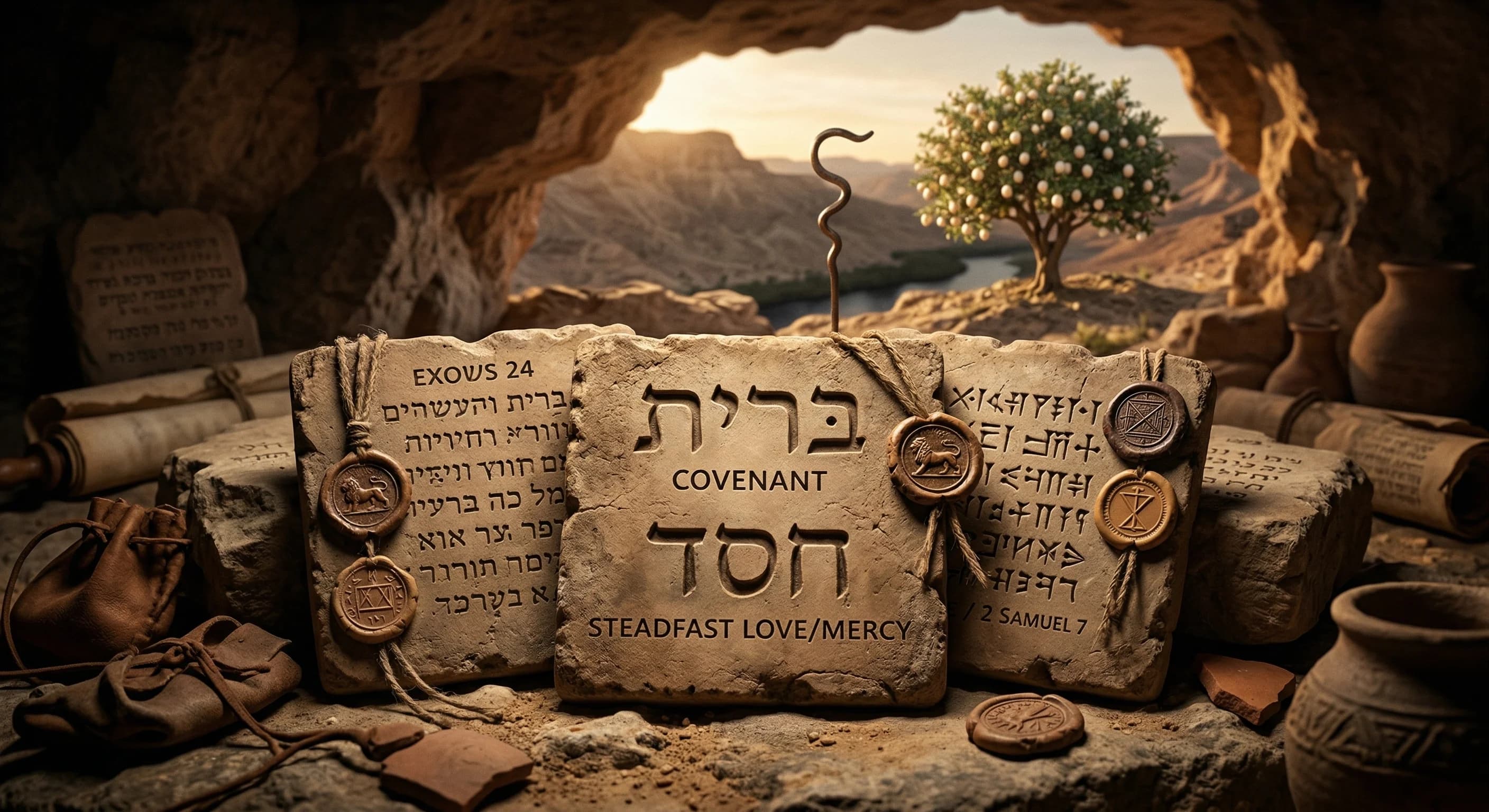
If you read the Old Testament looking for stories, you will find them. If you read it looking for moral lessons, those are there too. But if you read it looking for covenants, you will find the structural skeleton of the entire text. The Old Testament is, at its core, a covenant document -- a record of binding agreements between God and His people, their terms, their violations, and their renewals. The Hebrew word at the center of all of this is "berith," and understanding what it meant in its ancient context reshapes how we read scripture and how we understand our own covenantal life.
The word "berith" appears nearly 290 times in the Hebrew Bible. Its etymology is debated, but the most widely accepted derivation connects it to the verb "barah," meaning "to cut." This is not metaphorical. Ancient covenants were literally cut -- animals were slaughtered, divided, and the parties to the covenant walked between the pieces. The ritual is described explicitly in Genesis 15:9-18, where God commands Abraham to take a heifer, a goat, a ram, a dove, and a pigeon, divide them, and lay the halves opposite each other. Then, in a detail that should arrest every reader, a smoking furnace and a burning lamp -- representing God's presence -- pass between the pieces while Abraham sleeps. The symbolism is visceral: the one who walks between the divided animals is saying, "May what happened to these animals happen to me if I break this covenant." And in Genesis 15, it is God alone who passes through. Abraham does not walk. The covenant is unilateral. God binds Himself.
This cutting ritual explains why the Hebrew Bible consistently uses the phrase "karath berith" -- "to cut a covenant" -- rather than "to make a covenant" or "to enter a covenant." The language preserves the memory of the blood ritual long after the practice itself faded. Blood is the medium of covenant because blood represents life (Leviticus 17:11), and a covenant is a life-and-death commitment. When Latter-day Saints participate in the sacrament and hear the words "the blood of the covenant" echoed in the prayers, the phrase reaches back through three thousand years of Israelite practice to the animals divided on the ground before Abraham.
Free Scripture Study Tools
Explore the scriptures with Latter-Day Daily
Interlinear readers, word studies, timeline, maps, Come Follow Me guides, and 40+ more tools — all free.
Start for freeThe Abrahamic covenant, established in stages across Genesis 12, 15, and 17, contains three core promises: land (the land of Canaan), posterity (descendants as numerous as the stars), and blessing (through Abraham's seed, all nations of the earth will be blessed). These three elements -- land, posterity, and blessing to the nations -- reappear throughout the Old Testament as the standard against which God's faithfulness is measured and Israel's faithfulness is tested. Abraham 2:9-11 in the Pearl of Great Price expands the covenant to include the right to bear the priesthood and the responsibility to bring the gospel to every nation, a reading that transforms the Abrahamic covenant from an ancient Near Eastern treaty into a missionary and priesthood mandate that extends to every Latter-day Saint who has received the same covenant in the temple.
The Mosaic covenant, established at Sinai in Exodus 19-24, operates on a different model. Where the Abrahamic covenant was unconditional -- God bound Himself regardless of Abraham's performance -- the Mosaic covenant is conditional. Exodus 19:5-8 states the terms explicitly: "If ye will obey my voice indeed, and keep my covenant, then ye shall be a peculiar treasure unto me above all people." The conditional "if" is the hinge. Israel's status as God's covenant people depends on obedience. Scholars have noted that the structure of the Mosaic covenant closely mirrors ancient Hittite suzerainty treaties, which followed a standard formula: preamble (identifying the sovereign), historical prologue (recounting what the sovereign has done for the vassal), stipulations (the laws to be obeyed), blessings for compliance, curses for violation, and provision for deposit and periodic reading of the treaty. Deuteronomy follows this pattern almost exactly, suggesting that Moses used a well-known diplomatic form to structure Israel's relationship with God. The implications are significant: covenant is not a vague spiritual concept in the Old Testament. It is a legal, political, and relational framework with specific terms and consequences.
The Davidic covenant in 2 Samuel 7:12-16 introduces another dimension. God promises David that his throne will be established forever -- "thy kingdom shall be established for ever before thee: thy throne shall be established for ever." Unlike the Mosaic covenant, the Davidic covenant is again unconditional, echoing the structure of the Abrahamic covenant. Even when David's descendants sin, God will discipline them but will not withdraw the covenant. This promise becomes the theological foundation for messianic expectation: if David's throne is eternal, then a descendant of David must eventually reign in an eternal kingdom. For Latter-day Saints, the fulfillment is Christ -- the "Son of David" whose kingdom, as Gabriel tells Mary in Luke 1:32-33, "shall have no end."
Running through all of these covenants is the concept of "hesed" -- the Hebrew word usually translated "mercy," "lovingkindness," or "steadfast love," but which more precisely means covenant faithfulness. Hesed is not generic benevolence. It is the specific loyalty that one party owes to another because of a covenant bond. When the Psalmist writes "His hesed endureth for ever" (Psalm 136), the claim is not that God is generically nice. The claim is that God keeps His covenant commitments permanently, regardless of whether Israel keeps theirs. Hesed is what makes the Abrahamic and Davidic covenants functional: even when the human party fails, God's hesed sustains the relationship.
Jeremiah 31:31-34 looks forward to a "new covenant" -- "berith chadashah" -- that will not be like the Mosaic covenant, which Israel broke. The new covenant will be written on hearts rather than on tablets of stone, and under it, every person will know the Lord directly. Latter-day Saints read this passage as prophesying the Restoration, and 3 Nephi 20:25 places the new covenant squarely in the context of the Book of Mormon, with Christ Himself declaring to the Nephites that they are "children of the covenant." The language of berith, the pattern of cutting, the conditional and unconditional structures, the role of hesed -- all of these Old Testament patterns converge in Restoration theology and in the ordinances of the temple, where covenant making is not historical study but present-tense practice.
Understanding covenant language in the Old Testament is not an academic exercise. It is the key to understanding why the scriptures are structured the way they are, why the ordinances take the form they do, and why the relationship between God and His people is described in terms of binding promises rather than mere preference. The Old Testament does not tell us that God loves us in a sentimental sense. It tells us that God has bound Himself to us -- cut a covenant, passed between the pieces, and declared that His hesed will not fail.
Go deeper with Latter-Day Daily
40+ free tools for scripture study: interlinear Hebrew & Greek, word origins, Come Follow Me, maps, timelines, and more.
Related Study Tools
Covenant Tracker
Track God's covenants from Adam through the Restoration and see how each builds on the last.
Etymology Explorer
Trace the Hebrew roots of berith, hesed, and other covenant terms to uncover their full meaning.
Scripture Timeline
See how the Abrahamic, Mosaic, and Davidic covenants fit into the chronological sweep of scripture.
Related Posts
Genesis 24-33 Study Guide -- "Let God Prevail" (Jacob and Esau)
Jacob's story is the story of transformation. From the scheming supplanter who stole a birthright to the man who wrestled with God and became Israel, Genesis 24-33 shows that God works with imperfect people.
Genesis 42-50 Study Guide -- "God Meant It unto Good"
Joseph's reunion with his brothers and his declaration -- "ye thought evil against me; but God meant it unto good" -- is one of the Old Testament's most powerful statements of divine providence.
Genesis 6-11, Moses 8 Study Guide -- "Noah Found Grace"
The story of Noah and the Flood is more than a catastrophe narrative. It is a story of one man who found grace, a world baptized by water, and a covenant sealed with a rainbow.
Weekly scripture insights
Get study guides delivered to your inbox each week.