Scripture Timeline -- A Visual Walk Through Bible History and Beyond
Key Takeaway
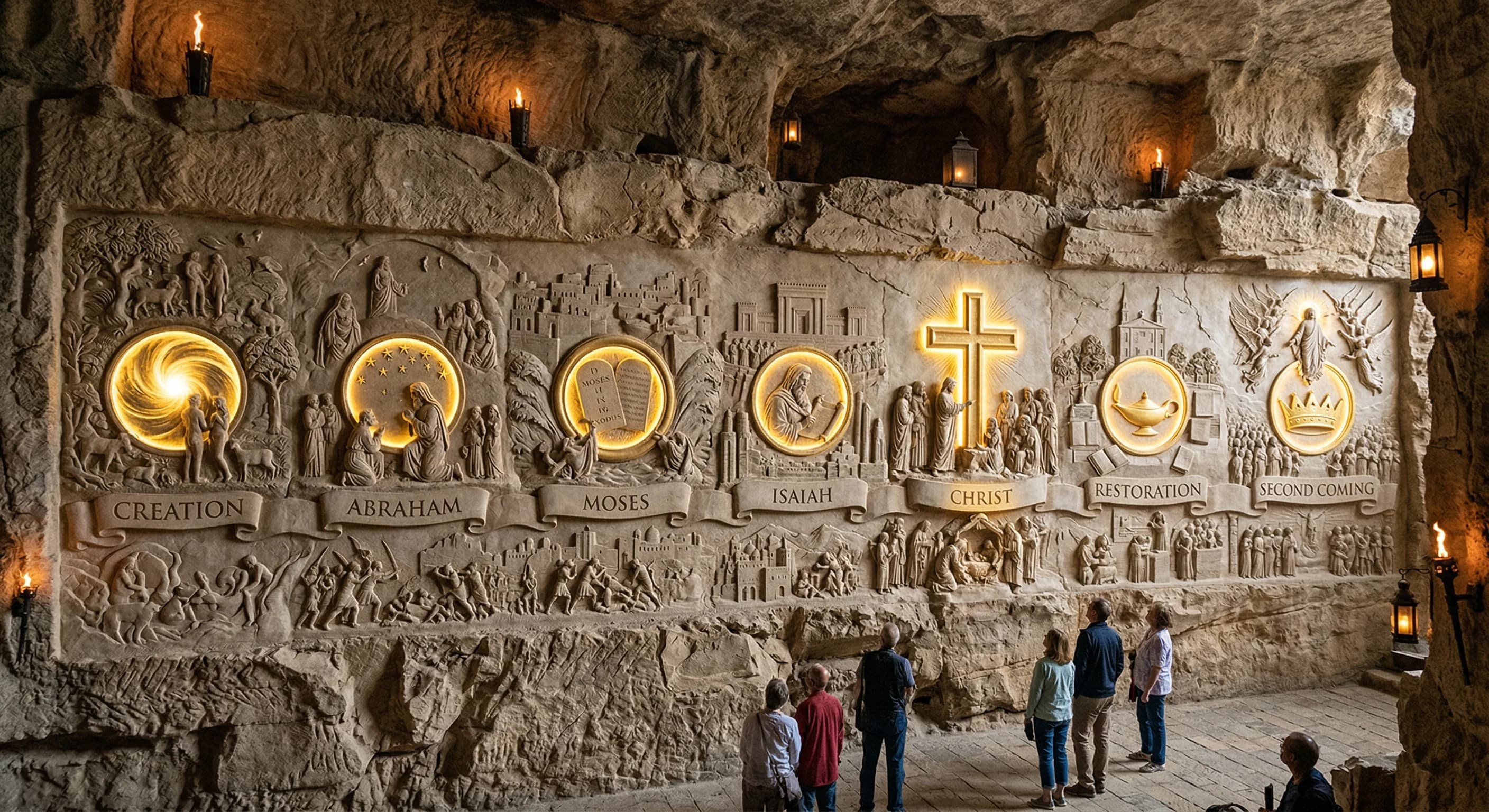
When you see all of scripture history on a single timeline, patterns emerge that chapter-by-chapter reading obscures. Dispensations overlap, prophecies find fulfillment centuries later, and the consistency of God's plan becomes visible.
Scripture covers thousands of years, but we tend to study it in small weekly portions. A visual timeline corrects that by placing every major event on a single continuum, from the Creation through the patriarchs, the Exodus, the monarchy, the exile, the mortal ministry of Christ, the apostasy, and the Restoration. When you see it all at once, the structure of God's work becomes unmistakable.
One pattern that emerges immediately is the rhythm of covenant and apostasy. God establishes a covenant with Adam. Humanity falls away. He renews the covenant with Noah. The cycle repeats with Abraham, Moses, and the Israelite nation. Each dispensation rhymes with the others, and the timeline makes these parallels visible in a way that sequential reading does not. You can place the covenant at Sinai alongside the covenant at the waters of Mormon alongside the restoration of priesthood keys in Kirtland and see the same structure repeating.
The timeline also resolves confusion about overlapping events. Many readers do not realize that the prophets Isaiah, Hosea, and Micah were contemporaries, all preaching during the decline of the northern kingdom of Israel. Or that Daniel was in Babylon at the same time Ezekiel was writing among the exiles by the river Chebar. Or that Lehi left Jerusalem around 600 BC, roughly when Jeremiah was imprisoned for prophesying the city's fall. These connections matter because they show that God was working on multiple fronts simultaneously.
Free Scripture Study Tools
Explore the scriptures with Latter-Day Daily
Interlinear readers, word studies, timeline, maps, Come Follow Me guides, and 40+ more tools — all free.
Start for freeThe Scripture Timeline tool lets you zoom in on any period and see the events, people, and scriptures associated with it. You can compare Old Testament events with Book of Mormon events happening on the other side of the world during the same century. You can follow a single theme -- like temple worship -- across the entire span and watch how it evolves from the tabernacle in the wilderness to Solomon's temple to Herod's temple to the Kirtland Temple.
History is not a collection of isolated stories. It is one continuous narrative, and the timeline is the lens that brings it into focus.
Go deeper with Latter-Day Daily
40+ free tools for scripture study: interlinear Hebrew & Greek, word origins, Come Follow Me, maps, timelines, and more.
Related Study Tools
Related Posts
LDS Callings and Lay Ministry: How the Church Works Without Paid Clergy
In The Church of Jesus Christ of Latter-day Saints, a 'calling' is a volunteer assignment given to a member by a leader — to teach, lead, or serve in some capacity. The Church runs almost entirely on lay ministry with no paid local clergy.
What Is an LDS Ward? A Beginner's Guide to Local Congregations
A ward is the basic local congregation of The Church of Jesus Christ of Latter-day Saints — roughly equivalent to a Catholic parish or Protestant congregation. Here's what you need to know.
LDS Seminary and Institute: Scripture Education for Teens and Young Adults
Seminary is a weekday religious education program for Latter-day Saint teenagers. Institute of Religion is the equivalent for college students and young adults. Both are free and cover all LDS scripture on a rotating cycle.
Weekly scripture insights
Get study guides delivered to your inbox each week.