Scripture Heatmap: Visualizing the Bible and Book of Mormon Through Color-Coded Density
Key Takeaway
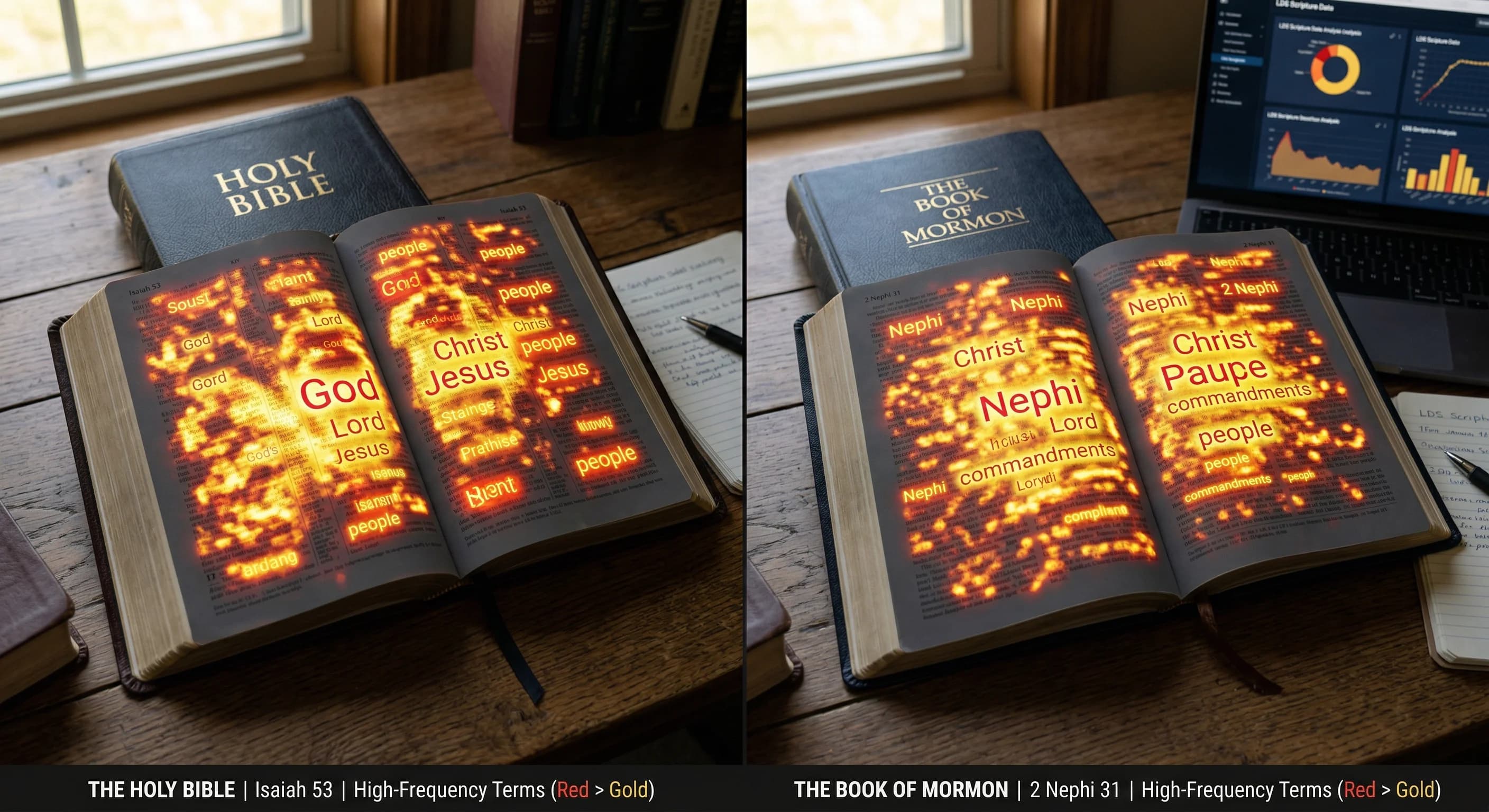
What if you could see the entire Bible or Book of Mormon at once, with colors showing where certain themes cluster? The Scripture Heatmap does exactly that, transforming text into a visual map that reveals patterns invisible to the linear reader.
Reading scripture is inherently linear -- you start at verse 1 and move forward. But the patterns that matter most often span entire books, testaments, or volumes. The Scripture Heatmap on Scripture Deep transforms the text into a visual grid where each cell represents a chapter or passage, and the color intensity shows the density of a particular theme, word, or concept. The result is a bird's-eye view of scripture that lets you see structural patterns that would take years of sequential reading to notice.
Select a theme like "covenant" and the heatmap lights up in expected places -- Genesis, Exodus, Deuteronomy -- but also in places you might not expect. The Book of Mormon shows high covenant density in 2 Nephi and Mosiah, consistent with those books' focus on the covenant relationship between God and Israel. The Doctrine and Covenants shows clusters in sections 84 and 132, the great revelations on priesthood and the new and everlasting covenant. Seeing these patterns side by side, across all volumes at once, helps you understand how the scriptural canon fits together as a unified whole rather than a collection of separate books.
The heatmap is also useful for studying individual books. Apply it to the Gospel of John and you can see that references to "light" and "darkness" cluster in the first twelve chapters (the Book of Signs) and then largely disappear in the farewell discourses. Apply it to Alma and you can see the dramatic shift from war narrative (dense references to cities, armies, and strategy) to doctrinal exposition (dense references to faith, repentance, and resurrection). These are not hidden insights -- any careful reader eventually notices them -- but the heatmap lets you see them in seconds rather than after repeated readings.
Free Scripture Study Tools
Explore the scriptures with Latter-Day Daily
Interlinear readers, word studies, timeline, maps, Come Follow Me guides, and 40+ more tools — all free.
Start for freeThe tool supports multiple visualization modes: you can view density by verse count, by word frequency, or by thematic tags. You can compare two themes side by side to see where they overlap and where they diverge. Where do references to "mercy" and "justice" co-occur? The answer is Alma 42, one of the great doctrinal chapters on the Atonement, and the heatmap makes that convergence visible immediately. This is not a replacement for reading -- it is a complement that gives you a map before you enter the territory.
Go deeper with Latter-Day Daily
40+ free tools for scripture study: interlinear Hebrew & Greek, word origins, Come Follow Me, maps, timelines, and more.
Related Study Tools
Related Posts
Doctrine and Covenants: Modern Revelation to the Church
The Doctrine and Covenants is one of four LDS standard works—a collection of revelations received primarily by Joseph Smith from 1828 to 1844, plus a few later revelations from succeeding prophets. Unlike historical narratives, it is direct revelation addressing 19th-century church organization, doctrine, and practice.
Word of Wisdom: The LDS Health Law and Why No Coffee
The Word of Wisdom is a health law revealed to Joseph Smith in 1833, prohibiting alcohol, tobacco, coffee, and tea, while encouraging whole grains, fruits, and vegetables. Members view it as a covenant practice that demonstrates self-mastery and trust in God, and studies show statistically lower rates of cancer and heart disease in LDS populations.
Latter-day Saints vs. Catholics: Similarities and Key Theological Differences
Both Latter-day Saints and Catholics claim roots in early Christianity and value community, family, and scripture. They diverge on apostolic succession, priestly authority, the role of a living prophet, the nature of God, and the seven sacraments versus Latter-day Saint ordinances.
Weekly scripture insights
Get study guides delivered to your inbox each week.