Doctrinal DNA -- Trace How Doctrines Develop Across All Five Volumes
Key Takeaway
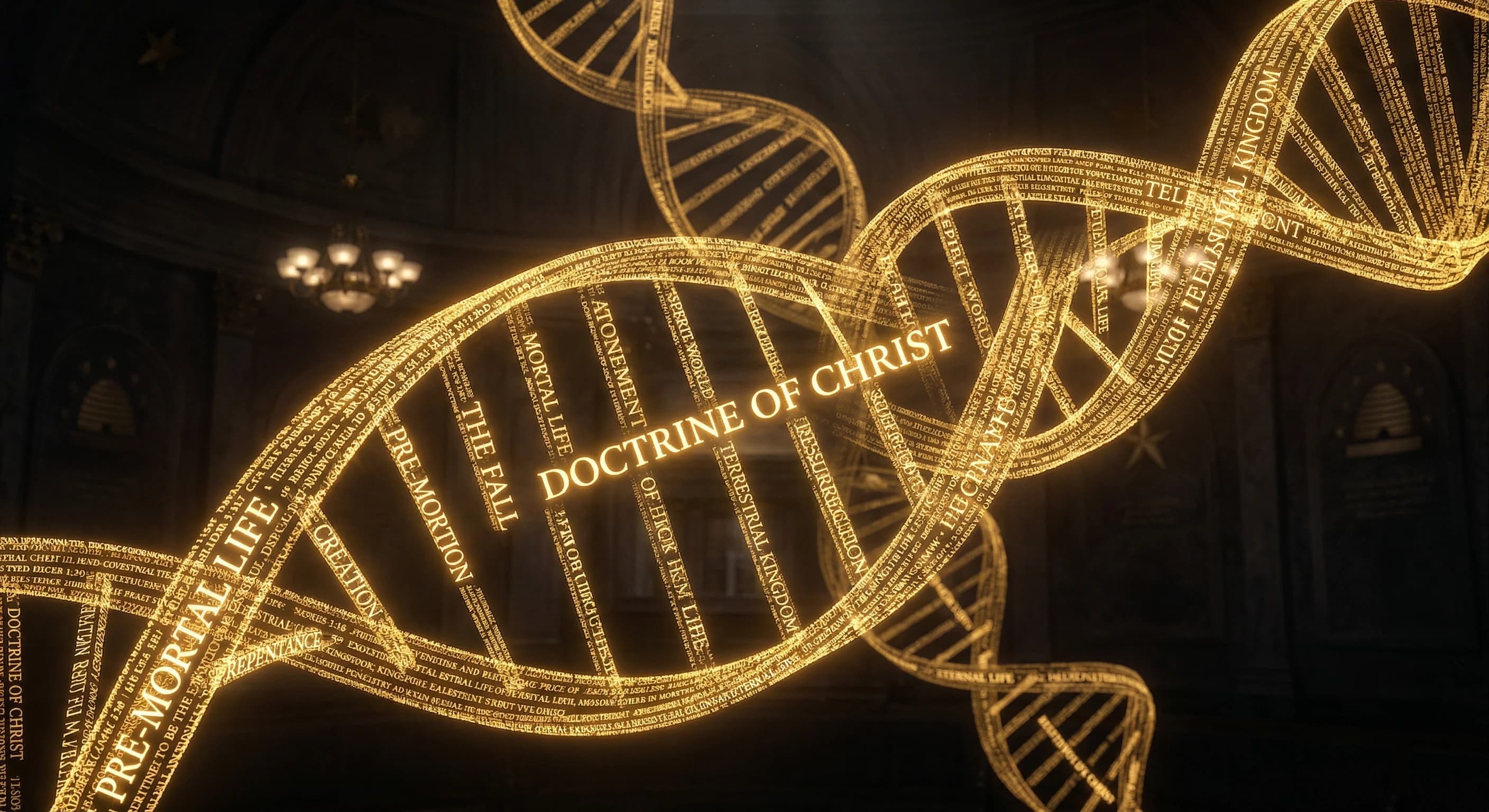
Doctrines do not arrive fully formed. They develop across dispensations, each prophet adding a layer. Doctrinal DNA traces these threads from their earliest appearance to their fullest expression in the Restoration.
Doctrines do not arrive fully formed in a single verse. They develop across dispensations, each prophet adding a layer of understanding, each scripture volume contributing something the others lack. Doctrinal DNA traces these threads from their earliest scriptural appearance to their fullest expression, making the progressive nature of revelation visible in a way that reading any single volume cannot.
Take baptism as an example. Its earliest Old Testament foreshadowing appears in the waters of creation (Genesis 1:2) and the flood narrative, where Peter himself draws the connection in 1 Peter 3:20-21. The washings prescribed in Levitical law (Leviticus 14-15) establish ritual purification through water as part of Israel's covenant life. Naaman's sevenfold washing in the Jordan (2 Kings 5:14) prefigures the idea that immersion in water brings spiritual renewal. The New Testament makes baptism explicit: John baptizes in the Jordan for repentance (Matthew 3:5-6), and Jesus himself submits to baptism "to fulfil all righteousness" (Matthew 3:15). But even the New Testament does not contain the full doctrine. The Book of Mormon records Christ teaching the Nephites the precise mode and authority for baptism (3 Nephi 11:23-26), resolving debates that persisted for centuries in the Old World. And Doctrine and Covenants 20:72-74 codifies the baptismal prayer and requirements for the restored Church.
Doctrinal DNA maps this entire arc for you. You see each passage in its dispensational context, you see what it adds to the doctrine's development, and you see where gaps exist that later revelation fills. The result is a richer understanding of why the Restoration was necessary. It was not that earlier dispensations had it wrong -- it was that the full picture required every dispensation's contribution.
Free Scripture Study Tools
Explore the scriptures with Latter-Day Daily
Interlinear readers, word studies, timeline, maps, Come Follow Me guides, and 40+ more tools — all free.
Start for freeThis tool is particularly powerful for doctrines that Latter-day Saints understand differently from other Christian traditions. The gathering of Israel, for instance, threads from God's promises to Abraham in Genesis, through the prophetic writings of Jeremiah 31:10 and Ezekiel 37, into the Book of Mormon's detailed treatment in 1 Nephi 22 and 3 Nephi 21, and finally into the Doctrine and Covenants sections on missionary work and temple ordinances. Seeing the full DNA strand makes the doctrine feel less like an abstract idea and more like a living thread woven through every page of scripture.
Go deeper with Latter-Day Daily
40+ free tools for scripture study: interlinear Hebrew & Greek, word origins, Come Follow Me, maps, timelines, and more.
Related Study Tools
Related Posts
Doctrine and Covenants: Modern Revelation to the Church
The Doctrine and Covenants is one of four LDS standard works—a collection of revelations received primarily by Joseph Smith from 1828 to 1844, plus a few later revelations from succeeding prophets. Unlike historical narratives, it is direct revelation addressing 19th-century church organization, doctrine, and practice.
Word of Wisdom: The LDS Health Law and Why No Coffee
The Word of Wisdom is a health law revealed to Joseph Smith in 1833, prohibiting alcohol, tobacco, coffee, and tea, while encouraging whole grains, fruits, and vegetables. Members view it as a covenant practice that demonstrates self-mastery and trust in God, and studies show statistically lower rates of cancer and heart disease in LDS populations.
Latter-day Saints vs. Catholics: Similarities and Key Theological Differences
Both Latter-day Saints and Catholics claim roots in early Christianity and value community, family, and scripture. They diverge on apostolic succession, priestly authority, the role of a living prophet, the nature of God, and the seven sacraments versus Latter-day Saint ordinances.
Weekly scripture insights
Get study guides delivered to your inbox each week.