Loading...
Concept Explorer -- Theological Concept Analysis
Trace how rich Hebrew and Greek theological concepts are fragmented into multiple English words by translation, and explore semantic fields that map the web of related words surrounding core scriptural ideas.
What Is Concept DNA?
When the Bible was translated from Hebrew and Greek into English, something inevitable happened: single concepts that existed as unified ideas in the original language were split into multiple English words. The Hebrew word 'hesed,' for example, appears in the King James Version as 'mercy,' 'lovingkindness,' 'goodness,' 'kindness,' and 'favour' -- five different English words for one Hebrew concept. An English reader has no way to know that these scattered words are all translating the same underlying idea. This fragmentation is what we call Concept DNA.
The Concept DNA tab in Latter-Day Daily's Concept Explorer reveals these hidden connections. For each theological concept, you see the original Hebrew or Greek source word, its intact meaning (the full unified concept), and then every English word the KJV uses to translate it. Each fragment is labeled to show whether it appears in the KJV, in modern translations, or both, along with a description of what aspect of the original meaning that particular English word captures -- and what it loses. This lets you reconstruct the original concept from its scattered pieces.
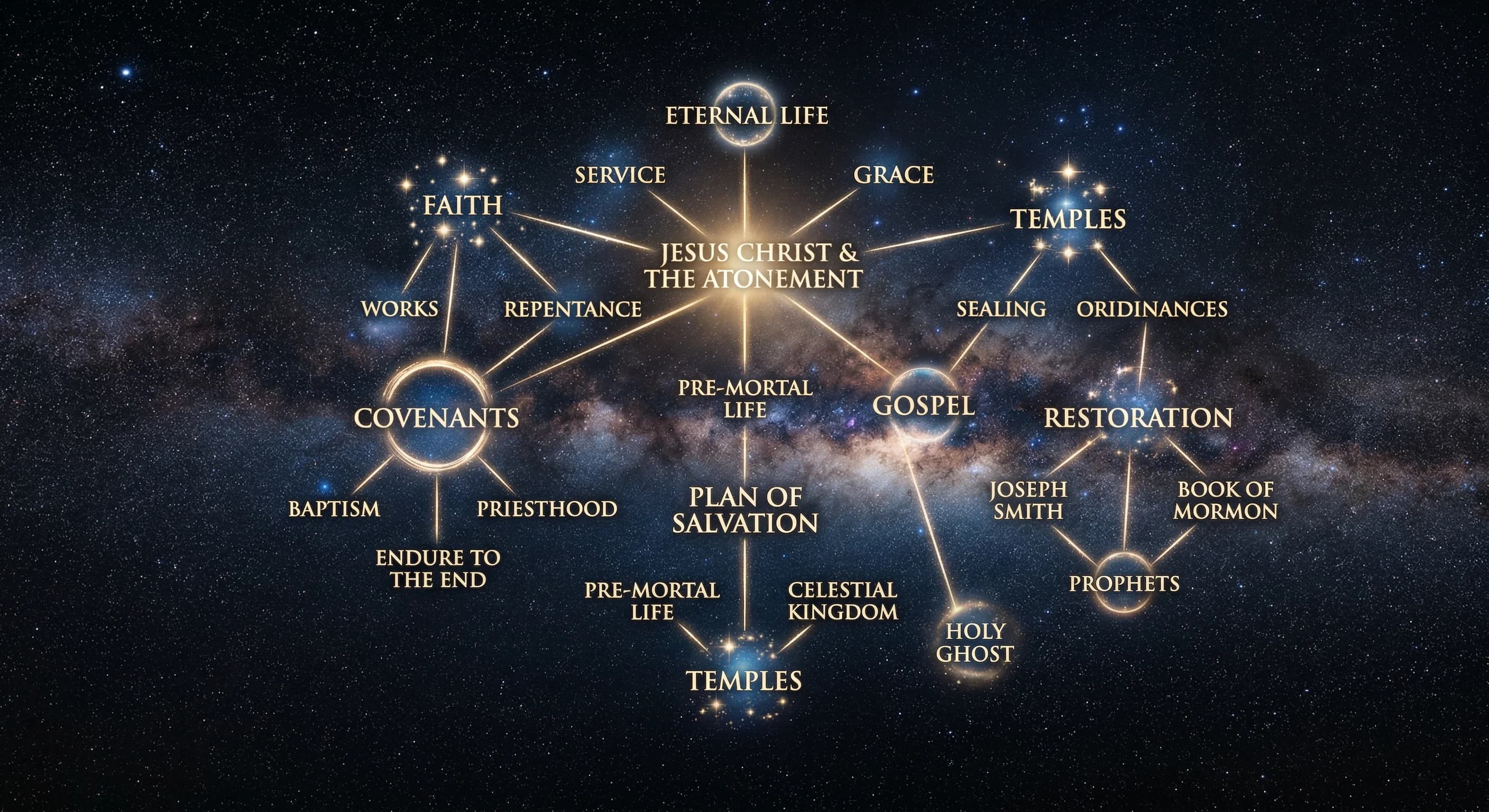
The Semantic Fields tab takes a complementary approach. Instead of starting with a single original-language word, it starts with a core English concept -- like 'faith,' 'covenant,' or 'redemption' -- and maps all the related words that orbit around it in scripture. These semantic clusters include synonyms, broader terms, narrower aspects, metaphors, and companion practices. Seeing these relationships visually helps you understand how the scriptures build theological meaning through networks of interrelated terms rather than isolated vocabulary.
For Latter-day Saints, concept study is essential because the Restoration adds volumes of scripture that use English vocabulary to express ideas originally rooted in Hebrew and Greek thought. When you understand that the Book of Mormon's use of 'charity' connects back to the Greek 'agape' and its full semantic field of self-giving love, or that 'repentance' in the New Testament translates 'metanoia' (a complete change of mind, not merely feeling sorry), your study of all five standard works gains a depth that surface-level English reading cannot provide.
How It Works
1
Choose Concept DNA or Semantic Fields
The Concept DNA tab shows how single Hebrew or Greek concepts fragment into multiple English words. The Semantic Fields tab maps webs of related words around core scriptural ideas.
2
Search or browse concepts
Search for any theological concept or browse the full list. Concept DNA entries are sorted by the number of English fragments; Semantic Fields are categorized by type (virtue, doctrine, covenant, deity, salvation, worship).
3
Study the connections
Expand any concept to see its full breakdown -- the original word, its intact meaning, every English fragment with loss analysis, or the complete semantic cluster with word relationships and scripture references.
Key Features
Concept DNA Analysis
See how a single Hebrew or Greek concept is fragmented into multiple English words, with analysis of what each translation gains and loses.
Semantic Field Mapping
Explore visual clusters of related words that surround core theological concepts, including synonyms, broader terms, metaphors, and companion practices.
Category Browsing
Filter semantic fields by theological category -- virtue, doctrine, covenant, deity, salvation, or worship -- to focus on the domain of scripture study that interests you.
Scripture Frequency Data
Every word in a semantic field includes its scripture frequency count and a sample reference, showing how prominent each related term is in the scriptural text.
Frequently Asked Questions
What is Concept DNA in scripture study?
Concept DNA refers to the way a single unified theological concept in Hebrew or Greek gets 'split' into multiple different English words when the Bible is translated. For example, the Greek word 'logos' appears in the KJV as 'word,' 'saying,' 'account,' 'speech,' 'reason,' and other terms. Concept DNA analysis identifies these fragments and shows how they all connect back to one original idea, helping you reconstruct the full meaning the biblical author intended.
What is a semantic field?
A semantic field is a group of words that are related in meaning and cluster around a core concept. In scripture, the semantic field for 'redemption' might include 'ransom,' 'deliver,' 'save,' 'buy back,' 'restore,' and 'atone.' Understanding semantic fields helps you see how the scriptures build theological meaning through networks of related words rather than depending on a single term to carry the full weight of an idea.
Why do English Bibles use different words for the same Hebrew concept?
English translators use different words because they choose the English term that best fits the immediate context of each verse, even when the same Hebrew or Greek word appears in all of them. The Hebrew 'hesed' might be translated 'mercy' in one verse and 'lovingkindness' in another because each context highlights a different facet of the concept. The result is that English readers lose sight of the underlying unity that Hebrew readers would naturally see.
How does concept analysis help Latter-day Saint scripture study?
Concept analysis is particularly valuable for Latter-day Saints because the Restoration canon includes scripture in English that draws on Hebrew and Greek theological vocabulary. Understanding that the Book of Mormon's 'charity' connects to the Greek 'agape,' or that 'repentance' in the Doctrine and Covenants relates to the Greek 'metanoia' (a complete transformation of mind), deepens your study of all five standard works and reveals doctrinal threads that run through the entire canon.
What categories are available in the Semantic Fields explorer?
Semantic Fields are organized into six theological categories: virtue (concepts like faith, hope, and charity), doctrine (concepts like resurrection and judgment), covenant (concepts like promise and oath), deity (names and attributes of God), salvation (concepts like atonement and redemption), and worship (concepts like prayer and sacrifice). You can filter by category to focus your study on a specific domain of scriptural teaching.
Start Using Concept Explorer
Full access to Concept Explorer and 40+ other study tools.
Starting at $7/mo or $69.99/yr
Already have an account? Sign in